TRANSMISSION // 2611.33158v1
One Robot Policy, Trained Across a Million Designs
Source published
OmniAct trains one manipulation policy using a large collection of simulated robot designs, conditioning actions on each robot’s structure and scene. Its results are promising, but much of the evidence comes from simulation and small real-world trials.
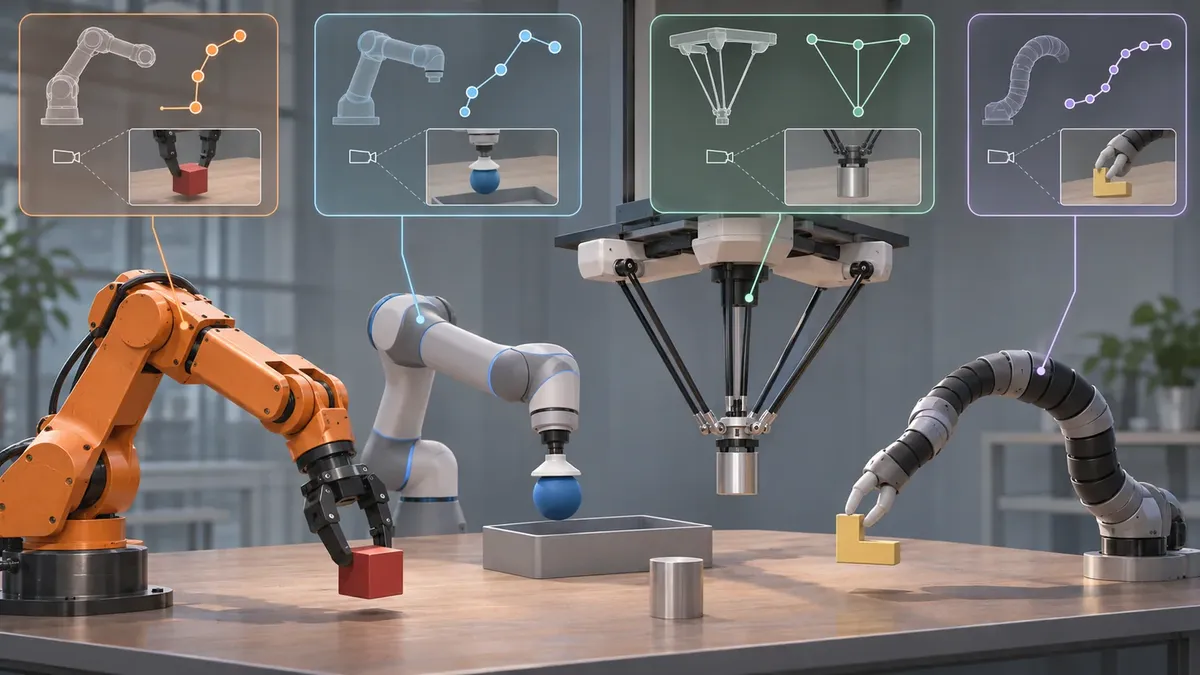
A robot’s shape changes what it can reach, grasp and move. OmniAct is designed to let one learned policy account for those differences rather than apply the same manipulation strategy to every machine.
A robot policy that works on one arm may struggle on another. Differences in joint arrangement, reach and gripper design can make a familiar task require a different approach. The challenge is not only to transfer knowledge of the task, but also to adapt motion to the robot doing it.
OmniAct, described in an arXiv preprint, tackles this problem by training a single manipulation policy across many simulated robot designs. Rather than representing every robot only through a shared action format, the method gives the policy information about each robot’s joints and how they sit in relation to objects and surfaces seen by its cameras.
Representing a robot in its scene
The researchers encode each robot as a kinematic graph: a map of joints and their connections, with information about joint positions, motion axes and other features. Crucially, the graph is grounded in the camera’s view of the scene. This gives the model a way to relate the robot’s physical structure to nearby objects, rather than treating the robot description as separate from what it sees.
A flow-matching model then predicts movements for the graph’s nodes. Its action format is designed to handle robots with different numbers and arrangements of joints. During use, the policy predicts a chunk of actions, executes part of it, observes the scene again and replans.
For training, the team procedurally generated one million candidate robot embodiments and filtered them for physical and grasp feasibility. The resulting dataset covers 800,196 embodiments and contains about 1.03 million trajectories generated in simulation. Tasks include picking, opening, closing and placing objects. The policy was evaluated on held-out combinations of embodiments and scenes, as well as in physical-robot trials.
Results across simulated and real robots
On 2,000 simulation episodes involving held-out embodiments and scenes, OmniAct achieved a reported 63.0% success rate under a 500-step limit. The strongest baseline in that comparison reached 57.9%; the paper reports 17.8% for π0.5. On task families also evaluated with GPT-6 Astra, OmniAct scored 64.7% against 41.1% at the same step budget. These figures describe particular benchmarks and evaluation settings, not a general measure of robot competence.
The authors also tested the policy without fine-tuning on two physical arms. On a Franka arm, it completed 14 of 20 pick-and-place setups. On an OpenYAM arm with a fine-tip gripper not seen during training, it completed 13 of 20. The paper reports 7 of 20 for a MolmoAct2 model specialized for YAM on the OpenYAM test. These are small trials, and the comparison involves models trained and equipped differently; they should not be read as a definitive ranking for real-world use.
The researchers describe examples in which the policy changed its grasp to fit the task or robot. It approached a knife from the side rather than above, and used a different approach on a shorter-reach arm than on a longer-reach one. Such examples fit the goal of adapting motion to morphology, but do not establish how reliably the system will do so across everyday settings.
What remains uncertain
The paper’s ablation tests suggest that both training diversity and scene-grounded robot information matter: reducing the number of training embodiments lowered simulated success, and removing the kinematic graph also reduced performance. These experiments indicate contributions within the tested setup, but do not settle how the method will perform beyond the tested tasks and designs.
Most training and evaluation takes place in simulation, where results depend on how well simulated physics and tasks reflect real conditions. The physical evidence covers two arms and a limited number of setups. The authors identify bimanual arms, humanoids and everyday tools as directions for further work, so the reported tests do not establish transfer to those systems.
The supplied source identifies this work as an arXiv preprint. Its reported comparisons and conclusions should be treated as preliminary; independent replication and broader real-world testing would help clarify how far the approach generalizes.
- robotics
- robot manipulation
- cross-embodiment learning
- robot morphology
- simulation
- OmniAct
Related reading
Automatically matched by shared topic keywords. These links do not imply that the sources agree or establish a consensus.
Robot-coding agents need better failure diagnosis, not just more feedback
Source published
Shared keywords: robot manipulation
A robot twin built from first-person video
Source published
Shared keywords: robot manipulation
How MAWAM imagines teamwork for robots
Source published
Shared keywords: robot manipulation
A lazier search helps robots plan complex retrieval tasks
Source published
Shared keywords: robot manipulation
Teaching robot actions to stay on track—and gentle
Source published
Shared keywords: robot manipulation