TRANSMISSION // 2611.33128v1
A shortcut for studying sparse random quantum systems
Source published
A proposed classical algorithm uses free probability to estimate several properties of sparse random Hamiltonians without directly tracking the full quantum state.
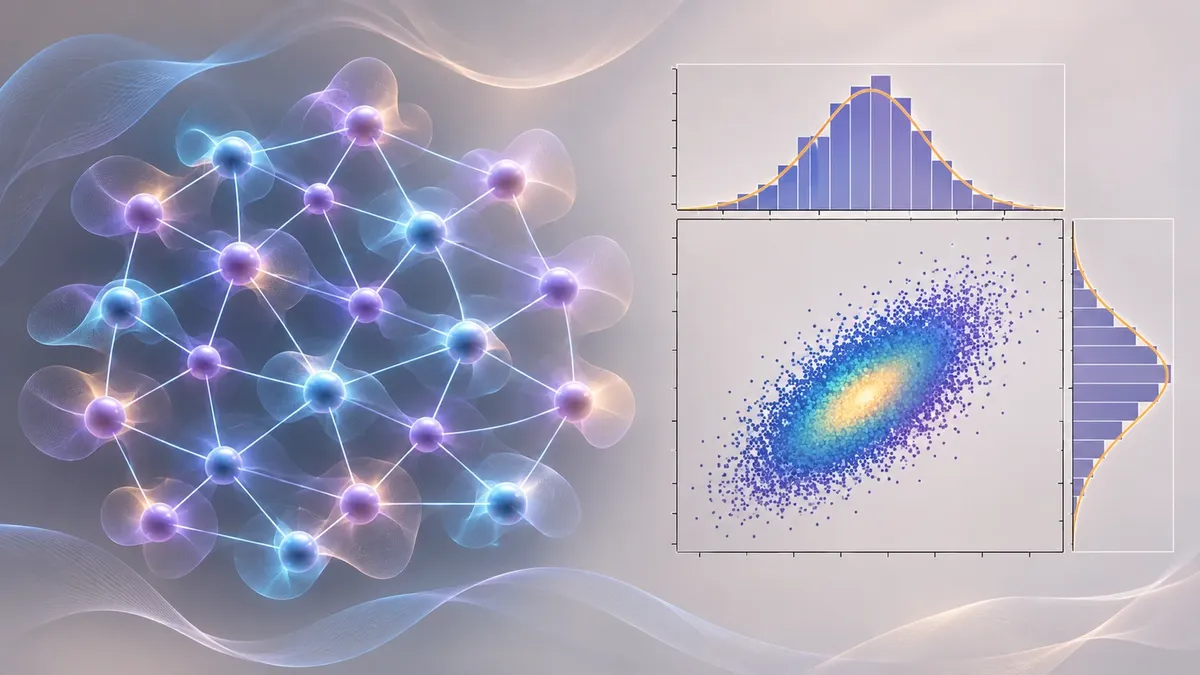
Quantum many-body systems can be difficult for classical computers to simulate, especially at long times or low temperatures. A theoretical study proposes a different strategy for a particular class of random systems: calculate their mean behavior, then add a short hierarchy of corrections tailored to each instance.
The question: when is classical simulation still possible?
Quantum many-body systems contain many interacting parts, and their possible states multiply rapidly as the system grows. That can make it hard for classical computers to follow the full quantum state. Researchers therefore ask whether some average-case problems—those involving typical instances from a specified random model—might still be tractable classically, including in regimes where familiar methods struggle.
Matthew Ding, Robbie King and Thomas Schuster study sparse random non-local Hamiltonians. In plain language, these are models of interacting quantum systems with sparse, non-local interactions; the abstract does not give further detail about the interaction structure. Their arXiv preprint proposes a classical algorithm for estimating several properties of these models.
Averages first, then corrections
Instead of directly representing and evolving the entire quantum state or its associated operator, the method first calculates the model’s mean behavior. It then adds a short hierarchy of corrections that depend on the particular random instance. The authors use free probability theory to connect short-time data to predictions of longer-time behavior.
The abstract says the algorithm can compute spectral fluctuations, thermal values, and time-ordered and out-of-time-order correlation functions. It reports a running time of $(1/\varepsilon)^{2+o(1)}$ for any subexponential precision $\varepsilon$, and describes this scaling as nearly identical to that of a quantum simulation.
What the result does—and does not—show
According to the abstract, the approach applies even at late evolution times, low temperatures and near critical points—settings where the authors say existing classical methods require exponential time. This is a claim about the studied algorithm and model class, not evidence that all quantum many-body systems can be simulated efficiently on ordinary computers.
Nor does an efficient classical algorithm for these tasks settle the broader question of quantum advantage. The result concerns specified estimates for sparse random Hamiltonians. It does not establish that every property, every individual system or every quantum simulation has a comparable classical shortcut.
This account is based on the paper’s abstract, not a full-text examination. The work is identified as version 1 of an arXiv preprint; the available source does not establish whether it has undergone peer review. Because the full paper was not assessed here, this account cannot evaluate its detailed assumptions, proofs or limitations.
- quantum simulation
- free probability
- Hamiltonians
- classical algorithms
- quantum many-body physics
Related reading
Automatically matched by shared topic keywords. These links do not imply that the sources agree or establish a consensus.
A world model reads quantum dynamics to infer hidden interactions
Source published
Shared keywords: quantum many body physics, quantum simulation
PEPSKit.jl brings iPEPS methods together in Julia
Source published
Shared keywords: quantum many body physics, quantum simulation
A Quantum Thermalization ‘Burst’ Can Be Built to Order
Source published
Shared keywords: quantum many body physics, quantum simulation
A phase-based estimate for quantum simulation error
Source published
Shared keywords: quantum simulation
When Do Eighth-Order Quantum Simulation Formulas Help?
Source published
Shared keywords: quantum simulation