TRANSMISSION // 2611.33119v1
Teaching AI to write better parallel code
Source published
MetaFORGE refines written guidance for generating MPI code using execution feedback and stored optimization advice. Its abstract reports improvements across six tasks, but gives no effect sizes.
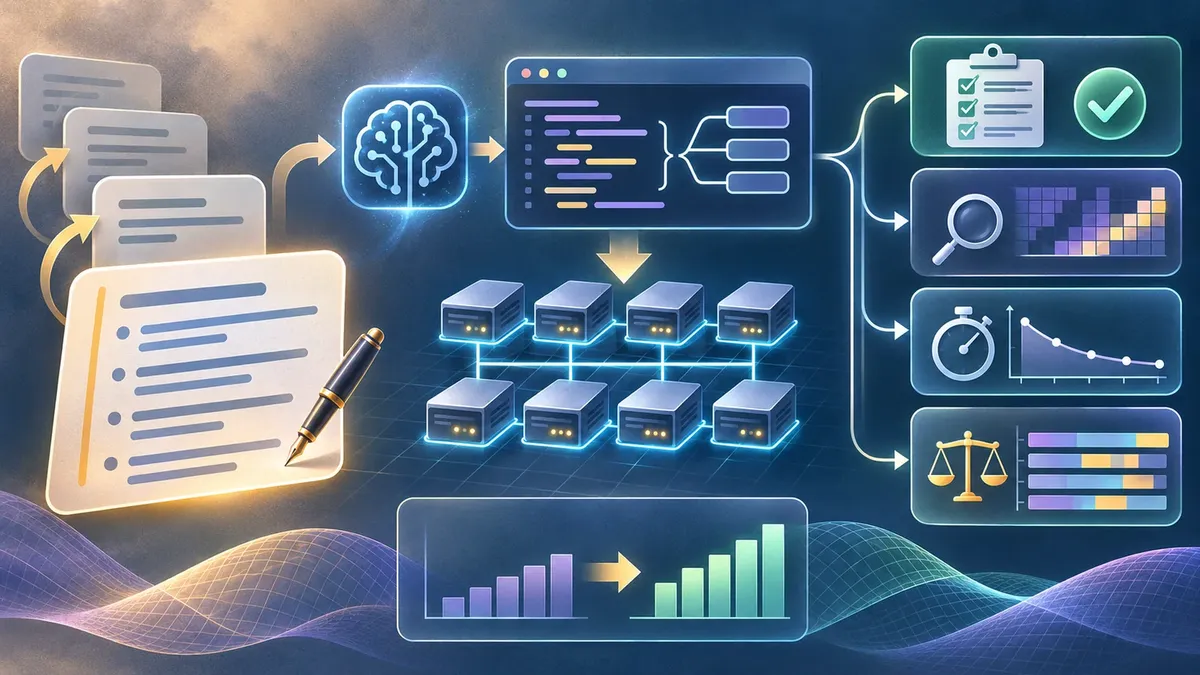
Can feedback from running and analyzing generated code help improve the instructions used to produce later code? A new arXiv preprint tests that idea with MPI C programs, using evaluation results to refine persistent natural-language guidance.
Refining guidance with feedback
The paper introduces MetaFORGE, a framework that iteratively updates natural-language “skill” specifications used to guide generation of MPI C code. MPI is a system for writing programs that coordinate work across multiple processes. MetaFORGE also maintains external memory: it distills optimization knowledge supported by reward signals and retrieves that advice across runs.
The abstract says the framework combines correctness tests, compiler diagnostics, static-analysis findings, runtime measurements and rank-level load-imbalance profiles into a single reward. A textual-gradient refinement process uses that reward to guide revisions to the written specifications. The abstract describes the feedback process, but does not provide enough detail to reconstruct its implementation.
What the evaluation reports
The authors report evaluating MetaFORGE across six MPI tasks and three workload sizes. They say it improved static-analysis quality, runtime and load balance relative to generation without iterative refinement, and generally exceeded the evaluated TextGrad baseline. The abstract does not specify whether every task was tested at every workload size.
A model-matched ablation found that MetaFORGE’s reported advantage persisted when its refinement model was reduced to GPT-4o. In a separate retrieval ablation spanning all 18 task–workload configurations, the authors report a consistent runtime benefit and broad benefits for static-analysis quality and load balance when retrieved context was included.
The abstract also describes leakage-controlled held-out and zero-update experiments. The authors interpret these results as evidence that optimization knowledge persisted in both the revised skill and external memory under their evaluation protocol. This supports a conclusion about the tested setup; it does not establish how well the method transfers to other programs or settings.
What remains uncertain
The available source here is the abstract, not the full paper. It gives no numerical effect sizes, so readers cannot tell how large the reported changes were. Nor does the abstract provide detailed methods and results needed to assess the task choices, reward design, evaluation procedures or statistical uncertainty.
MetaFORGE is presented as an arXiv preprint, which may not have undergone peer review. Its abstract reports encouraging results, but independent evaluation and the full paper would be needed to judge their scale, robustness and broader relevance.
- MetaFORGE
- parallel computing
- MPI
- code generation
- large language models
- AI evaluation
Reviewed cross-references
These connections were reviewed by a model, not independently fact-checked by a human. Similarity does not imply agreement; consult the original papers and the evidence below.
How Robust Are AI Coding Models to Rewording?
Supporting evidence: Both studies indicate that code-generation outcomes can depend on task instructions: MetaFORGE reports that its results depend strongly on generation instructions, while the robustness study reports that wording changes can lead to incorrect outputs. This is a bounded connection, not a direct comparison: MetaFORGE evaluates MPI C skill refinement, whereas the robustness study examines Java tasks and a specific paraphrase-based robustness method.
Model review: · openai-codex/gpt-6-luna
Evidence and provenance
Selected excerpts, not complete papers. PDF extraction can omit figures or damage equations, tables and reading order; sources may be preprints.
2611.33119v1 — Original paper
Excerpt reference:
static/papers/2611.33119v1.md:13-84
Basis: Paper text
Source SHA-256:0ed88139025a9026261de487462aac224d2917eb622a412a642e648250edbddf2611.28957v1 — Original paper
Excerpt reference:
static/papers/2611.28957v1.md:15-90
Basis: Paper text
Source SHA-256:a478a64dcde2e889d56ac4a5ae48cdde5c210463c0bfdacbd2a657b3163c0dad
Targeted AI repairs improve scientific code translation—but simple tests miss errors
Shared method: Both frameworks use execution-related feedback to assess generated parallel code: MetaFORGE combines correctness tests, compiler diagnostics, static analysis, runtime, and load-imbalance measurements, while the translation framework uses compilation diagnosis and execution validation to guide repairs. The methods overlap in feedback-grounded evaluation, but differ in goals and design: persistent skill refinement for MPI generation versus targeted repair for CUDA, OpenMP, and SYCL translation.
Model review: · openai-codex/gpt-6-luna
Evidence and provenance
Selected excerpts, not complete papers. PDF extraction can omit figures or damage equations, tables and reading order; sources may be preprints.
2611.33119v1 — Original paper
Excerpt reference:
static/papers/2611.33119v1.md:85-150
Basis: Paper text
Source SHA-256:0ed88139025a9026261de487462aac224d2917eb622a412a642e648250edbddf2611.08947v1 — Original paper
Excerpt reference:
static/papers/2611.08947v1.md:132-203
Basis: Paper text
Source SHA-256:de224fcf2c0a62b65d7dbfea1b6fe755c2583bb2bfc1afd7d402fdb2ab2c5d23
Related reading
Automatically matched by shared topic keywords. These links do not imply that the sources agree or establish a consensus.
A shared test bench for predicting how LLMs train
Source published
Shared keywords: large language models, parallel computing
AI diagram errors shift from counting to seeing when code takes over
Source published
Shared keywords: ai evaluation, code generation
Can coding agents learn from security mistakes?
Source published
Shared keywords: ai evaluation
How Robust Are AI Coding Models to Rewording?
Source published
Shared keywords: code generation, large language models
When one AI plans and another writes the code
Source published
Shared keywords: code generation, large language models