TRANSMISSION // 2611.33106v1
Why a Chess AI Needs to Watch the Clock
Source published
A chess model that sees the clock as well as the board better matches human moves and mistakes under time pressure, according to a study using online games.
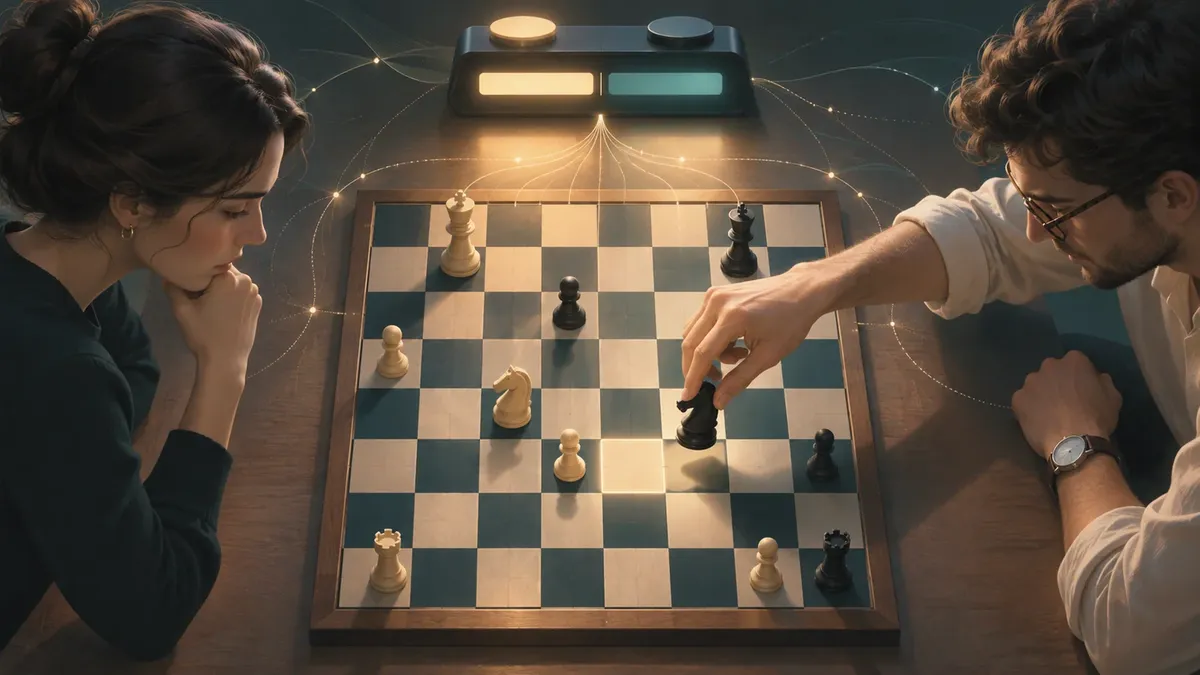
Chess players do not make decisions in a vacuum: the same position can invite different choices when seconds are running out. A new study tests whether giving a move-prediction model direct access to clock information helps it behave more like people do under pressure.
A chess player with plenty of time can study a position; one with only a few seconds may have to rely on instinct. Yet many models trained to predict human moves focus on the board and leave out the changing clock. That can make their play look too steady in situations where human decisions become less accurate.
Victor Dziwniel and Tianxiang Lu ask whether a model can better imitate human chess if it is told how much time remains. Their study, “Temporal Conditioning for Human Behavioral Cloning in Chess,” builds a transformer that uses both the board and information about the clock.
Giving the model a sense of time
The researchers adapted a Chessformer-style model, representing the 64 squares as tokens processed by a transformer. They added four learned tokens encoding the time control, each player’s remaining clock, and recent move timing. These inputs let the model’s move predictions respond directly to the game’s tempo.
The model also predicts how long a player might think before making a particular move and whether they will resign. Training used rated Lichess games with clock information. The central comparison was a pair of similarly sized models trained under the same setup: one received temporal inputs, while the other received zeroed-out inputs. Both were tested on held-out games. The authors also compared a larger time-aware model with a released Maia-3 model, while noting that this was a comparison between systems with different training histories, not a controlled test of clock information alone.
To assess whether play resembled human performance—not just whether the model guessed the recorded move—the researchers examined the quality of sampled moves using Stockfish as a reference. They also ran tests that changed or shuffled clock inputs while holding the board position fixed, helping distinguish the effect of time information from differences between the positions players encounter in different clock conditions.
Gains were concentrated in time trouble
In the controlled comparison, the time-aware model’s move-matching accuracy was 0.73 percentage points higher overall. The difference grew as time pressure increased, reaching 2.45 points in the study’s “critical” category, where less than 5% of the base time remained. A smaller, reduced-training run with three matched pairs of random seeds showed a similar pattern, though the authors’ main results come from one full-budget run per model.
The move-quality analysis points to a separate benefit. On the authors’ test data, sampled human moves became worse by the study’s engine-based measure as the clock ran down. In critical positions, the time-aware model’s sampled moves were close to the human average. The time-blind model, by contrast, played about 15 centipawns better than the human average in that category—an indication that it failed to reproduce the decline in move quality associated with severe time pressure.
The fixed-board tests strengthen the case that clock information matters to the model. On positions where the human player was in critical time trouble, the time-aware model’s blunder rate was close to the human rate when given the actual clock state. Changing the temporal inputs on those same boards shifted the model’s behavior. This is evidence about the model’s response to its inputs, not proof that the clock alone explains every human mistake.
The added information also helped with other predictions. The time-aware model more accurately predicted thinking time and game outcomes, and it had a higher resignation F1 score than its time-blind counterpart. In critical positions, its estimated thinking time was closer to the human average. These results suggest that timing is relevant not only to which move a model selects but also to how it represents the pace and progression of a game.
What the evidence cannot settle
The comparison with Maia-3 should be read cautiously. The authors report that their larger model was ahead on the full test set, with a larger gap in critical time trouble. But the models differed in data, training recipe and budget. A test that permuted the larger model’s dynamic clock inputs reduced much of its advantage in critical positions, supporting a role for those inputs without making the broader comparison a clean, one-variable experiment.
The study measures behavior offline. It does not show whether people find the model more realistic in a game, or whether improved move and timing predictions translate into better coaching or cheat detection. All the data came from Lichess, so results may not carry over to other platforms or over-the-board chess. The study also notes that one-second clock recording limits precision for very fast moves. Some analyses—particularly move quality and behavioral predictions—rely on one full-budget run per model.
The paper is an accepted version of a 2026 IEEE Gaming, Entertainment, and Media Conference paper, according to its text; it is not simply an unreviewed arXiv manuscript. Even so, its findings concern particular models, datasets and evaluation choices. The main takeaway is narrower than “clocks make chess AI human”: directly representing time helped these models better match several human behaviors, especially when little time remained.
- chess AI
- human behavior modeling
- time pressure
- transformers
- behavioral cloning
Reviewed cross-references
These connections were reviewed by a model, not independently fact-checked by a human. Similarity does not imply agreement; consult the original papers and the evidence below.
Helping AI learn from demonstrations that leave an uneven picture
Shared method: Both papers use behavioral cloning, but address distinct problems: the chess study conditions move prediction on clock state to model time-pressure behavior, while DrilDICE targets covariate shift from demonstrations collected under arbitrary state distributions. This is a shared method, not evidence that either approach solves the other’s problem; the settings and evaluations differ.
Model review: · openai-codex/gpt-6-luna
Evidence and provenance
Selected excerpts, not complete papers. PDF extraction can omit figures or damage equations, tables and reading order; sources may be preprints.
2611.33106v1 — Original paper
Excerpt reference:
static/papers/2611.33106v1.md:85-151
Basis: Paper text
Source SHA-256:5320d3c86107218a928d4ce1b6667ece0261586d5d5d0caba309a765631759272611.09371v1 — Original paper
Excerpt reference:
static/papers/2611.09371v1.md:126-168
Basis: Paper text
Source SHA-256:3a59052c2e3b46328f3788d32b28331d75fd27e7a0291689080b7d8a5304164a
Related reading
Automatically matched by shared topic keywords. These links do not imply that the sources agree or establish a consensus.