TRANSMISSION // 2611.33103v1
How a vortex exodus may stop itself
Source published
A theoretical model and simulations propose that a growing vortex-free sector can weaken flow near a container wall and limit further vortex escape. The mechanism’s relevance to pulsar glitches remains uncertain.
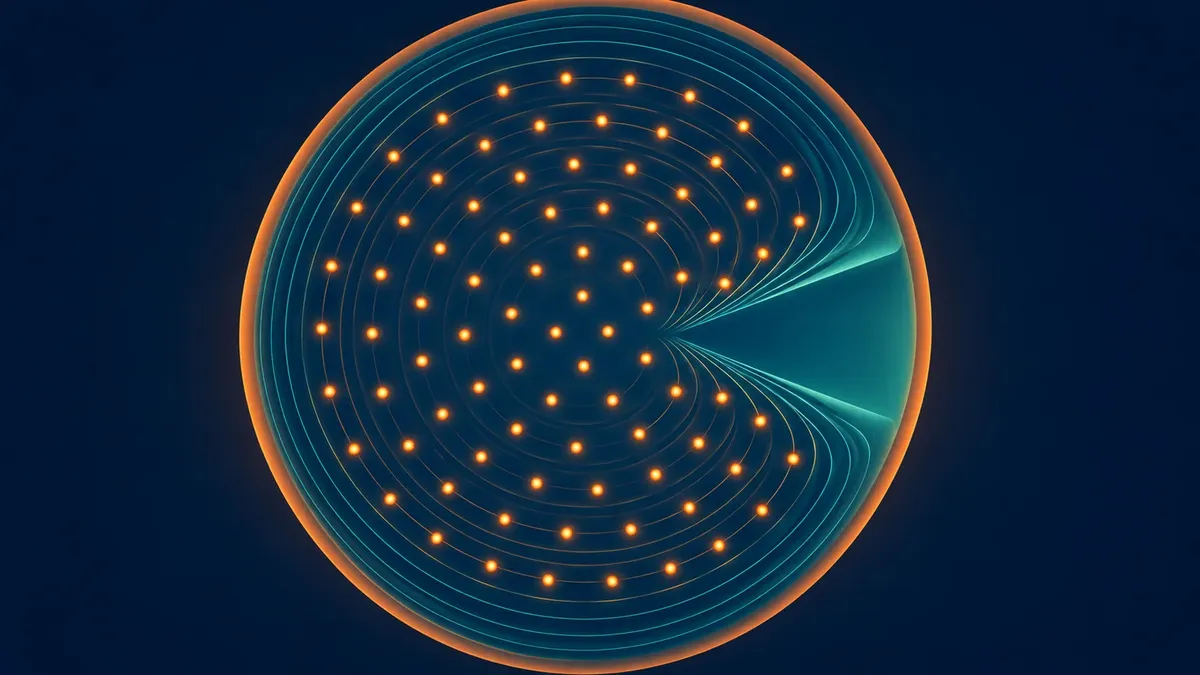
Pinned vortices can make a spinning superfluid respond to a slowing container with a sudden rearrangement—and a brief spin-up. A new preprint investigates how such an event might begin and stop, using a simplified model and simulations.
A rotating superfluid carries its rotation in tiny whirlpools called quantized vortices. When these vortices are evenly arranged, their collective motion can let the fluid track a rotating container. But pinning sites can hold vortices in place as the container slows, building a mismatch between the fluid and the container. If vortices then rearrange and move outward, they can transfer angular momentum to the container, briefly speeding it up.
Abrupt spin-ups of this kind are thought to be relevant to pulsar glitches, sudden increases in a neutron star’s rotation rate. In an arXiv preprint, S. V. Anantharaman and Dipankar Bhattacharya propose a mechanism for how a vortex rearrangement could begin and limit its own progress.
A sector changes the flow
The authors consider a cylindrical container that gradually slows while holding a superfluid with pinned vortices. They assume the vortices remain straight, so the system can be represented by a two-dimensional cross-section. Pinning is treated as uniform: a vortex comes loose when the local flow in the container’s frame exceeds a specified critical speed.
In this setup, the mismatch between the container and pinned vortices grows most strongly near the wall. A small disturbance may leave a wedge-shaped sector without vortices. The authors’ analysis predicts that the missing vortices increase flow near the sector’s inward-facing tip. Once the sector’s opening reaches a critical size, flow there can reach the unpinning threshold, potentially allowing the disturbance to grow through further vortex loss.
The proposed stopping mechanism depends on how the expanding sector also changes flow near the wall. Vortices need outward drift to reach the boundary and leave the fluid. The authors calculate that the sector reduces tangential flow near the wall as it grows. At a particular depth, their model gives zero tangential flow there; they argue that this could favor inward drift and recapture of vortices, limiting further exit. This is a model-based account, not a directly established sequence: the paper notes that the detailed mechanics of the exodus invite further study.
The analysis associates the depleted sector’s angular width and radial depth mainly with the critical unpinning speed, container size and initial rotation rate. It also uses the sector’s dimensions to estimate angular-momentum transfer. However, the paper distinguishes the first exodus from the later rearrangement. It says the later stage contributes marginally to net transfer for sectors with small opening angles; that qualification should not be extended to every case considered.
Simulations and pulsar estimates
To compare the analytical picture with a more detailed calculation, the researchers simulate point vortices in a circular container. The simulation includes pinning sites, a small amount of dissipation and a boundary represented by image vortices. They run three cases, varying the critical unpinning speed while keeping the other stated setup parameters fixed. The measured sector scales and fractional spin-ups correspond with estimates from the analytical framework. This is support for the proposed mechanism within these modeled conditions, not evidence that it applies universally.
The authors also estimate possible fractional spin-ups for the Crab and Vela pulsars, using published stellar parameters and assumptions about the participating superfluid and pinning. Their estimates are about 10⁻¹⁰ for the Crab and 10⁻⁵ for Vela. The paper cites typical observed glitch sizes of about 10⁻⁹ and 10⁻⁶, respectively. These are approximate model-to-observation comparisons, not direct observations of vortex motion inside either star or proof that this mechanism causes glitches.
Important uncertainties remain. The calculation assumes a cylindrical geometry, straight vortices and uniform pinning. Neutron stars are spherical, and their physical properties vary with depth; the authors say it is unclear how the proposed mechanism would behave in an inhomogeneous pinning landscape. The study also does not examine every stage of the rearrangement in detail, and its simulations cover only a limited set of conditions.
The work is a preprint, not a settled account of pulsar glitches. Its contribution is a proposed way for localized vortex escape to become self-limiting, alongside analytical estimates and simulations that can be tested in more realistic models.
- superfluid vortices
- vortex pinning
- pulsar glitches
- angular momentum
- superfluid dynamics
Related reading
Automatically matched by shared topic keywords. These links do not imply that the sources agree or establish a consensus.