TRANSMISSION // 2611.33096v1
Teaching AI to Generate Event-Camera Signals
Source published
EventDiffusion aims to generate event-camera streams from video through a three-part probabilistic model. Its authors report strong benchmark results, but the abstract alone leaves important details unclear.
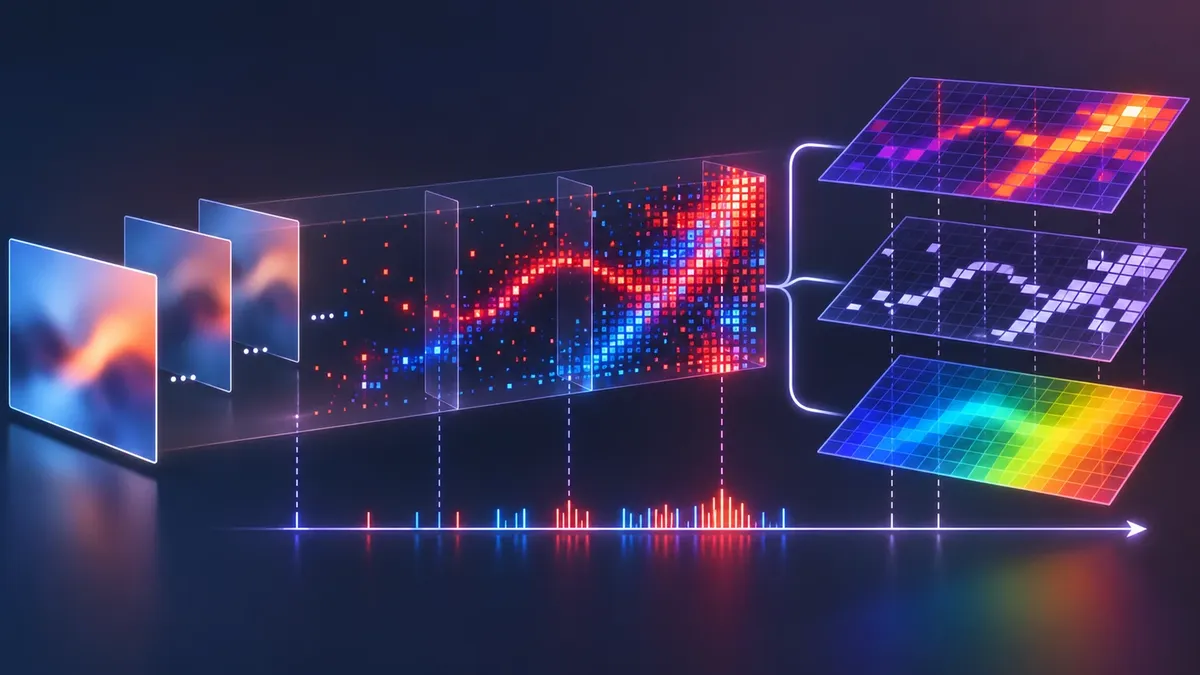
Event cameras capture brightness changes as asynchronous events rather than ordinary video frames. EventDiffusion is a proposed way to learn and generate such streams from real recordings—an uncertain task, since the same sparse video observations can be consistent with different event streams.
Event cameras record asynchronous brightness changes with high temporal resolution. Their event streams contain activity, polarity and timing information, but recordings are scarce, which can constrain data-driven research.
A key challenge is that sparse RGB observations do not uniquely determine the events that happened between them. The same frames may be consistent with streams that differ in activity, polarity or timing. The authors say existing simulators often rely on prescribed sensor dynamics and estimated brightness trajectories, assumptions that may limit the diversity and fidelity of generated streams.
The authors introduce EventDiffusion, a hierarchical generative framework that learns a conditional distribution of event streams from real recordings. It divides generation into three probabilistic processes: Event Activity Diffusion (EAD) learns discrete event counts; Event Spatial Allocation (ESA) distributes those counts among pixels while preserving the count; and Event Timing Diffusion (ETD) models continuous asynchronous timestamps. Put simply, the framework handles how many events occur, where they are allocated and when they happen as separate stages in its generation process.
The paper also proposes CEFS, a metric for assessing event-stream realism. The abstract says it combines event activity and polarity with multiscale space-time structure and temporal fidelity. This reflects several different features of a stream, rather than judging it by event activity alone.
The authors report that EventDiffusion achieves “double the accuracy of SOTA methods” across all datasets, and claim robustness across different cameras at any resolution. These are claims from the abstract, not independently verified results here. The abstract does not name the datasets or comparison methods, explain how accuracy is defined, or provide detailed numerical results or uncertainty estimates. The breadth and meaning of the reported gains therefore cannot be assessed from the available evidence.
This account is based on the abstract, not the full paper’s methods, experiments or tables. It does not establish how the model performs in specific applications or whether its generated streams improve downstream tasks. The source is an arXiv preprint; the supplied information does not establish peer review. The proposal offers a structured approach to generating event streams, but fuller evidence is needed to judge its performance and limitations.
- event cameras
- EventDiffusion
- event streams
- generative models
- computer vision
Related reading
Automatically matched by shared topic keywords. These links do not imply that the sources agree or establish a consensus.
How Event Cameras Learn Depth Without Dense Labels
Source published
Shared keywords: computer vision, event cameras
How EventSSM estimates depth from event-camera data
Source published
Shared keywords: computer vision, event cameras
How event polarity may help detect tiny drones
Source published
Shared keywords: computer vision, event cameras
How an event camera can help track a spacecraft
Source published
Shared keywords: computer vision, event cameras
When AI Memorizes—and When It Makes Something New
Source published
Shared keywords: generative models