TRANSMISSION // 2611.33083v1
A dark-matter simulation can get the density right—and still miss the wave
Source published
A new initialization framework for scalar-field dark matter simulations finds that matching the predicted density pattern does not ensure that a simulation grid can resolve the wave’s phase.
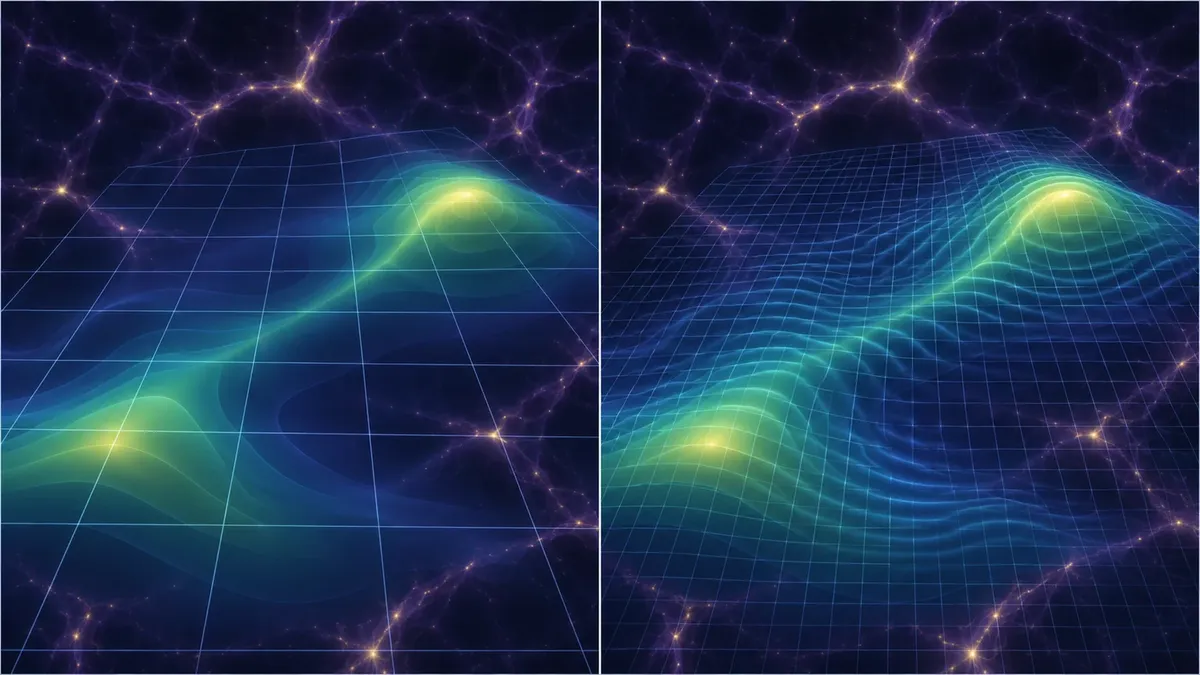
Scalar-field dark matter is modeled as a wave, so simulations must initialize more than where matter is concentrated: they must also represent how the wave changes across space. A study testing a pipeline for setting up these simulations finds that density agreement alone can hide substantial phase undersampling.
Simulating dark matter as a wave means keeping track of two connected features: its density and its phase. In scalar-field dark matter (SFDM) models, the wave’s phase gradient encodes velocity. If a computer grid is too coarse to represent that gradient, the initial wave can be poorly sampled even when its density pattern looks right.
A study by Hafiz Inam Ullah and colleagues builds and tests a framework for creating these initial conditions. The work asks whether a simulation can reproduce the intended linear density and velocity patterns—and whether its grid can represent the resulting wave phase before the simulation begins evolving the system.
Following the information into the wave
The researchers connect three tools: CLASS-SFDM, which calculates linear cosmological perturbations; MUSIC, which generates simulation initial conditions; and AxioNyx, which represents scalar dark matter using a complex wavefunction. They also compare CLASS velocity predictions with an independent code, AxiECAMB.
For their example, they use a quadratic scalar-field model with a particle mass of about 3.16 × 10⁻²² electronvolts, starting at redshift 120. They check the transfer functions that describe how density and velocity vary across scales, test whether MUSIC recovers the predicted density power spectrum, and examine whether neighboring grid cells can represent the phase changes implied by the velocity field.
That last test uses a sampling limit: when a phase change between neighboring samples exceeds π radians, the sampled values cannot uniquely capture the underlying change. This is a warning of possible phase aliasing, not a direct measurement of how a later simulation will behave.
Density agreement is not the whole test
The pipeline’s linear velocity-divergence result agrees closely with AxiECAMB over the tested range of scales. In the 256³ MUSIC realization, the density power spectrum also closely matches the CLASS prediction across the study’s selected cutoff interval: the median power ratio is 1.00131, with an RMS fractional difference of 0.138%.
But the phase test tells a different story. The share of velocity-implied neighboring phase increments exceeding the sampling limit falls from 46.7% at 256³ resolution to 13.685% at 512³ and 0.124060% at 1024³. A second realization gives similar results at the two higher resolutions. The highest-resolution result is a substantial improvement, but it does not mean every phase increment is resolved.
A comparison of 512³ and 1024³ initial conditions offers another perspective. Their central-plane density patterns remain strongly correlated, with a reported correlation of 0.9989. The phase differences are more noticeable: their median absolute circular difference is 0.264 radians without masking, and 0.246 radians for blocks passing the study’s phase-coherence selection. Because the finer grid adds small-scale modes, this is a resolution-sensitivity comparison—not proof that the wavefunction has converged.
What the results do—and do not—establish
The central methodological finding is that reproducing a density spectrum does not by itself show that a wave simulation’s phase is adequately sampled. Density, velocity conventions, the conversion from velocity to phase, and phase resolution need separate checks. The paper provides a set of such checks for its particular model and simulation setup, with inputs and analysis products described as available in an archive.
The scope is important. These tests concern initialization, before nonlinear evolution. The authors do not establish that the full three-dimensional wavefunction or its current has converged, nor do they report predictions for later structure formation, Lyman-alpha observations, or constraints on the dark-matter mass. The paper also identifies further checks—such as validating the reconstructed wave current—as unfinished.
This is an arXiv preprint, and the source material supplied for this article does not establish whether it has undergone peer review. Its numerical results should therefore be read as a proposed and tested initialization method, not as a settled result about observed dark matter. The findings apply to the particular parameters, codes, and resolutions examined; other setups may need their own validation.
- scalar-field dark matter
- cosmological simulations
- wave phase
- initial conditions
- numerical resolution
- dark matter
Related reading
Automatically matched by shared topic keywords. These links do not imply that the sources agree or establish a consensus.
Self-interacting dark matter deepens a galactic bar puzzle in simulations
Source published
Shared keywords: cosmological simulations
A New Way to Simulate Dark Energy Clustering
Source published
Shared keywords: cosmological simulations
A smarter way to track oscillating scalar dark matter
Source published
Shared keywords: scalar field dark matter
Could ancient magnetic fields have brought forward cosmic reionization?
Source published
Shared keywords: cosmological simulations
A cosmic census of dark matter halos, from planets to clusters
Source published
Shared keywords: cosmological simulations