TRANSMISSION // 2611.33063v1
What heat and losses do to a superradiant transition
Source published
A theory of the open Dicke model finds that temperature raises the critical coupling, while the soft mode becomes overdamped across a finite range near the transition.
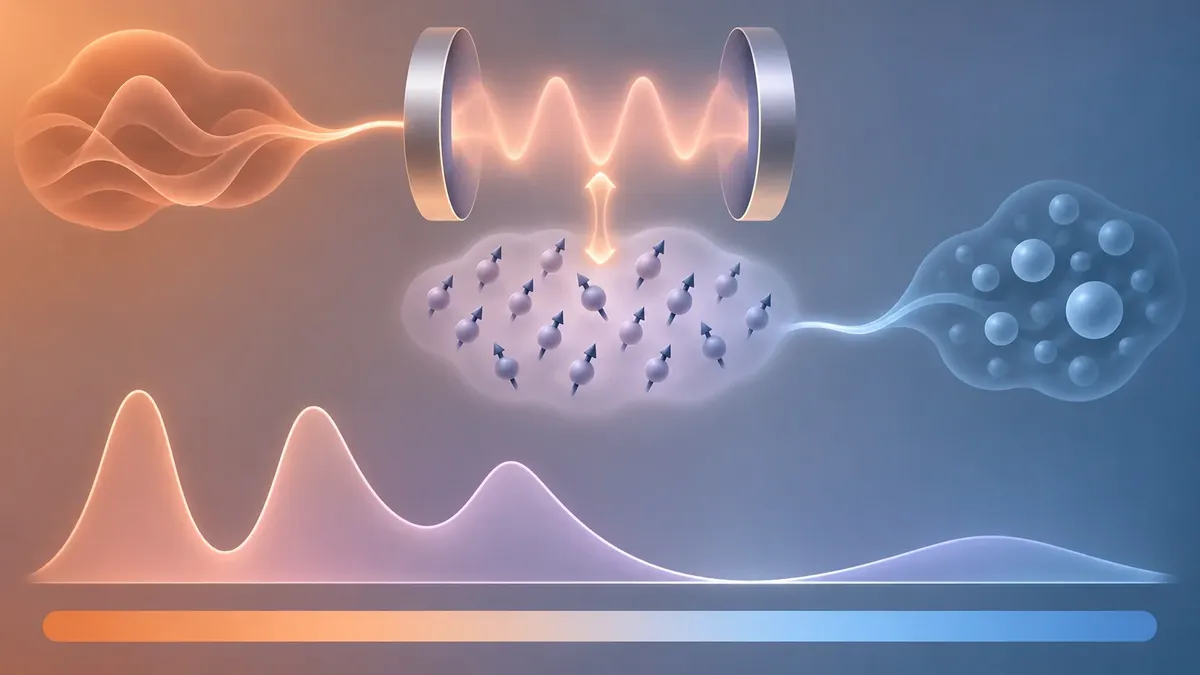
Near a superradiant transition, a light–matter system’s softening excitation can be strongly affected by its surroundings, making weak-loss approximations unreliable. Orlando and colleagues develop a finite-temperature theory of the transition and predict reflection and thermal-emission spectra while treating reservoir coupling beyond that weak-loss limit.
The question: what happens when a critical system leaks?
The Dicke model describes a cavity mode interacting collectively with many two-level systems, such as atoms or spins. In its superradiant phase, the cavity field and collective polarization become macroscopic even without an external drive. Approaching the transition, the lowest-frequency hybrid light–matter excitation—the lower polariton—softens toward zero frequency.
That softening challenges familiar ways of describing dissipation. When a mode’s frequency becomes very small, its losses can no longer be assumed to be a minor correction. The authors ask how temperature and reservoirs affect the transition, and what an experiment might see in reflected and emitted light.
A model with two different environments
The study is theoretical. It considers a cavity and an ensemble of two-level systems coupled to separate reservoirs: the cavity reservoir is at zero temperature, while the matter reservoir is at temperature T. The authors assume the spins remain thermalized with their reservoir, even as they interact with the cavity. They also work in the thermodynamic limit, where the number of two-level systems becomes very large.
The calculation first finds the system’s thermal mean-field state, including all total-spin sectors rather than restricting the atoms to a single collective-spin sector. The authors then describe fluctuations around that state and eliminate the reservoir variables to derive quantum Langevin equations. These equations retain frequency-dependent memory and do not use the usual Born–Markov or rotating-wave approximations. Such approximations can be unreliable near the transition, where the excitation may become overdamped.
For the main spectral illustrations, the paper specializes to Ohmic reservoirs, corresponding to frequency-independent damping. The broader formalism allows frequency-dependent damping under stated conditions. The reservoir coupling uses a shifted oscillator potential; the authors emphasize that this modelling choice matters for their result about the transition point.
What the theory finds
Temperature shifts the critical light–matter coupling upward: hotter spins are less polarized, so stronger coupling is needed to establish the macroscopic field. The authors derive a critical curve that matches the closed Dicke model’s equilibrium result. For a broad class of damping functions—those satisfying a specified low-frequency condition—the reservoirs do not shift this temperature-dependent critical curve.
That does not mean losses are unimportant. Across a finite interval of coupling strengths around the transition, the lower polariton is overdamped: it relaxes without oscillating. The authors identify the critical point itself by the simultaneous vanishing of the real and imaginary parts of the excitation frequency. This distinction matters: the whole overdamped interval does not have both parts equal to zero. The result helps explain why treating losses only as a small perturbation can miss behavior near criticality.
Above the transition, the model predicts that increasing temperature makes the order parameter rise more steeply and accelerates the decoupling of light and matter. In the calculated spectra, thermal emission becomes brighter near the transition, where the polariton softens and low-frequency thermal occupation is large. Farther into the superradiant phase, reduced light–matter mixing and a mismatch between effective damping rates suppress emission features.
The authors also identify conditions for reflectionless modes. At particular frequencies, incoming cavity radiation is fully absorbed; in the model’s specified thermal setup, the system then emits at the corresponding blackbody occupation. In that sense, it can act as both a perfect absorber and a perfect emitter at the same frequency. These are conditional predictions requiring suitable balance between the two dissipation channels—not a claim that every system will show perfect absorption.
What remains uncertain
These results come from a model, not a new experiment. The assumed spin thermalization, reservoir coupling form, thermodynamic limit, and treatment of damping all delimit what can be concluded. The authors note that applying their proposals to real materials will require realistic temperature-dependent coupling and loss rates. The paper suggests possible uses in spectroscopy, thermometry, and heat-flow control, but does not demonstrate those applications.
The source is an arXiv preprint, version 1, so its findings should be treated as theoretical work that may not yet have undergone peer review. The results offer a framework for comparison with experiments; they do not establish that a particular platform will display the predicted spectra or absorber–emitter behavior.
- Dicke model
- superradiant phase transition
- quantum optics
- thermal emission
- open quantum systems
- polaritons
Reviewed cross-references
These connections were reviewed by a model, not independently fact-checked by a human. Similarity does not imply agreement; consult the original papers and the evidence below.
When a quantum environment changes the ground state
Shared method: Both papers use quantum Langevin equations to treat system–reservoir dynamics without assuming weak losses near a soft mode. The finite-temperature Dicke paper considers independent cavity and atomic reservoirs and assumes the spins remain thermalized; the spin-ensemble paper studies a counterterm-free reservoir that can drive a transition. This is a methodological connection, not evidence that their critical behavior is the same; both sources are preprints, and the excerpts are selected.
Model review: · openai-codex/gpt-6-luna
Evidence and provenance
Selected excerpts, not complete papers. PDF extraction can omit figures or damage equations, tables and reading order; sources may be preprints.
2611.33063v1 — Original paper
Excerpt reference:
static/papers/2611.33063v1.md:168-323
Basis: Paper text
Source SHA-256:49420b450267e3632dc527023042f2ad08cdc5d8346fb3f1ae66972860d238812611.13934v1 — Original paper
Excerpt reference:
static/papers/2611.13934v1.md:12-70
Basis: Paper text
Source SHA-256:bbe51e6381737d0f67c1af9a5889b1ca86ccf8ee3640d21d863b541b4355731d
Related reading
Automatically matched by shared topic keywords. These links do not imply that the sources agree or establish a consensus.
A Magnetic-Drive Proposal for Paired Quantum Emission
Source published
Shared keywords: quantum optics, superradiant phase transition
A Magnetic-Drive Model Predicts a Superradiant Phase
Source published
Shared keywords: superradiant phase transition
When extracting vacuum photons costs sensing power
Source published
Shared keywords: quantum optics
How symmetry limits many-body contributions to Rydberg light
Source published
Shared keywords: quantum optics
How quantum systems behave over the long run
Source published
Shared keywords: open quantum systems