TRANSMISSION // 2611.33022v1
RecordRoute links AI failure localization to diagnosis
Source published
A new method first selects the agent record most likely to contain a decisive error, then uses that record to classify the failure. Benchmark results are promising, but do not establish performance in every real-world setting.
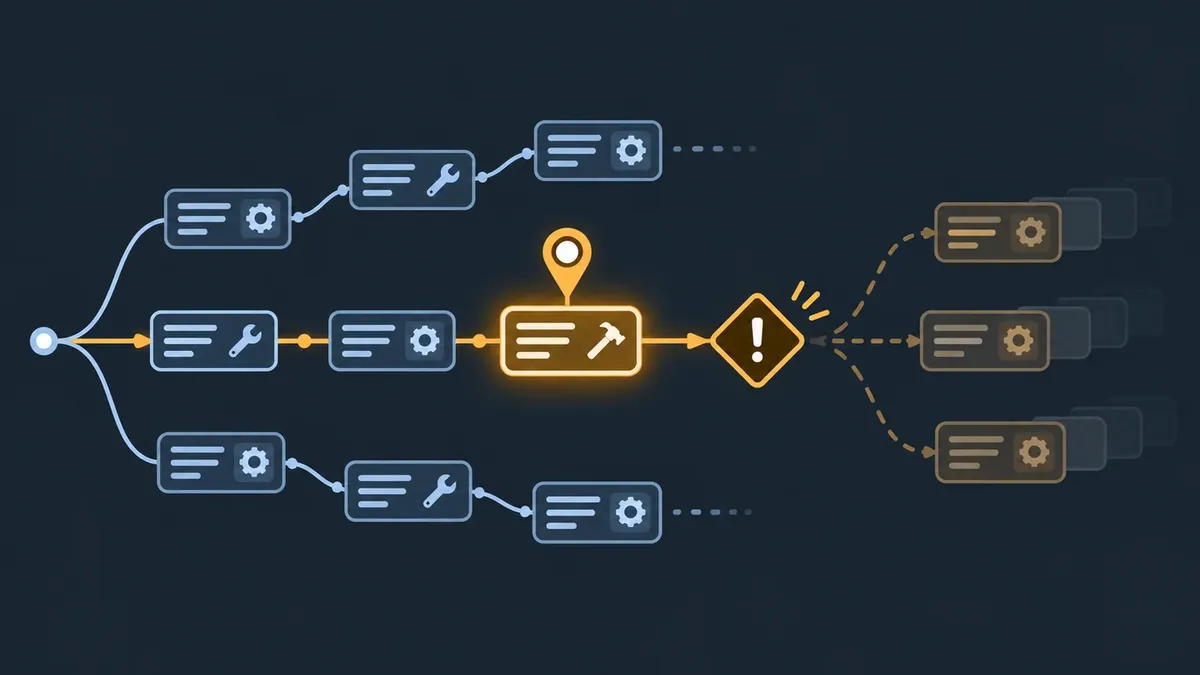
When an AI agent’s workflow fails, the final result may not reveal which agent made the crucial mistake—or when it happened. RecordRoute tackles that audit problem by locating a likely error record and using its contents to diagnose the error type.
Why look beyond the final outcome?
AI agents can work through long sequences of actions, use tools and pass information between agents. If the overall task fails, the final answer usually does not show whether the problem began with a mistaken action, a faulty tool interaction or a later step that repeated an earlier error. Auditors need to identify the responsible actor, the earliest decisive step and the kind of error—not just the outcome.
The authors of RecordRoute argue that these questions should be linked. A record may identify who acted and when, while its text may help explain what went wrong. But if a diagnosis model reads an entire trace at once, it can mix the initiating error with later symptoms and valid responses. RecordRoute instead uses its localization result to choose the text used for diagnosis.
How the method works
The system treats an execution trace as a sequence of records, such as messages, reasoning text or tool interactions. It represents each record with word and character features, designed to retain both broad wording and details such as tool names or fragments of error messages. Identifying headers are removed from the text used for ranking, but actor and step information remain attached to the record so they can be returned if it is selected.
During training, RecordRoute compares records within the same failed trajectory. A pairwise ranker learns to score annotated decisive records above other records, including those that may repeat or reflect later consequences of the original mistake. At test time, it scores records and selects the highest-ranked one. The actor and step come from that record; a separate classifier uses its text, actor identity and structural metadata to predict the error mode.
This is a supervised approach: it learns from labeled examples of failures. The paper evaluates it on Who&When Pro, which includes controlled injected failures, and on natural-failure data from TraceElephant and the retrospective POST setting of CatchBench. The authors compare it with supervised systems including StepFinder and ASCon, as well as other ranking methods and three open language models without benchmark-specific training labels.
What the tests found
On Who&When Pro, RecordRoute scored higher than StepFinder and ASCon on the four reported attribution measures. In the paper’s pooled results, it reached 90.86% exact-step accuracy and 77.47% joint accuracy—the latter requires the actor, step and error mode all to be correct. On TraceElephant and CatchBench POST, it ranked first among the evaluated methods for localization under the reported measures. These results show performance on the tested datasets, not a guarantee of reliable diagnosis for every agent system.
The authors also tested whether selecting a record helped diagnose its error mode. With actor and step predictions held fixed, diagnosis from the selected record achieved 77.47% pooled joint accuracy, compared with 69.28% when the classifier used the full trace. This comparison supports the idea that choosing diagnostic evidence matters in this setup. It does not show that localization is always the best way to choose evidence, or that the method prevents failures during execution.
What remains uncertain
A key limitation is scope. The results come from particular benchmarks, task mixtures and trace formats, with different evaluation setups across datasets. For example, the reported natural-failure comparisons assess localization; the headline joint actor-step-mode result comes from Who&When Pro. Performance on these tests cannot by itself establish how well the method would work on unseen kinds of failures, different logging systems or deployed workflows.
RecordRoute also depends on labeled failures for training. Its text-based features may be useful when wording and tool details signal a mistake, but benchmark results do not tell us how robust that signal is when records are sparse, phrased differently or missing important context. The paper includes tests on unseen tasks and agent frameworks, but these remain benchmark evaluations rather than evidence from broad real-world deployment.
The source is an arXiv preprint marked “under review,” so its claims should be treated as provisional rather than as peer-reviewed consensus. The findings are promising evidence for a practical design principle: first identify a candidate record, then diagnose the error using that record’s context. Further evaluation would be needed to establish how well this approach transfers beyond the tested settings.
- AI agents
- failure diagnosis
- agent auditing
- RecordRoute
- machine learning evaluation
Related reading
Automatically matched by shared topic keywords. These links do not imply that the sources agree or establish a consensus.
Wiki-style memory helps AI agents repeat workplace tasks in preprint study
Source published
Shared keywords: ai agents, failure diagnosis
How ProbeAgent Tries to Diagnose AI Agent Failures
Source published
Shared keywords: ai agents, failure diagnosis
Why Random Selection Matters in Feature-Selection Research
Source published
Shared keywords: machine learning evaluation
A benchmark asks whether deepfake defenses generalize
Source published
Shared keywords: machine learning evaluation
GUI Agent Failures Cluster in Tested Tasks
Source published
Shared keywords: failure diagnosis