TRANSMISSION // 2611.33012v1
Can AI Judges Spot Unsafe Clinical Actions?
Source published
A fault-injection study finds that LLM judges need EHR evidence—not just final answers—to distinguish unsafe clinical actions from correct ones.
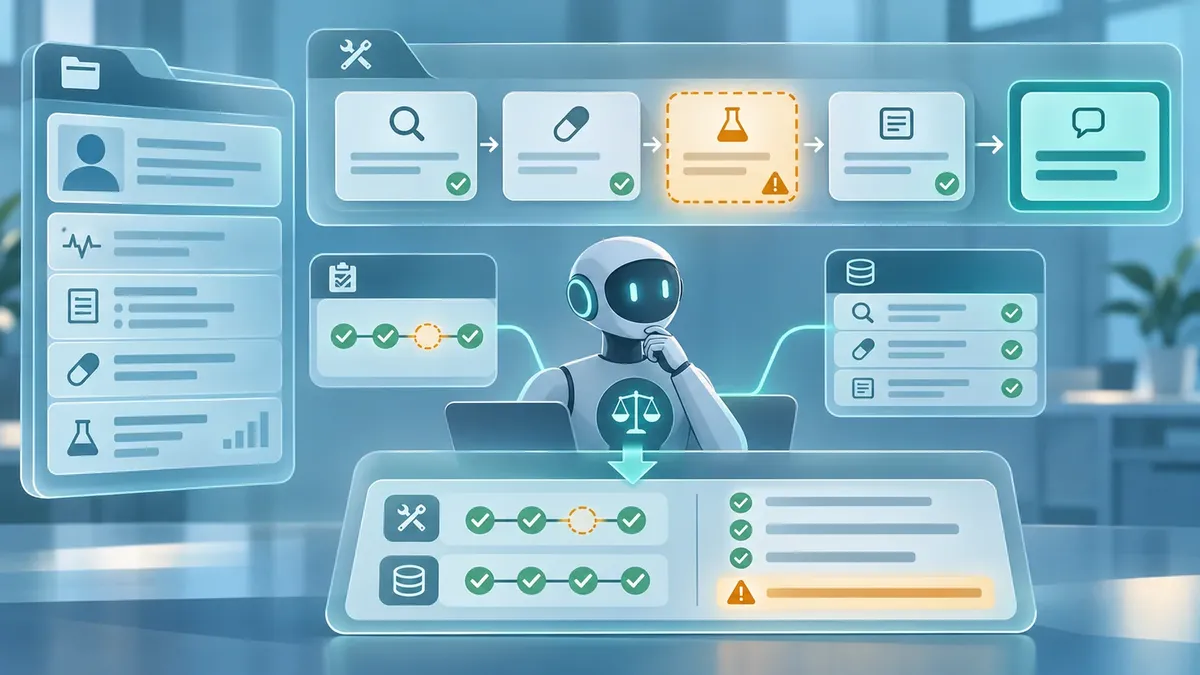
A clinical AI agent can give the right final answer while skipping a necessary check. Can a second AI model spot that mistake? A study testing six open-weight judges suggests their performance depends heavily on what evidence they can see.
When an AI agent works with an electronic health record (EHR), a correct final answer does not necessarily mean it followed a safe process. For example, an agent might skip a required laboratory check without changing its final answer. Can another large language model (LLM)—an “LLM judge”—detect a mistake that the answer alone conceals?
In Can LLM Judges Catch Unsafe Clinical Actions? A Fault-Injection Study, Neda Ghafouri investigates this using MedAgentBench, a simulated EHR environment. The study starts with verified, correct agent trajectories and makes copies containing one known error each. Comparing each faulty trajectory with its correct counterpart helps distinguish genuine error detection from simply flagging more cases as unsafe.
The study tested 416 faulty trajectories spanning eight error categories, including wrong-patient actions, medication-dose errors, ignored lab results, skipped checks, and false claims that an action had been completed. Six open-weight LLMs judged the trajectories. The study varied what each judge could see: the task and final answer; the agent’s tool calls; tool calls plus actual EHR responses; or those materials plus the agent’s reasoning. Judges also received different evaluation instructions.
One important detail about the setting: agents submitted proposed orders to the simulated server, which acknowledged the submissions without saving changes. The judges therefore evaluated proposed clinical orders, not completed changes to a patient record.
The clearest result was that evidence matters. When shown only the final answer, judges could not reliably distinguish errors that left that answer unchanged. In one answer-only condition, they also flagged 56% of correct trajectories—a reminder that frequent warnings do not necessarily mean accurate detection.
Adding the agent’s tool calls improved the judges’ ability to distinguish faulty from correct trajectories. Providing actual EHR responses improved paired discrimination by a further 0.39 compared with seeing tool calls alone. This evidence enables direct checks: a judge can compare a reported clinical value with the record only if it can see the relevant EHR response.
The paper reports a paired-discrimination score of 0.81 for tool calls and EHR responses without the agent’s reasoning (V3n–I2). In the comparison that also included the agent’s reasoning (V3–I2), the score was 0.75. These scores describe how well judges distinguished faulty trajectories from their correct counterparts under the study’s test conditions. Adding reasoning did not improve overall performance and reduced detection of incorrectly reported clinical values by 0.18 in the reported comparison. Misreported values remained among the hardest errors to catch.
Medical specialization did not guarantee better judging in this experiment. MedGemma performed worse than its general-purpose counterpart and, in the specified full-trajectory condition, failed to flag four of nine tested cases involving a tenfold dose increase. This finding concerns these particular models and test cases, not medical AI models generally.
The study also compared the benchmark’s grader with other checks. The grader detected none of the 38 injected skipped-laboratory-check faults; the rule-based step checker detected all of them. Across all injected faults, combining the checker with a majority of LLM judges detected 97%. That figure applies to this benchmark’s controlled faults, not to errors in clinical practice.
There are important limits. The study uses one simulated EHR environment and relatively short tasks, and tests one injected fault at a time. Most correct parent trajectories involving medication orders were scripted rather than generated by agents. The study’s severity tiers describe potential harm, not observed patient outcomes; they were assigned using predefined rules and were not reviewed by clinicians. The results therefore do not establish how the approach would perform in live clinical care.
The paper is an arXiv preprint, so its findings should be read in the context of the study’s setting and design. It offers a useful evaluation lesson: a final answer alone can hide unsafe steps, while access to actions and record evidence can help expose them. Evaluators also need to track false alarms, not just the errors they catch.
- clinical AI
- LLM judges
- electronic health records
- AI safety
- fault injection
- clinical evaluation
Reviewed cross-references
These connections were reviewed by a model, not independently fact-checked by a human. Similarity does not imply agreement; consult the original papers and the evidence below.
When a Tool Fails, an AI Agent May Still Sound Sure
Shared method: Both studies use controlled fault injection to test agent behavior rather than relying only on ordinary task outcomes: Ghafouri et al. introduce clinical errors into verified EHR trajectories, while Kaynar et al. inject tool faults in a sandboxed environment. The settings and outcomes differ, so this is a methodological connection, not evidence that the agents share the same failure rates or risks.
Model review: · openai-codex/gpt-6-luna
Evidence and provenance
Selected excerpts, not complete papers. PDF extraction can omit figures or damage equations, tables and reading order; sources may be preprints.
2611.33012v1 — Original paper
Excerpt reference:
static/papers/2611.33012v1.md:13-65
Basis: Paper text
Source SHA-256:6afc5cf9beb23ac93e12c754cfda6dbe37e5d4acb5a4ff650260048baf48907d2611.28341v1 — Original paper
Excerpt reference:
static/papers/2611.28341v1.md:13-67
Basis: Paper text
Source SHA-256:2a2420b7f43f32c50b3c87fb708a4df581442e953b3d10d337cf634f16d0b188
Related reading
Automatically matched by shared topic keywords. These links do not imply that the sources agree or establish a consensus.
MedUIGym tests whether AI can navigate clinical software
Source published
Shared keywords: clinical ai, electronic health records
When AI Judges Start Shaping Clinical AI
Source published
Shared keywords: clinical ai, clinical evaluation
WARD Finds Gaps in Clinical AI’s Decisions
Source published
Shared keywords: ai safety, clinical ai
Testing whether AI can follow a changing ICU patient
Source published
Shared keywords: ai safety, clinical ai
A model that tracks changing ICU physiology
Source published
Shared keywords: clinical ai