TRANSMISSION // 2611.33010v1
When Reflections Challenge Robot Policies
Source published
A benchmark found lower task success for five robot policies in mirror scenes. Selected controls and diagnostics suggest failure patterns consistent with phantom targeting and spatial mislocalization.
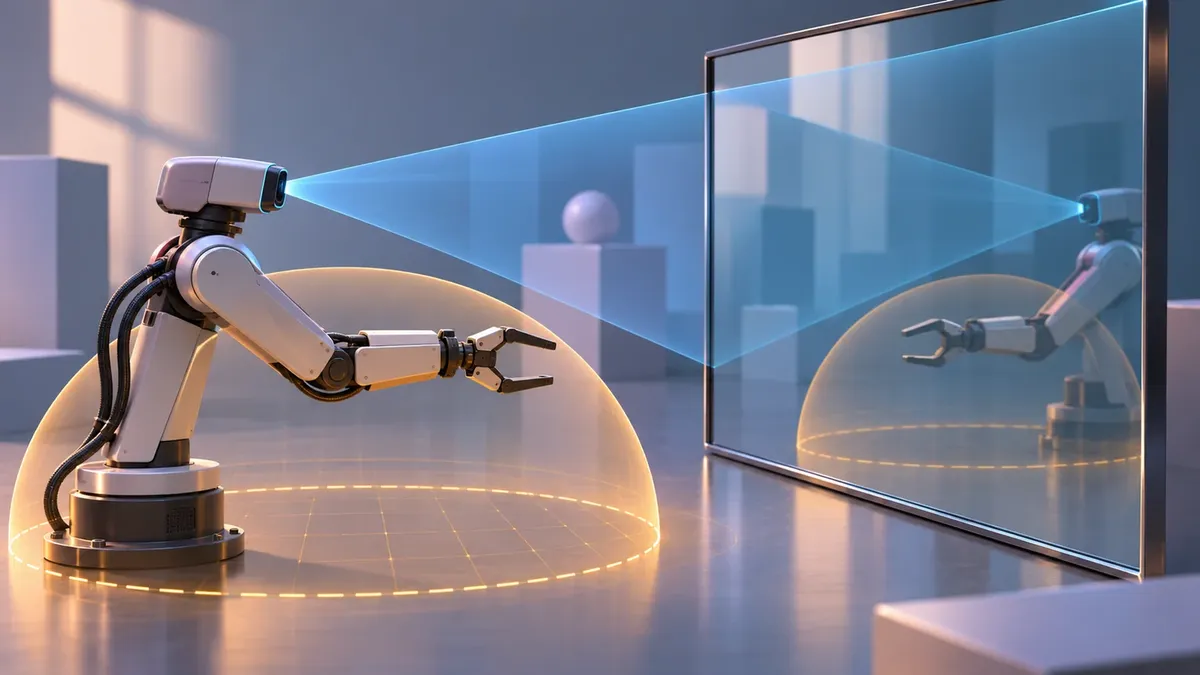
Mirrors show familiar objects at places where there is nothing to grasp. In one diagnostic, researchers blocked the main camera’s direct view of some targets while leaving their reflections visible—but wrist cameras still showed some targets directly. The study tests how robot policies act amid these competing visual cues.
A mirror presents a robot with familiar-looking objects in unfamiliar places: their reflections. Those apparent objects are not physical targets, though a reflection may provide information about a real object hidden from one camera. Can a robot manipulate real objects reliably when reflections enter its view—and can it use reflected information without acting on the reflection itself?
That is the question behind RoboDojo-Mirror, a benchmark described in the arXiv preprint “Embodied AI Fails the Mirror Test: How a Simple Mirror Breaks Robot Policies.” The animal mirror test inspired the study, but the researchers examined manipulation of external objects, not whether a robot recognizes itself.
A controlled test, plus separate diagnostics
Built on RoboDojo, the benchmark kept task goals, success criteria and policy checkpoints fixed while changing the scene. Eight tasks were tested in four conditions: no mirror, a single vertical mirror beside the workspace, two perpendicular vertical mirrors along adjacent sides of the workspace, and a mirrored tabletop. Five policies covered vision-language-action models, world-action models and a tool-using agent.
The main comparisons matched layouts and policy seeds against each policy’s own mirror-free baseline. They measure changes within each policy, not a controlled ranking between policies; execution budgets differed. For two policies—WALL-OSS and Awomo-0.5—the researchers also compared mirrors with geometrically matched non-reflective panels, but only for single- and dual-mirror scenes.
Additional grasping, pushing and target-occlusion experiments were separate diagnostics, with their own layouts, samples and budgets. The team also ran separate real-world validation experiments with π0.5 and FastWAM on a Franka robot; these were not the same five policies used in the simulation benchmark. These parts of the study address related questions, but their results should not be treated as one common experiment.
Lower success, with more than contact to explain
In the simulated main benchmark, all five policies had lower aggregate success in each mirror condition than in the no-mirror baseline. Averaged across the three mirror conditions, drops ranged from 10.8 to 56.7 percentage points across policies. For Rex-M1 Preview, the drop under the mirrored tabletop was 62.5 points. These are comparisons with each policy’s own baseline, not a universal measure of robot ability.
The panel controls help distinguish reflections from the presence of a physical obstruction. In matched tests of WALL-OSS and Awomo-0.5, mirror-only failures outnumbered panel-only failures for both policies under both tested configurations. Among mirror-specific failures in those comparisons, 50% to 87.5% occurred without recorded robot–panel contact in either the mirror or panel condition. This indicates that direct contact alone does not account for the observed difference in those tests; it does not identify the cause of every failure or establish the same pattern for all five policies.
Trajectory and contact records showed behaviors the authors interpret as consistent with phantom targeting—acting toward a reflected object—and spatial mislocalization—acting at the wrong position relative to a real object. These are interpretations of observed actions, not direct evidence of what a policy internally “believes.”
A separate mirrored-tabletop grasping diagnostic found that VPP2’s geometric empty close-and-lift rate was 0% without a mirror and 95.6% with one. Its task success in that diagnostic fell from 97.8% to 4.4%. These pooled results cover three tasks, with 45 episodes per condition for VPP2; they are not the main benchmark’s overall success rates.
In a separate pushing diagnostic, progress varied by policy and by the contour formed by an object and its reflection. The researchers measured object displacement and whether the object achieved sustained separation from its reflection. However, contour setups also differed in object pose and physical accessibility, so differences cannot be attributed to appearance alone. In a target-occlusion test, the main camera’s view of physical targets was blocked while reflections remained visible; wrist cameras still directly showed some targets. Mirror-related instructions did not consistently improve task completion in these small samples.
What the evidence can—and cannot—show
The real-world tests used four tasks and 10 trials per task and condition. Aggregate success was lower under both mirror conditions than without mirrors: π0.5 went from 77.5% to 52.5% with an upright mirror and 27.5% with a mirrored tabletop; FastWAM went from 60% to 30% and 10%. These small trials use a different setup from the simulation, so they show a similar direction of change, not a directly comparable estimate of performance.
The findings concern selected policies, tasks, camera arrangements and mirror setups. Results varied across policies and diagnostics, and the experiments do not establish one mechanism for every failure. The paper is an arXiv preprint and may not have undergone peer review. Its results are best read as a controlled evaluation of particular systems, not a verdict on embodied AI as a whole. They nevertheless make a case for testing whether robots can distinguish visual evidence from actionable physical space—including when reflections may help locate an occluded real target.
- robotics
- embodied AI
- robot manipulation
- mirror reflections
- RoboDojo-Mirror
- robot evaluation
Related reading
Automatically matched by shared topic keywords. These links do not imply that the sources agree or establish a consensus.
WorldFlow predicts motion in both pixels and 3D
Source published
Shared keywords: embodied ai
Why computer-savvy AI struggles with a real keyboard
Source published
Shared keywords: embodied ai, robot manipulation
Why a robot’s interface can matter as much as its AI
Source published
Shared keywords: embodied ai, robot manipulation
How MAWAM helps robot teams act together
Source published
Shared keywords: robot manipulation
How Robot Memory Can Guide the Next Move
Source published
Shared keywords: robot manipulation