TRANSMISSION // 2611.33002v1
Long-period eclipsing binaries reveal messy stellar lives
Source published
Archival observations offer clues to three interacting binaries, but uncertain mass ratios, sparse velocity data and faint companions leave their histories unresolved.
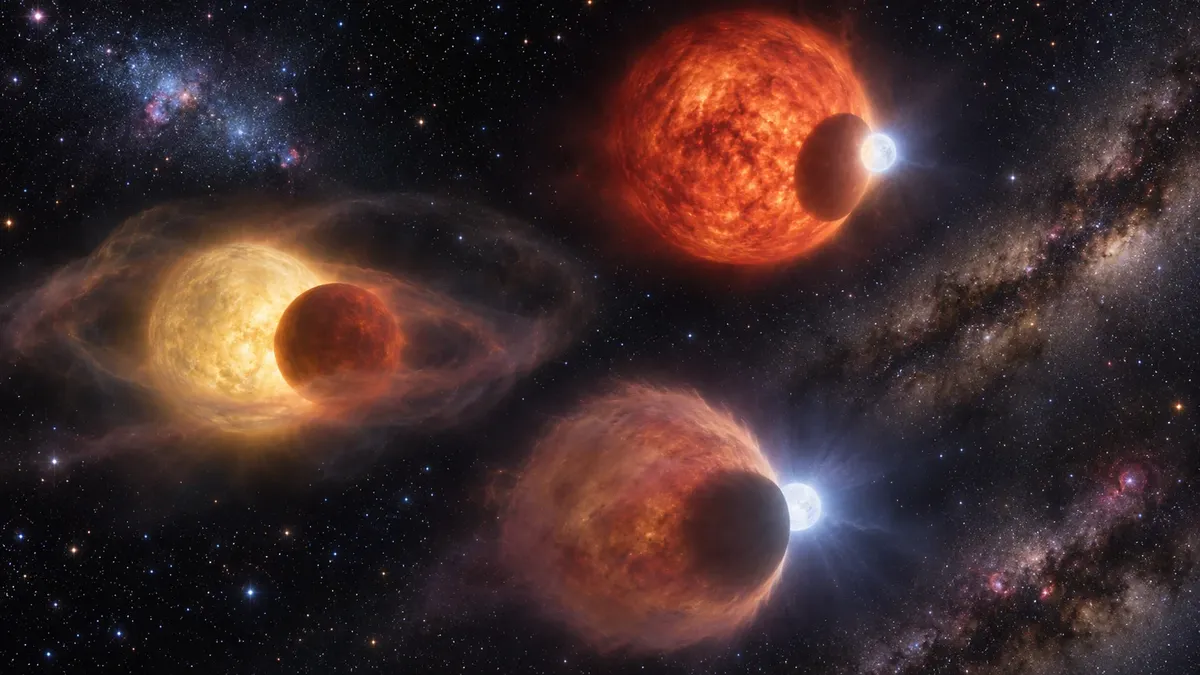
Three eclipsing binaries—with orbital periods of 158 to 456 days—may offer clues to how evolved stars exchange material. Two are in the Small Magellanic Cloud and one is in the Milky Way. Their light and infrared emission suggest complicated systems, but important details remain uncertain.
Stars in pairs can exchange material as they evolve. But what happens when a binary’s components are already evolved, and take hundreds of days to complete an orbit? T. J. Davidge examines three systems that may help address this question: SMC004701 and SMC005609 in the Small Magellanic Cloud (SMC), and PW Pup in the Milky Way.
An eclipsing binary is a pair whose orbit carries one star in front of the other from our viewpoint. The resulting dips in brightness—the light curve—can reveal clues about the stars’ sizes, temperatures and orbital geometry. The periods of these systems are 346, 456 and 158 days, respectively. The paper identifies evolved primaries in SMC004701 and PW Pup; the evidence for the evolutionary state of SMC005609 is less conclusive.
Comparing observations at different wavelengths
The study analyzes archival observations, not a new observing campaign. For the SMC binaries, it uses visible-light measurements from the OGLE and MACHO surveys and infrared data from WISE and NEOWISE. For PW Pup, it examines previously published visible-light observations and survey data.
Davidge models the light curves with PHOEBE, a software package for simulating binary-star brightness. Since the mass ratios are not known, the analysis tests several possible values rather than claiming one definitive solution. Infrared observations provide additional clues because cooler stars and surrounding material can contribute light at these wavelengths.
The paper does not present new spectroscopy of the three systems. Instead, it uses sparse, indirect archival radial-velocity information—measurements of motion toward or away from Earth—to estimate mass functions for SMC004701 and PW Pup. Those estimates offer constraints, but they are not a complete account of either system’s orbit or both stars’ masses.
Clues to interaction, with competing explanations
The light-curve models place the stars near the regions where their gravity dominates, called Roche lobes. This is consistent with past or ongoing mass exchange. Hα, a hydrogen emission line, has been reported in all three systems. Cycle-to-cycle changes in visible brightness are noted for SMC004701 and PW Pup. These features are suggestive of interaction, but none alone establishes exactly what is happening or when material moved between the stars.
The two SMC binaries show excess infrared emission. At longer infrared wavelengths, their overall energy distributions resemble those of isolated cool giants in the SMC. That similarity makes it difficult to attribute all the excess to a disk produced by mass transfer; some could come from a cool stellar companion. For SMC004701, changes in infrared color over the orbit suggest that at least some warm emission may be unevenly distributed. The same behavior is not evident in SMC005609.
Using the archival velocity data, the paper reports preliminary lower limits on the secondary masses: 3.8 ± 0.8 times the Sun’s mass for SMC004701 and 3.2 ± 0.3 for PW Pup. These are lower limits inferred from mass functions, not definitive measurements of the components’ masses. The broader component-mass estimates depend strongly on the uncertain mass ratio, and the paper notes that more complete velocity observations could change the inferences. It does not establish a comparable mass constraint for SMC005609.
What observations could clarify
A light curve alone often cannot determine a binary’s mass ratio: different model configurations can fit the available data. The paper therefore explores a range of possibilities and describes the resulting uncertainties as substantial. Infrared measurements also have lower image resolution than the visible observations, leaving them more vulnerable to light from unrelated sources, although the SMC targets were selected in relatively uncrowded fields.
The faint companion’s nature is unresolved. In some proposed interpretations, it could be a cool evolved star; in others, the observed light might come from a shell or disk surrounding a hotter star. These are possibilities, not confirmed structures, and the systems need not share the same configuration. For PW Pup, an unresolved third star could further affect interpretations of its light and masses.
More complete, high-resolution spectroscopy and infrared observations across the orbit could help reveal the companions’ motions and distinguish stellar light from surrounding material. Until then, the study provides clues rather than a settled reconstruction of how these binaries formed or will evolve.
This article is based on an arXiv preprint. The available source does not establish its peer-review status; its conclusions and interpretations should be read as preliminary.
- eclipsing binaries
- stellar evolution
- mass transfer
- Small Magellanic Cloud
- infrared astronomy
- radial velocity
Reviewed cross-references
These connections were reviewed by a model, not independently fact-checked by a human. Similarity does not imply agreement; consult the original papers and the evidence below.
FASTT 1558: A Close Pair Testing Binary-Star Evolution
Shared method: Both studies model photometric light curves to constrain binary-star properties: the origin examines visible and mid-infrared light-curve elements across mass ratios, while Baruah et al. use PHOEBE to model FASTT 1558. The systems and modeling setups differ, so this is a methodological connection, not evidence that their evolutionary conclusions agree.
Model review: · openai-codex/gpt-6-luna
Evidence and provenance
Selected excerpts, not complete papers. PDF extraction can omit figures or damage equations, tables and reading order; sources may be preprints.
2611.33002v1 — Original paper
Excerpt reference:
static/papers/2611.33002v1.md:1395-1435
Basis: Paper text
Source SHA-256:49385809f3d40d0b6edc454957cfb2968a4cdc2d5484caf0f2dac24aeea9efec2611.32296v1 — Original paper
Excerpt reference:
static/papers/2611.32296v1.md:12-62
Basis: Paper text
Source SHA-256:8141cd0a70cfba4740cae531f19859d51f00d9ab634b0d695378222fdddf430d
Related reading
Automatically matched by shared topic keywords. These links do not imply that the sources agree or establish a consensus.
FASTT 1558: A Close Pair Testing Binary-Star Evolution
Source published
Shared keywords: mass transfer
Four stars put stellar models to the test
Source published
Shared keywords: eclipsing binaries, stellar evolution
Two lithium-rich dwarfs pose a puzzle in M 4
Source published
Shared keywords: stellar evolution
Three kinds of observations refine the orbit and masses of V819 Herculis
Source published
Shared keywords: eclipsing binaries, radial velocity
How a star feeds a black-hole binary
Source published
Shared keywords: mass transfer, stellar evolution