TRANSMISSION // 2611.32978v1
Listening to the Sun at Multiple Frequencies
Source published
A simulation-tested method uses frequency-specific sound-wave travel times to infer solar circulation, recovering key flow patterns while exposing important uncertainties.
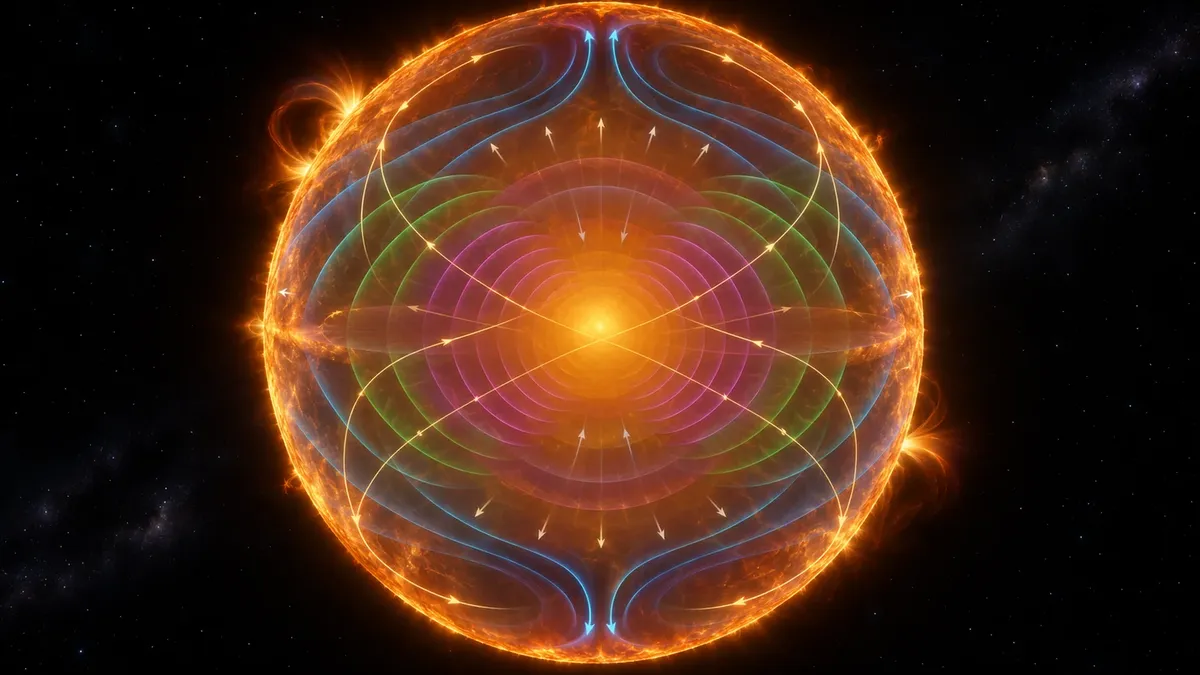
Inside the Sun, large-scale flows help redistribute magnetic fields and angular momentum. A new helioseismology method aims to map those flows by keeping information that standard measurements often average away: how the waves’ travel times vary with frequency.
Why listen at more than one frequency?
The Sun’s outer layers continually generate sound waves. As those waves travel through the solar interior, flows can slightly change how long they take to reach different points on the surface. In time-distance helioseismology, researchers use these travel-time shifts to infer motion beneath the surface.
One important target is meridional circulation: large-scale flows that move in the north–south direction, alongside weaker inward or outward motion. These flows matter for understanding how the Sun transports magnetic flux and redistributes angular momentum. But the signals from deep flows are difficult to isolate, and the Sun’s internal circulation remains challenging to map.
The usual approach often combines waves across a broad range of frequencies into a single travel-time measurement for each observing geometry. Hartlep and Zhao argue that this can discard useful information: waves at different frequencies sample the solar interior differently. Their study develops a way to use frequency-specific measurements and sensitivity kernels—the mathematical maps that describe how motion in different places affects a measured travel time.
Building and testing the method
The researchers derived kernels from three-dimensional simulations of wave propagation on a global scale, refining earlier calculations and extending them to include radial flows as well as horizontal flows. They examined three frequency bands centered at 3, 4 and 5 millihertz. Higher-frequency kernels have more tightly spaced structures and more confined regions of sensitivity, suggesting the potential for finer spatial detail.
To test the inversion, the team used simulated wavefields with prescribed circulation patterns. One model had a single circulation cell in each hemisphere; another had two. The simulations produced synthetic surface observations, from which the researchers measured wave travel-time shifts. They then used an iterative, regularized least-squares method to estimate the flows that could have produced those shifts. Regularization helps stabilize this underdetermined problem, but it also smooths the answer and can bias the inferred flow.
The tests were designed to check recovery under controlled conditions, not to measure the Sun’s actual circulation. The prescribed flows were strengthened in the simulations to improve the signal relative to noise, and the study used numerical models rather than observational data.
What the tests found
In the synthetic tests, the method recovered many features of the supplied circulation patterns, including the locations of flow reversals. For the single-cell model, the reversal was recovered to within about 4 megameters; for the double-cell model, the reported differences were about 1–7 megameters, depending on latitude. When the researchers enforced mass conservation—requiring the modeled flow to conserve mass—the method also recovered the sign and approximate strength of the much weaker radial flow in the single-cell test.
Using multiple frequencies together was not an uncomplicated improvement. Higher-frequency measurements were noisier and needed stronger smoothing. In a joint inversion, the model’s predicted measurements did not fit within the expected noise level under the study’s initial noise assumptions. The authors attribute much of this mismatch to uncertainty in the sensitivity kernels, which that noise model did not include. Adding a constant extra uncertainty made the fit consistent with the chosen regularization, but the authors describe this as a crude adjustment; the systematic errors may vary with frequency.
The inversions also had limitations in where they could reliably resolve flows. The shortest travel distances were excluded because the simulations did not resolve the associated waves well enough. Regularization produced discrepancies near the surface, and broad averaging kernels—maps of how the inferred flow blends information from surrounding regions—limited recovery near the bottom of the modeled domain. Higher frequencies may offer finer spatial sensitivity, but their lower signal-to-noise ratio makes that advantage harder to use.
What remains uncertain
This is a methodological demonstration on synthetic data, not evidence that the method has resolved the Sun’s real deep circulation. The paper notes that real observations contain additional systematic effects, including center-to-limb variations, that this work does not address. Its uncertainty estimates cover propagated random noise but not all regularization bias or uncertainty in the kernels. The authors propose more realistic, potentially frequency-dependent and correlated error models as next steps.
The work is presented as a draft preprint. It has not necessarily undergone peer review, and the results should be treated as an approach tested in simulations rather than a settled measurement of solar structure. The central promise is narrower: frequency-resolved wave travel times may provide a useful additional route to studying solar flows, provided their noise and systematic uncertainties can be better characterized.
- helioseismology
- solar meridional circulation
- solar interior
- sensitivity kernels
- wave propagation
- synthetic data
Related reading
Automatically matched by shared topic keywords. These links do not imply that the sources agree or establish a consensus.
How BOOST Weighs Synthetic AI Training Data
Source published
Shared keywords: synthetic data
More varied examples may help AI agents call tools
Source published
Shared keywords: synthetic data
Teaching Robots Through Verified Synthetic Touch
Source published
Shared keywords: synthetic data
Can synthetic brain data make image decoding more efficient?
Source published
Shared keywords: synthetic data
AI claims-analysis preprint tests policy citations and privacy safeguards on synthetic data
Source published
Shared keywords: synthetic data