TRANSMISSION // 2611.32963v1
An AI Scheduler Takes the Blanco Telescope for a Test
Source published
A scheduler trained on six years of expert-algorithm schedules controlled the Blanco telescope for one half-night. Simulations showed a data-quality gap, and wider performance remains uncertain.
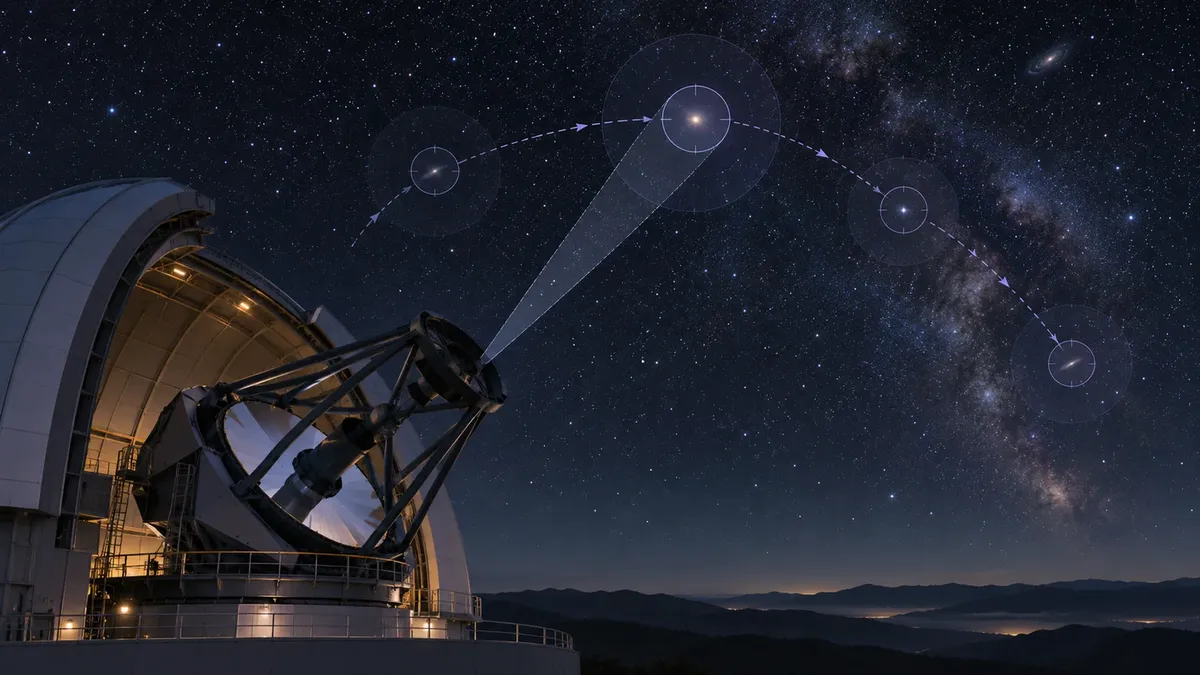
Choosing a telescope’s next target means balancing sky conditions, travel time between pointings and survey goals. Researchers trained a model to imitate past schedules generated by an expert-designed algorithm, then tested it in simulations and on the 4-m Blanco Telescope. Its first real-time run broadly matched offline expectations, while simulated nights showed a gradual data-quality decline compared with the archived schedule.
Teaching a telescope by example
A telescope scheduler must decide not only what to observe, but when. Targets rise and set, and each pointing affects which observations remain possible later. Expert-designed schedulers use rules and models to balance conditions and survey goals. Could a machine-learning system instead learn scheduling behavior from past observations—and operate a major telescope in real time?
Rachel Hur and colleagues trained a model using behavior cloning, a method that learns to imitate decisions in examples. Its training data came from six years of Dark Energy Survey observations with the Dark Energy Camera on the NSF’s Victor M. Blanco 4-m Telescope in Chile. The archived schedules were generated and executed by obstac, an expert-designed scheduling algorithm; they were not simply a record of individual human choices. The model was not given obstac’s scheduling rules or an explicit reward defining the scientifically best schedule. Instead, it learned from archival state–action pairs: records of the observing situation and the action selected in that situation. The state included environmental information, survey progress and features describing candidate actions.
The researchers split the data by observing night into training, validation and test sets, reducing the chance that closely related decisions from one night appeared in both training and evaluation. They assessed the scheduler in three stages: predicting actions in situations drawn from archived schedules, running closed-loop simulations in which its own choices shaped later states, and controlling the telescope with real-time feedback.
Similar snapshots, different sequences
On held-out archived states, the model reproduced several features of the schedule, including the distributions of airmass and Moon separation. Airmass describes how much atmosphere a target’s light passes through; larger values generally mean a lower target in the sky. The model matched the archived filter choice 61.4% of the time. Exact agreement was not the only useful measure: nearby pointings or different filters could be reasonable alternatives under similar conditions.
The picture changed when the model made a sequence of decisions in offline, closed-loop rollouts across test nights. The researchers estimated a data-quality metric called effective exposure time, or teff, from measured conditions including seeing, sky brightness and atmospheric transmission. On average, the model’s per-exposure teff was 6.9% ± 3.4% lower than the archived scheduler’s in these rollouts. The gap grew as simulated nights progressed, reaching about 13% toward their ends. The model also drifted toward targets that were setting, meaning it observed at higher airmass.
The authors suggest that small imitation errors may compound: a preference for short moves between targets could keep the telescope following a region of sky as it sets, rather than repositioning as the archived scheduler did. This is a proposed explanation, not a demonstrated cause. The rollout results also depend on a simulator and reconstructed data-quality estimates. For that reconstruction, the team assumed clouds were uniform across the sky; the estimate therefore would not reflect local differences in cloud cover.
One real-time observing run
The team deployed the model autonomously during the second half of a night on June 24, 2026. Over 5.2 hours, it scheduled 149 exposures in four filters. Their average teff was 0.75, with a standard deviation of 0.26. For that observing period, the authors found no additional performance loss compared with an offline replay using the same night’s measured seeing trajectory. The offline replay observed the same number of fields and observed 92% of the field–filter pairs that were observed on-sky.
This agreement suggests that offline evaluation was a useful guide for that particular run. It does not erase the lower quality seen in closed-loop comparisons with the archived scheduler, or establish how the model would perform on other nights. The deployment was a single half-night in good weather; the authors say more observing across nights, seasons and weather conditions is needed.
The metric also captures only part of scientific value. The paper notes that uniform depth across the survey and balance among filters matter too. The model’s actions were drawn from sky bins roughly the size of the camera’s field of view, without information about neighboring fields—information that could help plan a more effective tiling pattern.
This is a real-world demonstration, not evidence that an imitation-trained scheduler is ready to replace existing systems. It establishes a baseline for future work, including reinforcement-learning methods trained on archival schedules supplemented with simulated alternative trajectories. The paper was presented at the 2026 Workshop on Machine Learning for the Physical Sciences. Its conclusions should be read in light of the single on-sky run and the stated modeling constraints.
- telescope scheduling
- Blanco Telescope
- behavior cloning
- autonomous astronomy
- Dark Energy Survey
- machine learning
Related reading
Automatically matched by shared topic keywords. These links do not imply that the sources agree or establish a consensus.
DES Year 6 tests the cosmic picture
Source published
Shared keywords: dark energy survey
DES cosmic shear sharpens a view of matter
Source published
Shared keywords: dark energy survey
Who Triggered the Sensor? Tracking Shared Homes Without Cameras
Source published
Shared keywords: behavior cloning
Galaxy Distortions Put Limits on Giant Primordial Black Holes
Source published
Shared keywords: dark energy survey
How Supernova Colors Could Reveal Intergalactic Dust
Source published
Shared keywords: dark energy survey