TRANSMISSION // 2611.32938v1
How Lembas Shares a Token Budget Across Video Evidence
Source published
Lembas allocates a limited token budget across retrieved video frames and subtitles. In benchmark tests, the authors report higher accuracy in many comparisons and fewer TFLOPs for multi-turn questions, with important limits to the results.
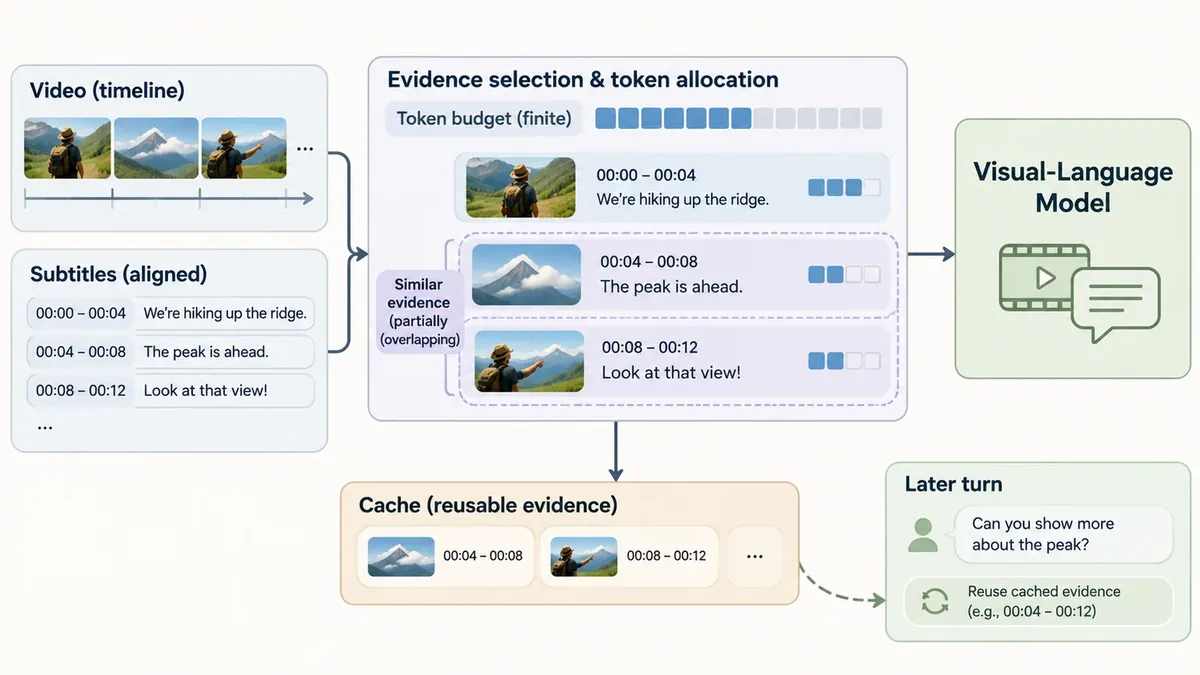
Long videos contain more visual and spoken information than a vision-language model can conveniently process all at once. A new preprint asks how to divide a token budget among evidence found by a retrieval system—and whether that evidence can be reused as questions continue.
When an AI is asked about a long video, it usually cannot examine every frame in detail. Retrieval systems narrow the search to promising frames or subtitle passages, but then face another decision: how many tokens should each selected piece of evidence receive? Giving every item the same number may spend tokens on repetitive or already-clear material.
A preprint by Ayush Barik, Fan Lai and Francis Y. Yan introduces Lembas, a framework for allocating tokens. It works after an existing video retrieval system has produced candidate frames and subtitle segments. Rather than replacing retrieval, Lembas chooses how many visual or text tokens to retain from each candidate before a vision-language model (VLM) answers a question. The token budget is distinct from the compute measured in the experiments, which the authors report separately in TFLOPs.
More evidence is not always equally useful
The method starts from two ideas. First, extra tokens can have diminishing returns: adding detail to a frame may help, but each additional token may contribute less than the previous one. Second, similar evidence can overlap. Lembas discounts redundancy among frames and, separately, among subtitles; it does not compare frames directly with subtitles for this purpose.
Its allocation objective combines query relevance, diminishing token value and within-modality similarity. An algorithm called iterative water-filling repeatedly updates how the shared budget is divided. The authors prove convergence to the global optimum of a continuous relaxation of the objective. Because a real VLM uses whole tokens, Lembas rounds the resulting allocation down; the continuous guarantee does not establish that this rounded, discrete allocation is globally optimal.
The researchers estimate token value by testing different token counts on held-out video-question-answering data and fitting a saturating function. For each frame, visual tokens are ranked offline, independently of the query, using last-layer vision-encoder attention summed across heads; Lembas retains the highest-ranked tokens up to the chosen count. In multi-turn conversations, it can prefill only tokens missing from the model’s existing cache. It also uses attention from the new query to cached evidence to refine relevance, without an additional VLM call for that update.
Benchmark results
The team evaluated Lembas with Qwen3-VL-8B and InternVL3.5-4B on MLVU, LongVideoBench and Video-MME, using multiple-choice questions. Comparisons included uniform frame sampling and several frame-selection or token-allocation methods, across embedding-based and graph-based retrieval pipelines. The authors controlled inference compute for the reported comparisons and counted auxiliary model calls. Offline indexing and token ranking were excluded because they are performed once per video and shared across queries.
The authors report that Lembas achieved the highest overall accuracy among the compared methods on all three single-turn benchmarks with both backbones. Against Top-K retrieval, reported gains ranged from 0.5 to 4.2 percentage points, depending on benchmark and model. There is a specific exception when Lembas is integrated with VideoRAG: accuracy rose on MLVU and Video-MME but fell by 0.7 percentage points on LongVideoBench.
For multi-turn testing, the researchers used MT-Video-Bench, which contains open-ended video conversations. They report accuracy 0.3–1.5 percentage points higher than the compared methods while using 1.7–17.3 times fewer TFLOPs. These ranges cover reported comparisons, not every possible setting. Responses were scored by an LLM judge against an answer checklist, so the accuracy measure has that limitation.
Ablations show how components performed in the tested settings. On Video-MME, removing subtitle allocation reduced overall accuracy by 3.6 points; removing the redundancy term reduced it by 0.7 points. In multi-turn experiments, disabling incremental allocation increased compute from 275 to 687 TFLOPs, while accuracy increased slightly. This demonstrates a compute trade-off in that ablation, but does not by itself isolate every source of the overall multi-turn savings.
What the results do—and do not—show
These are benchmark results for particular models, datasets, retrieval setups and token budgets. They do not establish that Lembas will improve every video task or production system. As an editorial caveat, performance in a new setting could depend on how well retrieval scores, similarity estimates and fitted token-value functions suit its data. The authors note that token-value parameters can be refitted if query distributions shift.
The compute accounting also matters: excluding one-time indexing and token ranking may fit repeated use, but total costs could differ when videos are rarely queried or preprocessing must be repeated. Multi-turn savings depend on opportunities to reuse cached evidence.
The source is an arXiv preprint, a publicly posted research manuscript that may not have undergone peer review. The findings here are the authors’ reported experimental results, not independent confirmation. Broader testing will be needed to establish how reliably the approach transfers beyond the evaluated benchmarks.
- video understanding
- retrieval-augmented generation
- vision-language models
- token allocation
- Lembas
- AI efficiency
Reviewed cross-references
These connections were reviewed by a model, not independently fact-checked by a human. Similarity does not imply agreement; consult the original papers and the evidence below.
AdaAlloc helps video AI decide where to look closely
Supporting evidence: Both papers report accuracy gains from allocating visual-token budgets rather than relying on uniform sampling: Lembas reports gains over baselines at comparable compute, while AdaAlloc reports gains over budget-matched uniform sampling. This supports the bounded claim that adaptive allocation can help on the evaluated long-video QA tasks; the methods, backbones, and evaluation protocols differ, so the results are not a direct head-to-head comparison.
Model review: · openai-codex/gpt-6-luna
Evidence and provenance
Selected excerpts, not complete papers. PDF extraction can omit figures or damage equations, tables and reading order; sources may be preprints.
2611.32938v1 — Original paper
Excerpt reference:
static/papers/2611.32938v1.md:190-256
Basis: Paper text
Source SHA-256:b02f4671b4d0c88dfecdb8c6bccb1bc6d197145e84e6e7713e71d802dbd2d4fd2611.09092v1 — Original paper
Excerpt reference:
static/papers/2611.09092v1.md:398-460
Basis: Paper text
Source SHA-256:f0ee21807145c542d29097ba5e2be07fabd814eb18746c9322c4b590c6c04952
Related reading
Automatically matched by shared topic keywords. These links do not imply that the sources agree or establish a consensus.
VoluCompose compresses medical scans for AI while preserving benchmark performance
Source published
Shared keywords: ai efficiency, vision language models
FP-Prune: Choosing Visual Tokens by What They Add
Source published
Shared keywords: ai efficiency, vision language models
Can a large vision model use a smaller model’s visual memory?
Source published
Shared keywords: ai efficiency, vision language models
ScopeAct divides smartphone tasks between AI models
Source published
Shared keywords: ai efficiency, vision language models
How VTree builds a reusable memory of long videos
Source published
Shared keywords: vision language models