TRANSMISSION // 2611.32923v1
A Fourier neural network tries to recover Shor’s signal from quantum noise
Source published
A theory-guided neural network improved Shor order estimates in simulations and tests on IBM processors, but the results are limited to small circuit families.
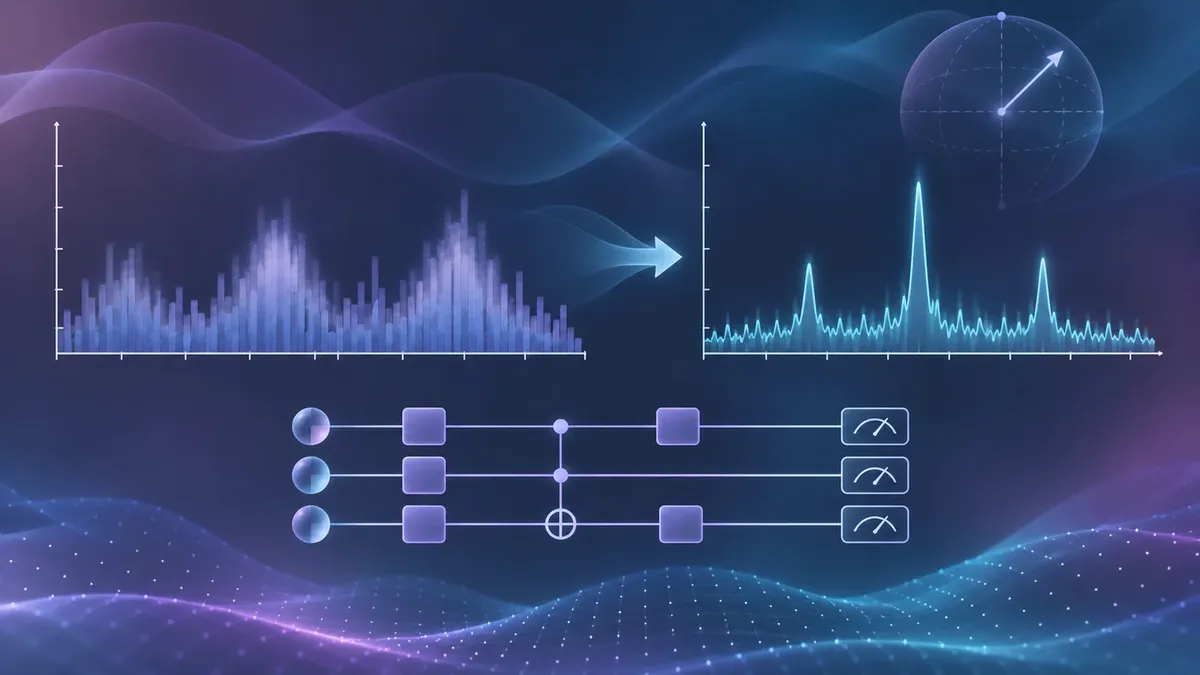
Shor’s order-finding algorithm leaves a repeating pattern in its measurement results. Noise can blur that pattern without necessarily erasing it. Researchers report a method that uses the algorithm’s expected structure and a Fourier neural network to infer the hidden order from noisy measurements.
The signal hidden in noisy measurements
Shor’s factoring algorithm relies on a quantum subroutine called order finding. In simplified terms, the subroutine looks for the period of a repeating sequence of modular arithmetic. Its measurements ideally form a series of peaks, and the spacing between those peaks carries information about the period, or “order.”
Real quantum circuits are noisy. Errors can weaken or spread the peaks, and measurement errors can mix up recorded outcomes. The central question in this study is whether the expected pattern can still help recover the order when noise makes it hard to see.
The authors propose a form of quantum error mitigation: a classical post-processing method that uses noisy circuit measurements to estimate what an ideal circuit would have produced. Rather than trying to correct individual physical errors, their approach uses known properties of the algorithm’s output to constrain the reconstruction.
How the method works
The researchers model several ways errors can alter the measurement pattern: faults in modular arithmetic, phase errors associated with the inverse quantum Fourier transform, and readout errors. Those models guide the creation of synthetic training examples as well as the design of a Fourier neural operator (FNO), a neural network that processes patterns using Fourier components.
For each possible order, the method has an ideal reference distribution: the pattern expected if that order were correct. It compares those references with measurements from three separate executions of the same circuit. The network adjusts the resulting candidate-order scores, learning which spectral features may have been weakened by noise and which may reflect sampling fluctuations. It then combines the ideal distributions into a weighted mixture. The weights are nonnegative and sum to one, so the reconstructed result is a valid probability distribution.
The team tested the approach first on simulated general modular-exponentiation circuits. The test set contained 1,351 examples, separated from training by circuit configuration. They also tested a separate model, trained and calibrated using simulations, on 101 Mersenne rotation circuits run across five IBM quantum processors. This hardware test used a specialized, shallower circuit family; it is not a test of general modular exponentiation on hardware.
What improved—and what did not
Across the simulated test cases, exact order recovery rose from 19% with the raw measurement-based decoder to 34% with the neural method. The median Jensen–Shannon divergence—a measure of how different two probability distributions are—fell from 0.64 to 0.32 compared with the ideal reference. A lower divergence indicates a closer match, but does not by itself mean the correct order was identified.
The improvement was not universal. At the largest tested precision-register size, the method recovered the exact order in only 22% of cases; most examples at that size remained incorrect for both approaches. Some previously correct predictions were also spoiled, although the paper reports that such cases were fewer than the predictions recovered overall.
On the IBM processor data, the abstract reports 53 correct order estimates out of 101, compared with 35 for the raw decoder. The results section reports the improved rate as 52%; that percentage is consistent with rounding 53 out of 101. The hardware result is a limited improvement, not reliable recovery in every case.
Limits and next steps
The simulations test generalization to held-out circuit configurations under the same error models used for training. They do not establish performance when the noise differs substantially from those models or when the modulus is entirely unseen. The hardware evaluation concerns Mersenne rotation circuits, not general modular arithmetic, and the authors identify broader hardware tests and larger problem sizes as future work. They also note that candidate screening and substantially larger registers need further evaluation.
These findings come from an arXiv preprint, which may not have undergone peer review. The study offers evidence that algorithm-specific structure can help recover information from noisy measurements in the tested settings. It does not show that the method makes large-scale Shor factoring practical or replaces quantum error correction.
- quantum computing
- Shor algorithm
- quantum error mitigation
- Fourier neural operators
- quantum noise
- order finding
Related reading
Automatically matched by shared topic keywords. These links do not imply that the sources agree or establish a consensus.
Learning when quantum error mitigation is worth the cost
Source published
Shared keywords: quantum computing, quantum error mitigation
A small learned model tackles larger quantum circuits
Source published
Shared keywords: quantum computing, quantum error mitigation
How noise changes the best stopping point for quantum search
Source published
Shared keywords: quantum computing, quantum noise
Choosing how much noise to keep in quantum generative models
Source published
Shared keywords: quantum error mitigation
A Raman amplifier uses feedback to quiet its own quantum noise
Source published
Shared keywords: quantum noise