TRANSMISSION // 2611.32909v1
A Hidden Companion Eclipses the Be Star V1294 Aql
Source published
TESS and ground-based observations support an eclipse in V1294 Aql, constraining the companion’s mass while leaving its identity uncertain.
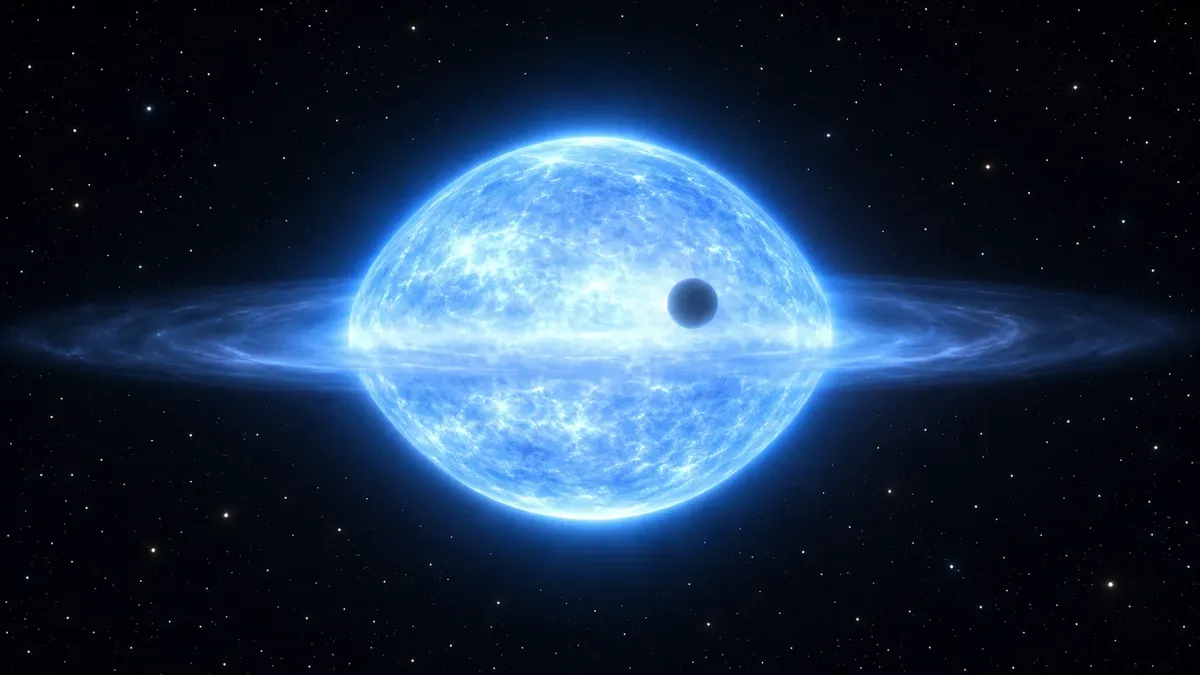
A brief dip in the light of V1294 Aql may offer a rare clue to the companion orbiting this bright, rapidly rotating star. TESS captured the event, and observations from Croatia helped confirm that it was an eclipse rather than the star’s usual variability.
A dimming with a second witness
V1294 Aql is a Be star: a hot, rapidly rotating star surrounded by a disk of gas that can change over time. It belongs to a binary system with an orbital period of about 193 days. Before this study, the companion’s properties—and the tilt of the orbit—were uncertain.
The researchers found a short-lived dimming in TESS observations from one observing sector. They checked for signs that it came from background noise, a neighboring star, or data processing. The signal was absent from the background and other stars in the field, and pixel-level analysis linked it to V1294 Aql. It also appears in light curves processed by TESS’s science pipeline.
Ground-based U, B and V-band measurements from the Hvar Observatory in Croatia provide an independent check. Hvar observations captured the same event, as well as coverage at other orbital cycles. Together, the data support the interpretation that the Be star was eclipsed by its companion.
The dip occurred close to the predicted time for the companion to pass in front of the Be star, according to an earlier schedule of the binary’s orbit. An eclipse also indicates that the orbit is oriented nearly edge-on from our viewpoint. That geometry reduces a major uncertainty in calculating the companion’s mass.
What the dip suggests about the companion
Combining the orbit’s measured motion with an estimated range for the Be star’s mass, the authors infer a companion mass of about 0.99 to 1.17 times the Sun’s mass. The roughly six-percent dip also suggests that the companion’s radius is about one-quarter of the Be star’s radius, subject to assumptions about the eclipse’s shape and the stars’ light.
That apparent size is inconsistent with a white dwarf, which would be much smaller. It also does not fit a typical hot, stripped-down subdwarf star. One possibility is a stripped star still contracting after losing material to its former companion. If it retains a hydrogen-rich outer layer, that could prolong the contraction. Alternatively, the companion could be a young, pre-main-sequence star; in that case, the pair may not have interacted through mass transfer.
These alternatives point to different histories. Many Be stars are thought to have gained rapid rotation through interactions with a companion, but the observations do not establish whether that happened in this system. The companion’s evolutionary identity remains unresolved.
Evidence, caveats and next steps
The eclipse was recorded in only one TESS sector, and the star’s own pulsations complicate the light curve. The estimated width and shape change with the method used to remove instrumental trends. The authors favor a background-subtracted light curve, which is supported by the pipeline data and Hvar observations, but the exact profile is uncertain. Their estimate of the stars’ relative sizes assumes a flat-bottomed eclipse, in which the companion passes fully across the star rather than grazing its edge.
The companion has not been directly identified. Two newer interferometric observations did not resolve it, and high-resolution ESPRESSO spectra show no clear signature from the eclipsing star. These non-detections do not determine its nature: the companion may be faint or difficult to distinguish from the bright Be star.
The spectra also reveal another star, apparently a mid- to late-type B star in a short-period binary. The authors distinguish it from the eclipsing companion, suggesting that V1294 Aql’s wider system contains at least four stars.
Further observations during predicted eclipses could better establish the event’s shape. Detecting a secondary eclipse or the companion’s spectral lines and motion would help distinguish a young star from a stripped remnant and improve the system’s measured properties.
The source is an Astronomy & Astrophysics manuscript labeled as proofs. It acknowledges a referee, but the supplied material does not establish the final publication status. The eclipse interpretation is supported by multiple observations; the proposed explanations for the companion remain possibilities rather than a definitive identification.
- V1294 Aql
- Be stars
- eclipsing binaries
- TESS
- stellar companions
- binary star evolution
Related reading
Automatically matched by shared topic keywords. These links do not imply that the sources agree or establish a consensus.
FASTT 1558: A Close Pair Testing Binary-Star Evolution
Source published
Shared keywords: binary star evolution
Three kinds of observations refine the orbit and masses of V819 Herculis
Source published
Shared keywords: eclipsing binaries
Long-period eclipsing binaries reveal messy stellar lives
Source published
Shared keywords: eclipsing binaries
A survey of 63,254 stars puts the brown dwarf desert on a relative scale
Source published
Shared keywords: stellar companions
Gaia Can Flag Unusual Stars, but Not Confirm LBVs
Source published
Shared keywords: eclipsing binaries