TRANSMISSION // 2611.32900v1
How a Robot Can Predict a Moving Target
Source published
A motion-aware world model helps robots track targets by predicting possible routes while accounting for how the robot’s own movement changes its view.
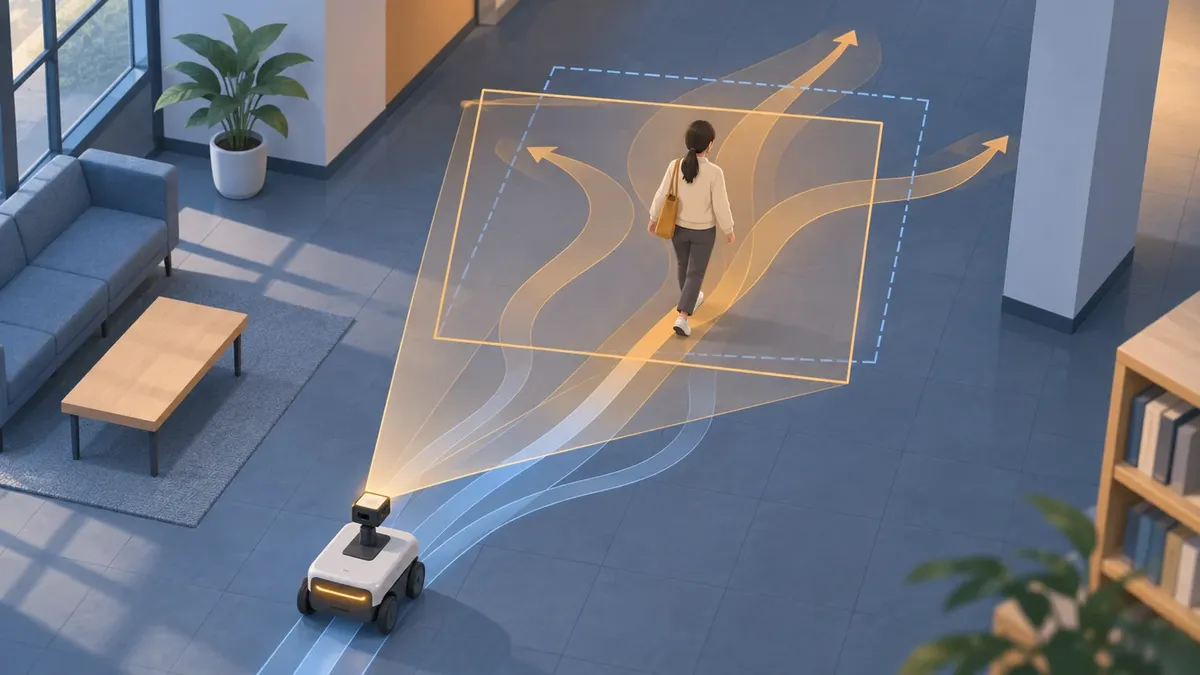
Following a person or other target is not just a matter of spotting them in each camera image. A robot must anticipate where the target may go—and distinguish that movement from changes caused by its own motion. A new preprint proposes a way to represent both.
Why tracking needs a forecast
A robot that follows a moving target has to do two things at once: estimate the target’s motion and steer itself so the target stays visible. These motions affect the camera image together. A person may turn or disappear behind an obstacle, while the robot’s own translation or rotation shifts the target’s apparent position. If a system treats each image as a fresh snapshot, it can struggle to tell what changed and what might happen next.
In a new preprint, Jiahao Zhang and colleagues propose a world model for embodied visual tracking that makes these two sources of change more explicit. A world model is a system that uses past observations and actions to predict future states. Here, the goal is to help a tracking policy use likely target motion—not only current visual cues—when choosing how to move.
Paths, progress and the robot’s viewpoint
The model’s central component, called Geometry–Progress, predicts a distribution of possible target routes and how far the target might travel along each route in one control interval. The distinction matters: a route describes where the target could go, while progress describes how far it might get. The model represents multiple possibilities and keeps route choice linked to the corresponding travel distance, rather than reducing the forecast to one future position.
It then accounts for the robot’s planned movement. The predicted target paths are transformed into the coordinate frame the robot is expected to occupy after taking an action. In plain terms, the model tries to separate the target’s movement through the scene from the camera-view changes caused by the robot itself. These motion estimates condition a transition in the model’s internal representation of the world, which is used to predict future visual features.
The system also connects those predictions to observations: during training, it is encouraged to reconstruct visual features from the next observation using the motion-conditioned transition. The full training objective combines a likelihood for the predicted path and progress, future-feature reconstruction, and supervision from expert tracking actions. The paper says path annotations, future observations and expert actions are used during training, but are not required at test time. A vision-language model supplies features from images and tracking instructions, and the system keeps a latent state summarizing visual history.
What the authors report
The authors evaluate the approach on three tracking benchmarks: EVT-Bench, Gym-UnrealCV and UnrealZoo. They report improved tracking performance and generalization across environments using a model with a 0.5-billion-parameter backbone. Their benchmark results are not uniformly best against every comparison: the paper reports that its method trails some larger models on distracted tracking, and its collision rate remains higher than that of one similarly sized baseline on some EVT-Bench tasks.
The authors also report a zero-shot deployment on a Unitree GO2 quadruped: the policy was trained in simulation and tested on the robot without additional real-world training or fine-tuning. This is evidence of a real-robot demonstration, not proof that the system is reliable across robots, locations or difficult conditions.
Ablation experiments on one EVT-Bench setting compare versions with and without probabilistic motion prediction and world-model learning. The combined version performs best on the reported success and tracking measures in that setting. This supports the authors’ claim that the components can contribute together, but a single ablation setting does not establish how much each component would help in every environment.
What remains uncertain
The results are benchmark-based and depend on the scenarios, baselines and evaluation protocols used. The paper itself identifies longer-horizon prediction, collision-aware control and better understanding of spatial relationships as future work. Those caveats matter: predicting a likely route is not the same as guaranteeing safe following, especially in cluttered scenes or during occlusion.
This article is based on the paper text supplied for the arXiv preprint, rather than an independent replication or a review of all supporting materials. The work has not been established here as peer reviewed. Its reported improvements and robot demonstration should therefore be read as the authors’ findings, not as settled evidence of general real-world performance.
- robotics
- embodied visual tracking
- world models
- motion prediction
- robot learning
Reviewed cross-references
These connections were reviewed by a model, not independently fact-checked by a human. Similarity does not imply agreement; consult the original papers and the evidence below.
A smoother way for robot AI to imagine what actions do
Supporting evidence: Both papers report benefits from making motion-related dynamics explicit in predictive models: the tracking study reports improved tracking and generalization with probabilistic target-motion cues, while ActField reports improved visual prediction and action-induced motion prediction using continuous-time latent dynamics. These results support a limited claim that structured dynamics can help prediction in the tested tasks; they are not a direct comparison, and the models, tasks, and evaluation measures differ.
Model review: · openai-codex/gpt-6-luna
Evidence and provenance
Selected excerpts, not complete papers. PDF extraction can omit figures or damage equations, tables and reading order; sources may be preprints.
2611.32900v1 — Original paper
Excerpt reference:
static/papers/2611.32900v1.md:828-877
Basis: Paper text
Source SHA-256:9781409fa8a0e0c93f1cc41b76866c15d2262693f99b94d40624133979eb40cd2611.30659v1 — Original paper
Excerpt reference:
static/papers/2611.30659v1.md:494-582
Basis: Paper text
Source SHA-256:bc3668b4bc2ae6a3cb9070dc57a1d0712d3c94932413f13ad732f6bc6ff686c9
WorldFlow predicts motion in both pixels and 3D
Supporting evidence: Both studies connect explicit motion representations with visual prediction and report gains on their own evaluations: the tracking paper conditions latent transitions on predicted target motion, while WorldFlow jointly predicts video and queried 3D trajectories and reports lower displacement errors than its flow-only variant. This is compatible evidence for the bounded value of coupling motion with visual prediction, not a head-to-head comparison; the tasks and metrics differ.
Model review: · openai-codex/gpt-6-luna
Evidence and provenance
Selected excerpts, not complete papers. PDF extraction can omit figures or damage equations, tables and reading order; sources may be preprints.
2611.32900v1 — Original paper
Excerpt reference:
static/papers/2611.32900v1.md:13-83
Basis: Paper text
Source SHA-256:9781409fa8a0e0c93f1cc41b76866c15d2262693f99b94d40624133979eb40cd2610.39278v3 — Original paper
Excerpt reference:
static/papers/2610.39278v3.md:86-140
Basis: Paper text
Source SHA-256:4cce00abe647e8bfcd55fd3e7f9611ef349a0c318741a343b7a2c01f0e6669e8
Related reading
Automatically matched by shared topic keywords. These links do not imply that the sources agree or establish a consensus.
WorldFlow predicts motion in both pixels and 3D
Source published
Shared keywords: world models
A safety shield for image-based robot parking
Source published
Shared keywords: world models
Teaching robot video models to focus on what moves
Source published
Shared keywords: world models
A graph-based approach to robot world-model drift
Source published
Shared keywords: robot learning, world models
A smoother way for robot AI to imagine what actions do
Source published
Shared keywords: world models