TRANSMISSION // 2611.32885v1
Why X-ray astronomers want a wider view
Source published
IXPE opened a new window on X-ray polarization, but its 2–8 keV range misses important signals at lower and higher energies. Nicolas De Angelis reviews the science case, detector technologies and mission concepts for extending that reach—and the trade-offs that remain.
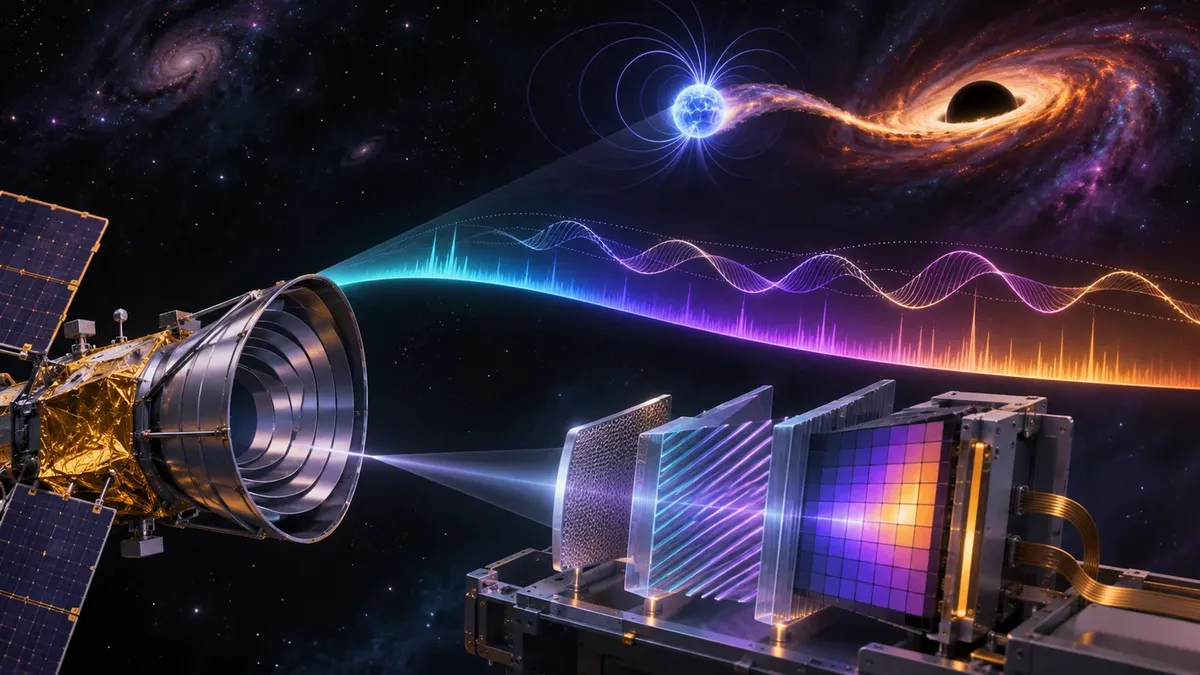
X-rays carry clues not only about how bright an object is, but also about the geometry and physics of the matter producing its light. A review by Nicolas De Angelis explores how future instruments might measure that light’s polarization across a much broader energy range than today’s leading X-ray polarimeter can cover.
A narrow window on polarized X-rays
X-ray polarization can reveal how radiation is produced and how it travels through extreme environments. Since its 2021 launch, the Imaging X-ray Polarimetry Explorer (IXPE) has measured polarization from objects including neutron stars, supernova remnants, black holes and active galaxies. But IXPE is sensitive mainly to X-rays between 2 and 8 keV (a unit of photon energy). Important signals lie outside that window.
In a review presented at a 2025 astrophysics conference, Nicolas De Angelis sets out the case for extending X-ray polarimetry to roughly 0.1–80 keV and beyond. The article surveys possible science targets, detection methods and mission concepts; it is not a report of a new observing campaign or a single instrument’s measured performance.
What the missing energy ranges could show
Below 2 keV, observations could reach the thermal X-ray emission of isolated neutron stars, magnetars and black-hole accretion discs. Measuring polarization where this emission is strongest could help constrain the shape of emitting regions and, in some cases, test how strong magnetic fields affect light. For magnetars, the role of a predicted quantum effect called vacuum birefringence remains debated; the review notes that soft-band measurements and a larger sample could provide a cleaner test.
Soft X-rays could also help trace emission from high-synchrotron-peaked blazars, galaxies with jets directed roughly toward Earth. IXPE has found polarization behavior in these sources that motivates measurements at lower energies, including whether changes across the X-ray band are smooth.
Above 8 keV, harder X-rays can help separate different sources of radiation. For example, they could better isolate reflected emission from material around black holes, investigate the hard tails of magnetars, and distinguish non-thermal emission in supernova remnants and pulsar wind nebulae. The review also highlights a longstanding uncertainty: the polarization associated with cyclotron lines in accreting pulsars has not been firmly measured, and theoretical expectations differ.
Different energies need different detectors
There is no single detector technology that works best across the whole proposed range. The review describes three main approaches, each exploiting a different interaction between X-rays and matter.
At the soft end, Bragg diffraction from carefully designed multilayers can measure polarization. The REDSoX rocket experiment and its proposed orbital successor, GOSoX, are examples of this approach. In the middle range, gas detectors can infer polarization from the direction of an electron track created when an X-ray is absorbed. New pixel readouts may record when each part of a track arrives, potentially improving its reconstruction. At higher energies, Compton polarimeters use the preferred directions of X-ray scattering events to infer polarization.
The article also discusses combining detectors in a stacked focal plane, so photons that pass through one stage can reach another tuned to a different energy range. This could increase coverage, but it makes the instrument design more demanding. Dedicated telescopes can optimize a detector for its energy band, but divide the available mirror area. Stacking can share a telescope across bands, but requires the front detector stages and their supporting materials to let enough higher-energy photons through.
Other practical constraints include background noise, imaging capability, calibration and the need to collect enough photons. Imaging can help distinguish a source from background and is important for extended objects. A detector that works well for bright, short-lived events may not be ideal for faint sources or detailed images. The review argues that overlap between neighboring energy bands could help teams check for instrumental effects as well as improve coverage.
A map of possibilities, not a guarantee
The review describes projects at different stages, from flown experiments and selected missions to proposals and concepts. It discusses REDSoX and GOSoX for soft X-rays, eXTP and other concepts for wider coverage, and POLAR-2, which is designed to combine soft-X-ray and higher-energy measurements of bright transients. These projects do not all have the same status: proposed capabilities and schedules should not be read as confirmed outcomes.
The central conclusion is that wider-band X-ray polarimetry could address questions that the 2–8 keV window cannot settle, but the path involves engineering and scientific trade-offs rather than one universal solution. The article is a conference review that synthesizes earlier studies and project plans; it does not itself demonstrate that a proposed instrument will achieve its projected sensitivity. Its discussion is therefore best read as a guide to opportunities and open design questions, not as evidence that those measurements have already been made.
- X-ray polarimetry
- IXPE
- neutron stars
- black holes
- space missions
Reviewed cross-references
These connections were reviewed by a model, not independently fact-checked by a human. Similarity does not imply agreement; consult the original papers and the evidence below.
Finding blazars worth watching in soft X-rays
Supporting evidence: Both papers motivate soft X-ray polarimetry of blazars: De Angelis identifies soft-band measurements as a way to test whether polarization behavior changes smoothly across the spectrum, while Capecchiacci et al. estimate which blazars may be detectable by GOSoX at 0.2–0.4 keV. The latter are model-based forecasts using representative spectral and polarization assumptions, not observed soft-band detections, so they complement rather than verify the proposed science case.
Model review: · openai-codex/gpt-6-luna
Evidence and provenance
Selected excerpts, not complete papers. PDF extraction can omit figures or damage equations, tables and reading order; sources may be preprints.
2611.32885v1 — Original paper
Excerpt reference:
static/papers/2611.32885v1.md:103-180
Basis: Paper text
Source SHA-256:cc5058a051f9146ad47f25041c8a0a6ac6e54c7f886978948012a7dca9b310b02611.26682v1 — Original paper
Excerpt reference:
static/papers/2611.26682v1.md:506-564
Basis: Paper text
Source SHA-256:f4d37d5ee7be1ca3acc1919024a5b1c77f2b545b3a7026e7d939e1f4075223f52611.26682v1 — Original paper
Excerpt reference:
static/papers/2611.26682v1.md:635-696
Basis: Paper text
Source SHA-256:f4d37d5ee7be1ca3acc1919024a5b1c77f2b545b3a7026e7d939e1f4075223f5
Related reading
Automatically matched by shared topic keywords. These links do not imply that the sources agree or establish a consensus.
Testing IXPE background signatures with cobalt-60
Source published
Shared keywords: x ray polarimetry
What dead stars reveal about matter, gravity and the early Universe
Source published
Shared keywords: black holes, neutron stars
Neutron star binaries may get their chance after a cluster’s black holes leave
Source published
Shared keywords: black holes, neutron stars
A transparent way to spot unusual X-ray spectra
Source published
Shared keywords: black holes, neutron stars
AI helps search for longer asteroid tours—but not by itself
Source published
Shared keywords: space missions