TRANSMISSION // 2611.32882v1
A Digital Twin That Learns a Data Center’s Power Behavior
Source published
A GPT-2-based model uses short samples from simulated electrical transients to predict data-center responses under changing loads and operating modes.
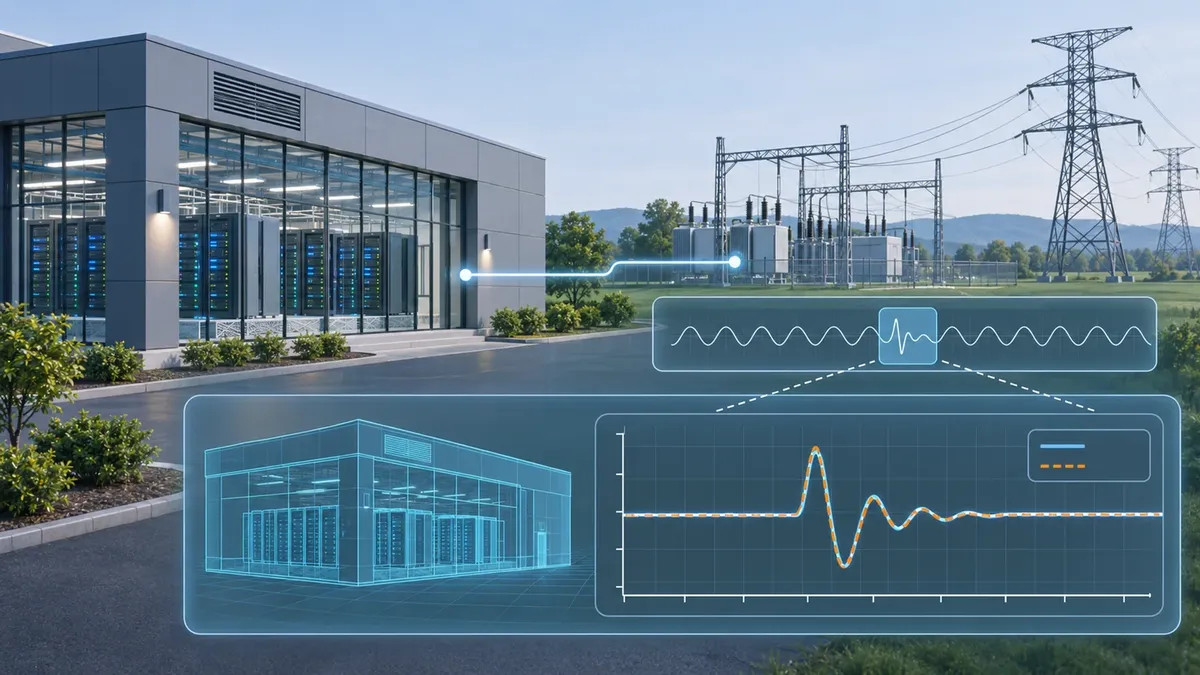
Data centers can experience fast changes in voltage and current when workloads shift or power supplies switch modes. A new preprint tests whether a digital twin can learn these responses from a small number of examples—without being retrained for each configuration.
Why predict electrical transients?
A data center is not just a collection of computers: its electrical infrastructure includes equipment such as transformers, inverters and uninterruptible power supplies. When the IT load changes abruptly, or a facility switches between grid-connected and islanded operation, voltage and current can fluctuate rapidly. These electromagnetic transients (EMTs) matter for assessing equipment behavior and power-system reliability.
Detailed EMT simulations can represent these fast changes, but running them across many possible configurations and events can take substantial computing time. A digital twin—a model that imitates a real or simulated system—could provide quicker predictions. The difficulty is that a twin trained for one configuration may not work well when the system changes.
The authors propose a way to adapt a twin at prediction time. Their central question is whether a GPT-2-based model can use a short sample of a system’s transient response to predict what happens next, even for a configuration it did not see during training.
How the study worked
The team built a detailed data-center power-system model in PSCAD, a high-fidelity EMT simulation tool. It included an upstream grid, a transformer, a battery-backed inverter, control equipment and an aggregate representation of IT load. The researchers varied system parameters to generate training data across many configurations, then held out configurations for testing.
They examined three simulated events: a sudden load change, a gradual load change, and a switch between grid-connected and islanded operation. The model predicted voltage and current waveforms at the point where the data center connects to the grid. To adapt to an unfamiliar configuration, it was given a short sequence of transient samples. The authors call this in-context learning: the model uses examples supplied as input rather than updating its parameters through retraining.
The researchers compared its predictions with three non-adaptive alternatives: an autoregressive model (ARMAX), a long short-term memory neural network (LSTM), and a physics-informed neural network (PINN). They also compared execution time with a full PSCAD simulation.
What they found
Across the three simulated scenarios, the adaptive model predicted voltage responses. For the sudden-load-change case, the paper also compares current predictions across methods; the proposed model closely followed the simulated current waveform. For the gradual-load-change case, it reported voltage errors, with the LSTM achieving a lower error on that particular configuration. In the mode-switching case, the reported cross-method comparison is for voltage: the adaptive model captured the sharp voltage transient, while the fixed-configuration baselines had larger errors. The paper does not report a corresponding cross-method current comparison for mode switching.
The authors report an average execution time of about 9.9 seconds for the adaptive model, compared with about 128 seconds for a full PSCAD simulation—roughly a 13-fold speedup in this test setup. The simpler baselines ran faster, but they were trained for a particular configuration and were not designed to adapt to new ones. The proposed model’s trade-off is adaptability with a smaller speed advantage over detailed simulation, rather than maximum speed at any cost.
What remains uncertain
These results come from computer-generated data and a modeled system, not measurements from operating data centers. The study tests three representative events within its chosen setup; it does not establish how well the method would work across the full range of real facilities, equipment, disturbances or measurement conditions. The model also needs transient samples from the new configuration before it can make predictions, so adaptation is not immediate. The authors identify reducing that delay as future work.
Some physical details were deliberately simplified. The battery is treated as having unlimited energy, and the model leaves out converter behavior inside the IT load and associated harmonics. It also assumes a strong upstream grid, so it does not test wider transmission-system effects. These boundaries limit what can be inferred from the reported accuracy and speed.
The paper is an arXiv preprint. The supplied source does not establish its peer-review status. Its results suggest that in-context learning could help build adaptable simulation surrogates, but they do not establish field readiness. Testing with real operational data and more varied system conditions will be needed to assess the approach in practice.
- data center
- digital twins
- electromagnetic transients
- in-context learning
- GPT-2
- power systems
Reviewed cross-references
These connections were reviewed by a model, not independently fact-checked by a human. Similarity does not imply agreement; consult the original papers and the evidence below.
What ICLWorld Reveals About AI Agents on Screens and Robots
Shared method: Both papers study inference-time in-context learning without parameter updates: the data-center study conditions a GPT-2 model on EMT trajectory samples to adapt predictions across configurations, while ICLWorld tests agents learning task rules from text or video. The shared method is broad; their tasks, systems, and evaluations differ, so results are not directly comparable.
Model review: · openai-codex/gpt-6-luna
Evidence and provenance
Selected excerpts, not complete papers. PDF extraction can omit figures or damage equations, tables and reading order; sources may be preprints.
2611.32882v1 — Original paper
Excerpt reference:
static/papers/2611.32882v1.md:115-181
Basis: Paper text
Source SHA-256:8c228ae427828b5e7bec93ff89b22341706b1c469ba7ae51d0a11ad9bc5dd2212611.32649v1 — Original paper
Excerpt reference:
static/papers/2611.32649v1.md:146-214
Basis: Paper text
Source SHA-256:7f551d1d27d0710b2fece4088f1aaab6af3f4b65897a58b38c7422ac99a985be
Related reading
Automatically matched by shared topic keywords. These links do not imply that the sources agree or establish a consensus.
Can statistical ‘digital twins’ help evaluate job training?
Source published
Shared keywords: digital twins
When should a digital twin be trusted—and what should it change?
Source published
Shared keywords: digital twins
Can AI World Models Help Robots Understand the Ocean?
Source published
Shared keywords: digital twins
A robot twin built from first-person video
Source published
Shared keywords: digital twins
Why Clinical AI Needs Statistical Guardrails
Source published
Shared keywords: digital twins