TRANSMISSION // 2611.32865v1
How neutron-star magnetic fields shape accretion columns
Source published
Four simulations explore how magnetic-field strength relates to accretion-column width and estimated shock height, then compare simulated geometry with values inferred from X-ray spectra.
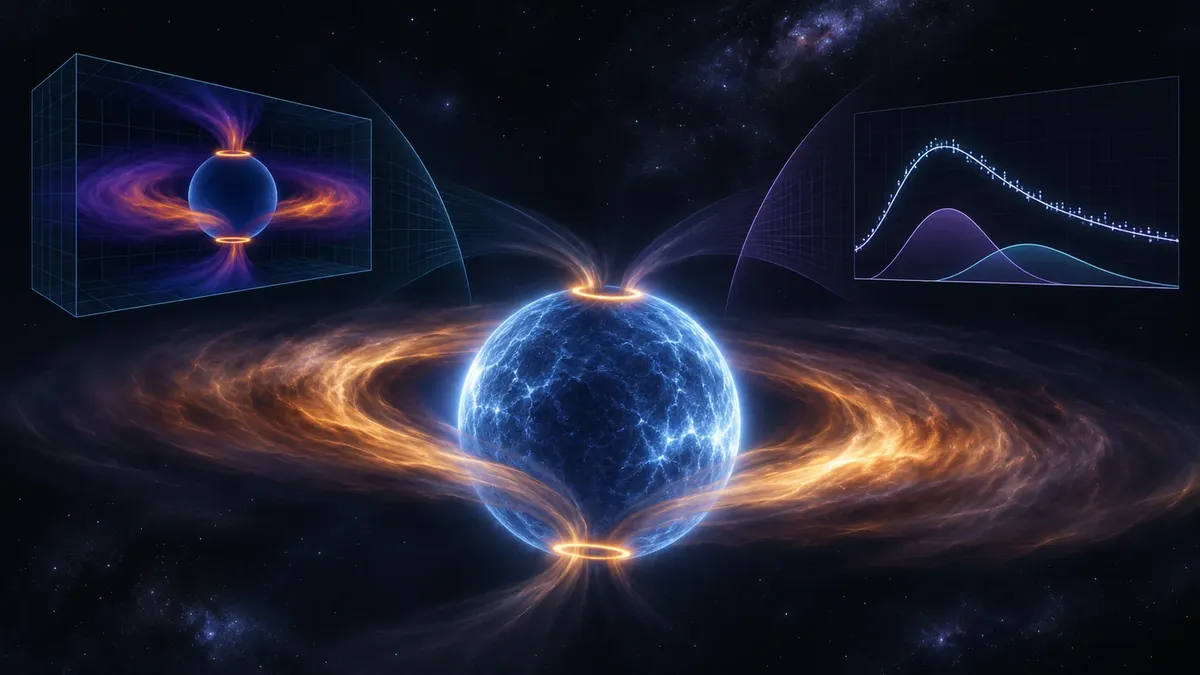
How does a neutron star’s magnetic field shape the stream of matter accreting onto it—and do simulations produce columns like those inferred from X-ray spectra? Fatemeh Kayanikhoo and Marios Kouzis investigate these questions with four relativistic simulations and a preliminary comparison with spectral-model results.
Simulating accretion columns
In some binary systems, matter accretes onto a magnetized neutron star. The magnetic field channels the flow toward the star’s poles, where radiation pressure can slow the incoming gas. The resulting column’s geometry matters because it affects how radiation travels through the flow and the X-rays that can emerge.
Kayanikhoo and Kouzis ran four axisymmetric general relativistic radiation magnetohydrodynamic simulations. These calculations track gas, radiation and magnetic fields while accounting for strong gravity. The simulated star had a mass of 1.4 times the Sun’s and a radius of about 10.3 kilometres. The models covered surface magnetic-field strengths from 3 × 10¹⁰ to 1 × 10¹¹ gauss.
The researchers measured the column’s angular width from the radiation-energy profile near the stellar surface. They estimated a characteristic radiation-shock height from the location where the inward flow decelerated most sharply, using the maximum positive gradient in its radial velocity. This is a diagnostic estimate from the simulated velocity profile, not a direct observation of a sharply defined shock boundary.
The simulations ran for about 0.35 seconds of physical time; the reported results use time-averaged data. To compare the simulated column footprints with a spectral model, the researchers also calculated an area-equivalent cylindrical radius. The simulations produce ring-like footprints, whereas the bwcycl model represents the column as a cylinder.
What changed across the models?
Across the four simulations, increasing magnetic-field strength coincided with a narrower angular column: its measured width decreased from about 0.14 to 0.07 radians. The estimated shock height increased from 1.95 to 3.89 kilometres. These are trends within this particular set of models; they do not establish that magnetic-field strength alone determines column structure in all neutron-star systems.
The area-equivalent radii ranged from 5.2 to 3.2 kilometres. Three fall in the upper part of the 0.8–4.9 kilometre range inferred from spectral fits using bwcycl. The authors suggest that a comparatively large radius inferred by the spectral model could partly reflect two narrow ring-shaped footprints represented as one filled cylinder. This is a proposed way to interpret the comparison, not a direct measurement of rings in an observed source.
The height comparison is less close. For comparison with the spectral model’s definition of the column top, the researchers used the simulated height at which the inflow reaches its maximum speed. That height was about 0.42–0.54 times the neutron star’s radius, below the roughly two or more stellar radii inferred from bwcycl fits. The definitions differ: the spectral model places the column top where the flow reaches local free-fall speed, while the simulated inflow never reaches free fall. The mismatch may therefore reflect modelling assumptions as well as differences between simulated and fitted systems.
Why the comparison is tentative
The authors describe the comparison as preliminary. The simulations and spectral fits cover different parameter ranges: the simulated accretion rates are higher and their magnetic fields lower than those of the fitted systems. The approaches also differ in geometry and treatment of radiation. And the simulations’ side-emission luminosity is not an observed isotropic luminosity, so the quantities should not be treated as equivalent.
Overall, the simulated area-equivalent radii overlap with the upper end of the spectral-model range, while the height estimates differ more substantially. The authors propose exploring other accretion rates and magnetic-field strengths, and including magnetic-opacity effects, in future simulations to test these comparisons.
This account is based on the supplied arXiv preprint. Its results come from four axisymmetric simulations, and the authors characterize the comparison with spectral fits as preliminary. The findings therefore inform a modelling question; they do not establish a universal structure for super-Eddington neutron-star accretion columns.
- neutron stars
- accretion columns
- super-Eddington accretion
- GRRMHD simulations
- X-ray astronomy
- magnetic fields
Related reading
Automatically matched by shared topic keywords. These links do not imply that the sources agree or establish a consensus.
How radiation slows matter falling onto ultraluminous pulsars
Source published
Shared keywords: accretion columns, neutron stars, x ray astronomy
A neutron star’s possible ultrafast wind remains uncertain
Source published
Shared keywords: neutron stars, x ray astronomy
Falling merger debris could fuel—and frustrate—a second cosmic jet
Source published
Shared keywords: x ray astronomy
How Magnetar Magnetic Fields May Slow Neutrino Cooling
Source published
Shared keywords: magnetic fields, neutron stars
Simple patterns emerge in models of magnetic neutron stars
Source published
Shared keywords: magnetic fields, neutron stars