TRANSMISSION // 2611.32857v1
A recombination hint fades when dark energy can evolve
Source published
A joint analysis of CMB, DESI BAO and large-scale-structure data finds that an apparent preference for earlier recombination weakens when late-time expansion can change.
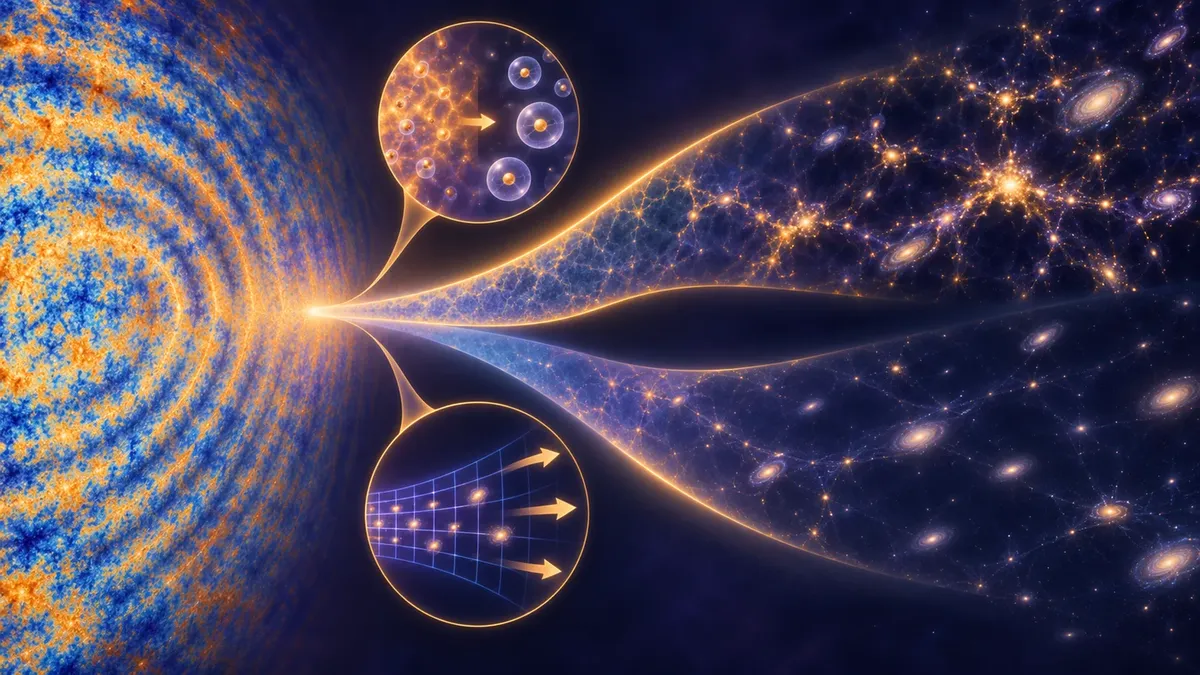
Could a mismatch between measurements of the early and recent Universe point to new recombination physics—or to evolving dark energy? A study comparing both possibilities finds that the apparent recombination signal largely disappears when dark energy is allowed to evolve. This is a model comparison, not proof that dark energy changes or that recombination is exactly standard.
The early Universe left clues that cosmologists can compare with observations today. The cosmic microwave background (CMB) is light released when the Universe became transparent, as electrons and protons combined into neutral atoms. Baryon acoustic oscillations (BAO) are a pattern in the later distribution of galaxies that acts as a cosmic distance ruler. Recent analyses found that allowing recombination to happen earlier than in the standard model can improve agreement between CMB and BAO measurements. But might that apparent signal instead reflect a change in the Universe’s later expansion, driven by dynamical dark energy?
Alexander Reeves and colleagues tested this possibility by fitting four model setups: the standard cosmological model, a flexible reconstruction of recombination, a model with evolving dark energy, and a model allowing both changes. Their recombination reconstruction used seven adjustable values for the free-electron fraction across the relevant redshift range. For dark energy, they used a two-parameter description in which its equation of state can vary over time.
The baseline analysis combined BAO measurements from DESI’s second data release with three alternative CMB datasets: Planck 2018, Planck PR4, and a combination of Atacama Cosmology Telescope data with selected Planck measurements. It also included “5 × 2-point” measurements combining galaxy clustering, CMB lensing and the integrated Sachs–Wolfe signal, which traces how changing gravitational potentials affect CMB light. In additional tests, the authors included Type Ia supernova measurements. They used neural-network emulators to speed up cosmological calculations, sampled the parameter constraints, and compared models with several statistical measures. Noiseless mock datasets helped test whether one kind of change could be mistaken for the other.
With dark energy fixed as a cosmological constant, the baseline data favored a lower free-electron fraction around the main epoch of recombination—an effect corresponding to earlier recombination. When dark energy was allowed to evolve, that preference mostly went away. In the joint model, most recombination-node means were within about one standard deviation of the standard prediction, although a positive departure remained at the highest-redshift ACT node at about two standard deviations. The dark-energy constraints changed comparatively little when the analysis also allowed recombination to vary. Adding supernova data did not change this overall pattern.
The authors’ explanation is that the two changes can partly imitate one another, but do not leave identical clues. Earlier recombination can shift the distance scale inferred from the CMB toward BAO measurements. Evolving dark energy can also shift that scale, while changing how distances vary with redshift. The authors point to DESI’s measurements of the ratio of transverse to radial distances as a way to distinguish the possibilities.
The mock-data tests illustrate this difference. When the researchers generated mock observations from a universe with evolving dark energy but standard recombination, fitting modified recombination alone produced an apparent earlier-recombination signal. But for the P-ACT mock, that fit still had a total mismatch of Δχ² = 4.58, including 3.82 from BAO. In the reverse test, a mock with modified recombination did not produce a false preference for evolving dark energy. Instead, the dark-energy-only fit missed features in the CMB, with a P-ACT mismatch of Δχ² = 9.94.
Model comparisons favor evolving dark energy over the combined model with extra recombination freedom under the Akaike information criterion (AIC), which penalizes added parameters. Adding recombination freedom to the dark-energy model raises the AIC by 5.1–11.7 and is disfavored by Bayesian evidence. But support for evolving dark energy over the standard model is less decisive: Bayesian evidence varies across CMB datasets, and conclusions depend on the comparison method. Evidence calculations also depend on parameter priors. The authors note that a systematic study of this prior dependence is beyond the paper’s scope.
The study does not establish that dark energy evolves or rule out departures from standard recombination. It tests a particular seven-parameter recombination reconstruction and two-parameter dark-energy model against selected datasets. The authors note that further treatments of photon transport and reionization could affect the conclusions. This is a 2026 preprint; the supplied source does not establish that it has undergone peer review. Independent scrutiny and future observations will help test whether the apparent preference for evolving dark energy persists.
Source: Reeves et al., “Modified recombination or dynamical dark energy (or both)?”, arXiv:2611.32857v1.
- cosmology
- dark energy
- recombination
- cosmic microwave background
- DESI
- baryon acoustic oscillations
Reviewed cross-references
These connections were reviewed by a model, not independently fact-checked by a human. Similarity does not imply agreement; consult the original papers and the evidence below.
Combining Cosmic Probes to Test Dark Energy
Supporting evidence: Both studies indicate that combining expansion-history measurements with large-scale-structure information can help constrain dark-energy models: Reeves et al. include galaxy-clustering and CMB-lensing data when testing recombination and evolving dark energy, while Shah et al. report improved constraints on dark-energy perturbations after adding structure probes. The analyses use different models and datasets, so this is a broad methodological connection, not confirmation of either study’s specific model preference.
Model review: · openai-codex/gpt-6-luna
Evidence and provenance
Selected excerpts, not complete papers. PDF extraction can omit figures or damage equations, tables and reading order; sources may be preprints.
2611.32857v1 — Original paper
Excerpt reference:
static/papers/2611.32857v1.md:124-193
Basis: Paper text
Source SHA-256:2bdb6e2ce7a27452ab6dd5a7e646e18c10293b0c2b5e0f4f6befc3a453ca11a62606.31977v3 — Original paper
Excerpt reference:
static/papers/2606.31977v3.md:12-86
Basis: Paper text
Source SHA-256:31cd23b2dbacad3260fea38aff3e71b69f69cf8193d4a7e6c3a1057a14f9cd54
Related reading
Automatically matched by shared topic keywords. These links do not imply that the sources agree or establish a consensus.
Can dark matter and dark energy share an origin? A new cosmology test keeps the idea in contention
Source published
Shared keywords: cosmic microwave background, dark energy
Galaxy clusters reveal an ancient cosmic ruler
Source published
Shared keywords: baryon acoustic oscillations, dark energy
DES Year 6 tests the cosmic picture
Source published
Shared keywords: cosmic microwave background, dark energy
Early dark energy faces a tight cosmic ceiling
Source published
Shared keywords: cosmic microwave background, dark energy
Dark energy’s apparent evolution survives a test of uncertain error bars
Source published
Shared keywords: dark energy