TRANSMISSION // 2611.32856v1
JWST Spectrum Reveals DG Tau’s Disk and Jets
Source published
A JWST mid-infrared spectrum reveals hot gas, grown dust grains and differently shaped jets around young star DG Tau. The authors propose a shock-cooling explanation for the jets’ emission.
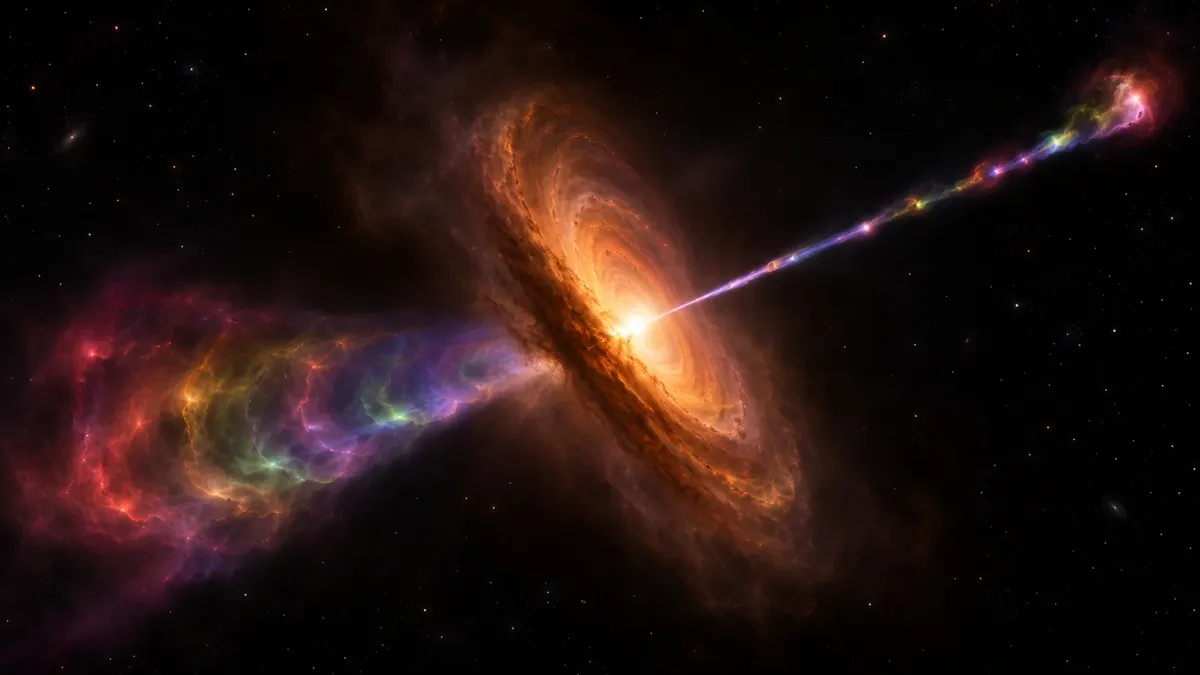
DG Tau is a young star still surrounded by a planet-forming disk and launching jets in opposite directions. Using the James Webb Space Telescope, researchers examined its mid-infrared light to study the disk, gas and outflows close to the star. The spectrum points to hot molecular gas and grown dust grains, while the two jets have different reported structures.
A young star can be both a construction site and a launch point: gas and dust circle it in a disk, while some material streams outward in jets. DG Tau offers astronomers a chance to study those processes together. It is no longer buried in a dense molecular cloud, yet it retains features associated with earlier stages of star formation.
In a preprint, Manuel Güdel and colleagues use the James Webb Space Telescope’s Mid-Infrared Instrument (MIRI) to examine DG Tau. Their aim is to characterize its mid-infrared spectrum and interpret what the light reveals about the star’s disk and outflows.
Reading the light
The team used MIRI’s Medium Resolution Spectrometer. A spectrum spreads light into its component wavelengths: its broad continuum and distinct emission lines can reveal properties of the material producing them. The authors report a very bright continuum with silicate features, alongside lines attributed to molecules and atoms including carbon monoxide, water, hydroxyl, hydrogen, neon, argon, iron and nickel.
The researchers interpret the molecular lines as evidence that carbon monoxide and water are present at temperatures of about 600–2,000 kelvin. Silicate features, meanwhile, provide clues to dust grains in the disk. The authors infer that grains have grown to sizes of at least 2 micrometres, which they describe as substantial grain growth at this early evolutionary stage.
Two jets, different structures
The spectrum also reveals emission from ions in DG Tau’s pair of jets. The forward jet has a collimated structure, as found in previous studies. The receding jet, which the authors say had been less well characterized, is more widely dispersed over several arcseconds and has a layered structure. Within it, the fastest components are the most collimated.
The team considers how the jet gas became ionized. They argue that high-energy radiation from the star itself cannot account for the observed ionization. Instead, they propose a unified, non-equilibrium shock model: X-ray-emitting jet plasma cools and its ions gradually recombine. When the gas reaches temperatures around 10,000 kelvin and below, low-ionization forms of metals can produce the observed lines. This is a proposed explanation, not a direct observation of every step in that cooling sequence.
What the spectrum suggests—and what remains uncertain
The authors report that the ratio of warm to hot water is the lowest among previous JWST observations of disks. Together with DG Tau’s bright continuum, they say this points to strong accretion and, in turn, strong ultraviolet irradiation from the star. This is an interpretation of the spectrum, not proof that accretion or irradiation caused each observed feature.
The available evidence for this article is the paper’s abstract, not its full text. It does not provide the observing details, uncertainty estimates or analysis needed to assess how robustly the spectrum distinguishes emission from the disk, jets and other regions. Nor can it establish whether the proposed shock-cooling picture is the only explanation. The authors report comparisons with earlier JWST observations, but the abstract does not describe their scope or selection.
This work is an arXiv preprint, and the supplied source does not establish that it has been peer reviewed. Its results and interpretation should therefore be treated as provisional. Further analysis and independent scrutiny can test how well the proposed picture explains DG Tau’s spectrum and jet structure.
- DG Tau
- James Webb Space Telescope
- MIRI
- young stars
- protoplanetary disks
- stellar jets
- mid-infrared spectroscopy
Reviewed cross-references
These connections were reviewed by a model, not independently fact-checked by a human. Similarity does not imply agreement; consult the original papers and the evidence below.
DQ Tau’s molecular gas follows a slower rhythm than its accretion bursts
Shared method: Both studies use JWST/MIRI mid-infrared spectroscopy to examine molecular emission from protoplanetary disks. The DG Tau study analyzes its spectrum alongside spatially mapped jets, whereas the DQ Tau study uses repeated epochs and line broadening to track variability; this is a shared observing method, not evidence that their disk behavior is the same.
Model review: · openai-codex/gpt-6-luna
Evidence and provenance
Selected excerpts, not complete papers. PDF extraction can omit figures or damage equations, tables and reading order; sources may be preprints.
2611.32856v1 — Original paper
Excerpt reference:
static/papers/2611.32856v1.md:16-51
Basis: Paper text
Source SHA-256:2490a0fe6a7642611111b7ff4c876c7ab355ca815253ae5b204f4e96f6607a7c2611.07253v1 — Original paper
Excerpt reference:
static/papers/2611.07253v1.md:53-110
Basis: Paper text
Source SHA-256:8a334a792fc151f2c46aa3d3dd2bb1edcb268a303becfe6617ab5723e8f49bea
Related reading
Automatically matched by shared topic keywords. These links do not imply that the sources agree or establish a consensus.
Ansky’s galaxy shows signs of black-hole activity before its 2019 brightening
Source published
Shared keywords: james webb space telescope
DQ Tau’s molecular gas follows a slower rhythm than its accretion bursts
Source published
Shared keywords: protoplanetary disks
EX Lupi’s Uneven Bipolar Jet
Source published
Shared keywords: stellar jets, young stars
A proposed Webb survey would map dust, ice and shadows in planet-forming disks
Source published
Shared keywords: james webb space telescope, protoplanetary disks
JWST’s proposed time-lapse of the Milky Way’s center
Source published
Shared keywords: james webb space telescope