TRANSMISSION // 2611.32844v1
Field Life turns particle interactions into moving fields
Source published
A cellular automaton translates Particle Life’s colour-based attractions and repulsions into mass-conserving fields. Simulations produce sorted regions, stripes and travelling bodies, while hand-chosen sampling settings limit how broadly the results can be generalized.
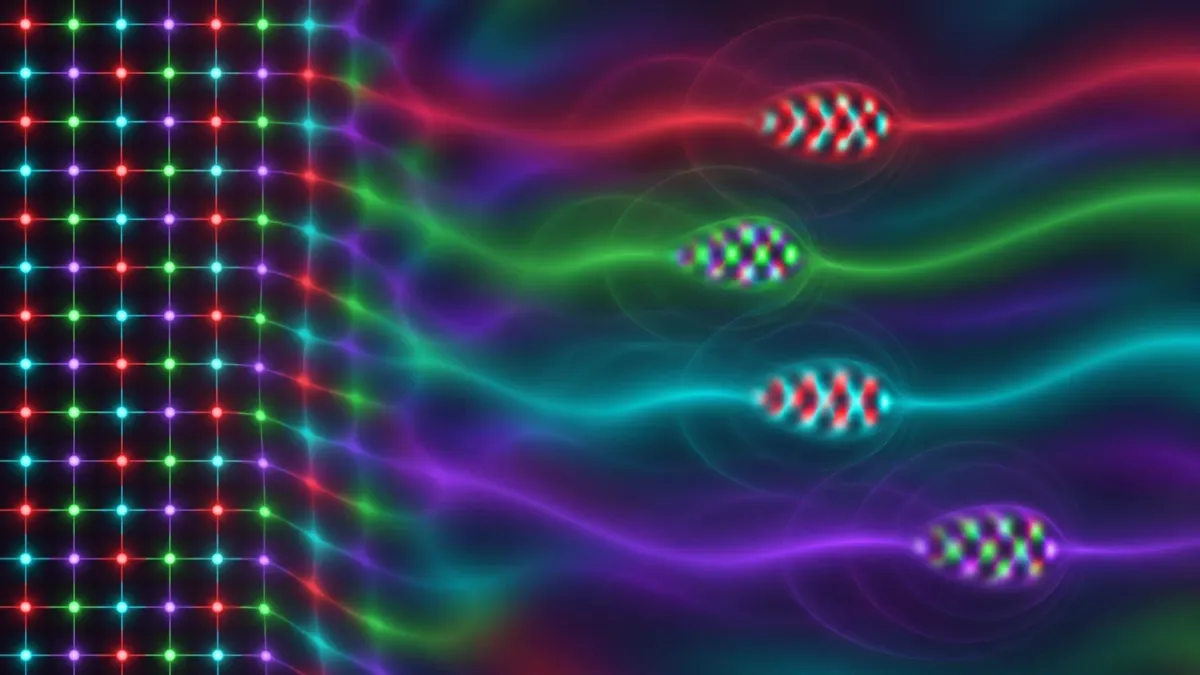
Can a grid of colour concentrations capture the lively motion of Particle Life without tracking individual particles? Field Life offers one answer: an update rule that conserves each colour’s mass yet can produce travelling structures. Its author reports gliders and other patterns, while noting that the exploration used settings chosen by hand.
From particles to fields
Particle Life is a simulation in which particles have colours, and a matrix determines how each colour attracts or repels each other colour. Field Life replaces those individual particles with concentrations spread across a square grid. Each cell holds some amount of every colour, treated as a chemical-like field—not as a literal chemical or a model of physical chemistry.
The paper asks how mass conservation and non-reciprocal interactions shape moving structures in this field-based model. An interaction is non-reciprocal when one colour’s response to another is not matched by the other colour’s response to it.
How a step works
Each update has three stages. First, a ring-shaped filter is applied to each colour’s field. It estimates how much of that colour lies around a cell at a particular distance: the filter is negative at its centre and positive in a surrounding ring. Next, an interaction matrix combines these filtered fields to calculate an attraction for each colour. A crowding term also pushes material away from locations that are already crowded.
Finally, each cell shares each colour’s mass among itself and its eight immediate neighbours. The model assigns transport weights using a clipped exponential of the calculated attraction: higher attraction generally gives a location a greater weight. Because each cell’s shares add up to its original amount, the update conserves the total mass of each colour, apart from numerical rounding.
Unlike Conway’s Game of Life, where a cell is alive or dead, Field Life’s cells hold continuous concentrations. The rule moves those concentrations around the grid.
What appeared in the simulations
For the reported sampling experiment, the author drew 48 random rules and ran them from noisy initial states for 300 steps. The rules were retained if they passed chosen thresholds for activity, structure size and movement; 44 passed. A stricter test for compact, moving, mostly single-colour bodies was passed by 30 of those 44. The paper also presents 120 released rules, called “worlds,” picked by eye from the same kind of sampling. The methods describe both noisy starting states and a disc of mixed colours as initial-state options, but the reported 48-rule counts are for runs from noise.
Across the examples, colours sometimes sort into separate regions, and some worlds develop stripes. The paper identifies compact travelling bodies, called gliders, in seven different worlds. To test whether a body could travel alone, the author copied it onto an otherwise empty grid and ran it under its original rule. All seven advanced more than 10 grid cells over 300 steps, the paper’s criterion for a glider. Outcomes varied: B0 and B3 maintained their speed and size over 3,000 steps, while another tested group eventually broke into smaller travelling bodies.
A key test replaced each glider’s interaction matrix with its symmetric part, so each pair of colours influenced one another equally. In these tests, all seven bodies stopped within 150 steps and settled into stationary patterns. The paper reports that asymmetry was needed for motion in these examples. But replacing the asymmetric part with a randomly chosen one did not reliably restore motion: only some control runs moved. Asymmetry alone is not enough; the particular interactions matter too.
What remains uncertain
These are results from simulations, not observations of real chemical systems or biological organisms. The sampling ranges, initial conditions, thresholds and several model settings were chosen by hand, based on what looked interesting to the author rather than derived from theory. The reported sample of 48 rules is small, and the 120 released worlds were selected by eye. The findings show what this model produced under the tested choices; they do not establish how often the patterns would arise under other sampling schemes.
The glider tests concern seven bodies from seven worlds, not a broad statistical survey. And although the model is inspired by Particle Life, the paper did not compare the two using the same interaction matrix or compare their computational costs. Movement is limited to transfers within a 3-by-3 neighbourhood, and the author notes that the model does not have the continuum limit found in Lenia.
The paper states that it was accepted for publication in the 2027 IEEE Symposium Series on Computational Intelligence. The source discussed here is the arXiv version; acceptance is publication context, not independent confirmation of the reported results. The author says the simulation and 120 saved worlds are released. Their availability makes the model and examples accessible for further examination, but does not by itself establish how broadly the findings apply.
- artificial life
- cellular automata
- Particle Life
- mass conservation
- self-organisation
- non-reciprocal interactions