TRANSMISSION // 2611.32831v1
Red-giant masses revised with stellar vibrations
Source published
A study of 583 red giants in the CASCADES survey finds lower typical mass estimates when TESS-measured stellar oscillations are combined with photometric radii.
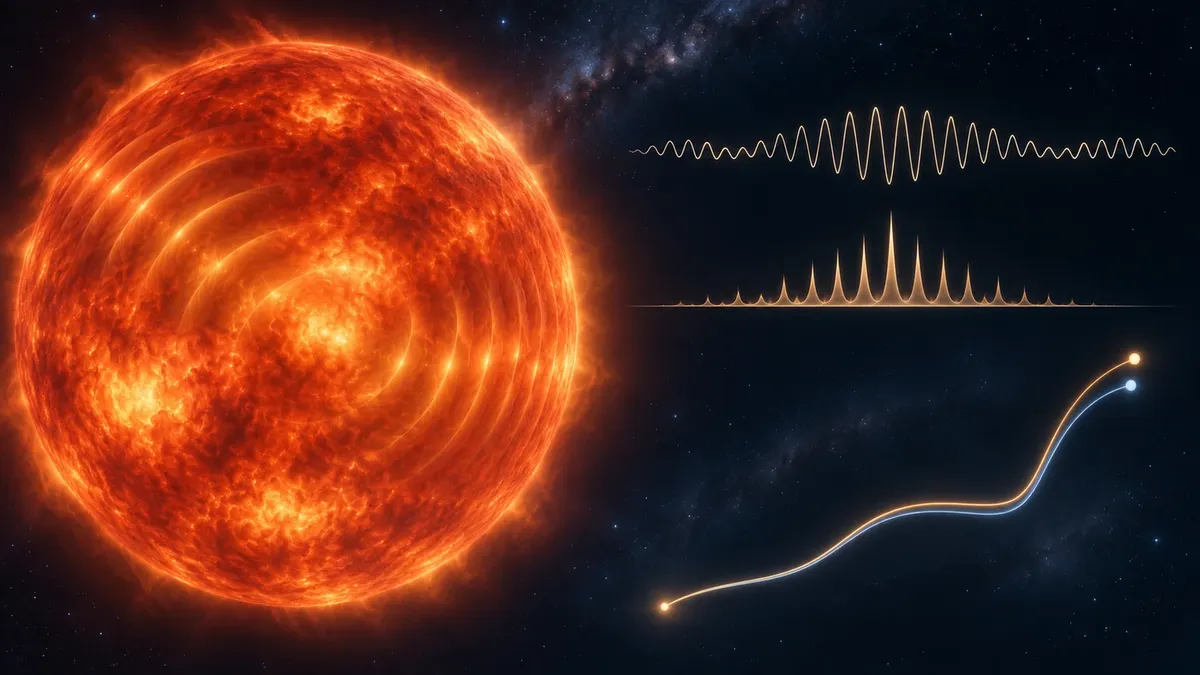
Red giants can reveal how planets vary with the mass of their host stars, but estimating those stars’ masses is tricky. A new analysis of the CASCADES survey uses TESS observations of stellar vibrations to revise mass estimates for hundreds of its targets.
A star’s mass helps astronomers interpret its planets. But for red giants, it can be difficult to tell whether a star is relatively massive and expanding on its way up the red-giant branch, or less massive and burning helium in its core. Both kinds can occupy similar locations on a diagram of stellar temperature and brightness, making estimates based on evolutionary models—called isochrone fitting—uncertain.
That ambiguity matters for the CASCADES project, a long-running radial-velocity survey looking for companions around evolved stars. Radial velocity tracks the slight back-and-forth motion of a star caused by an orbiting companion. To study how planets relate to host-star mass, astronomers need reliable masses for the surveyed stars.
In this study, Emile Fontanet and colleagues re-estimated stellar properties across the CASCADES sample. They analyzed light curves from NASA’s TESS mission, looking for the broad frequency range where a star’s oscillations are strongest. This frequency, known as νmax, provides information about surface gravity. The team combined it with stellar radii derived by fitting broadband photometry with the ARIADNE software. Their fits used spectroscopic measurements of temperature, surface gravity and metallicity as prior constraints.
The researchers applied a standard asteroseismic scaling relation to estimate masses from νmax, radius and temperature. They checked the oscillation measurements against published catalogs and found generally good agreement. They also compared photometric radii with independent estimates, including radii from Gaia and, for a smaller subset, from seismic measurements.
The team reports revised masses for 583 of the survey’s 640 stars. Compared with the earlier isochrone-based estimates, the new masses are typically 15–20% lower, with a median difference of −0.35 solar masses. The shift is especially pronounced among low-metallicity stars. Across the 583-star sample, the median mass falls from 2.11 to 1.65 times the Sun’s mass. The number classified as more massive than 1.5 solar masses drops from 505 to 342.
The pattern offers a plausible explanation for at least some of the discrepancy: many of the most affected metal-poor stars may be lower-mass, helium-burning red-clump stars rather than more massive stars ascending the red-giant branch. The added oscillation measurement constrains a star’s surface gravity and can help distinguish possibilities that look similar in the temperature–brightness diagram. The authors say their results are consistent with known difficulties in estimating evolved-star masses from isochrones alone.
These are revised stellar parameters, not a new count of planets or a measurement of how often planets occur around different kinds of stars. The updated masses give future CASCADES occurrence-rate studies a changed basis for comparing host-star populations. They also affect inferred minimum masses for radial-velocity companions, though the paper reports that the changes do not challenge the planetary nature of the previously published companions.
There are important qualifications. The team did not measure the second commonly used global oscillation quantity, the average spacing between consecutive modes, for the whole sample; doing so robustly is harder with the available TESS observations. Instead, it combined νmax with photometric radii, a survey-level approach that the authors say is less detailed than individual-star seismic modeling. The radius and temperature fits also use spectroscopy as a prior, so they are refinements of existing information rather than wholly independent measurements. For five stars, available photometry was insufficient for reliable fitted radii; other stars lacked usable oscillation measurements.
The source is a version-one arXiv manuscript dated November 2026 and presented as an Astronomy & Astrophysics manuscript. The supplied material does not establish whether it has completed peer review or been formally published. The result is best read as a systematic update to one survey’s stellar catalog, with uncertainty remaining in how accurately any individual evolved star’s mass is known.
- red giants
- stellar masses
- asteroseismology
- TESS
- radial velocity
- CASCADES
- exoplanet surveys
Reviewed cross-references
These connections were reviewed by a model, not independently fact-checked by a human. Similarity does not imply agreement; consult the original papers and the evidence below.
Stellar pulsations help weigh both stars in HD 70510
Shared method: Both studies combine asteroseismic information with photometric SED constraints to estimate stellar parameters: Fontanet et al. use TESS νmax and ARIADNE radii for red-giant masses, while Lv et al. combine δ Scuti radial-mode modeling and a two-star SED with an SB2 orbit. The shared approach is broad; the stars and seismic observables differ.
Model review: · openai-codex/gpt-6-luna
Evidence and provenance
Selected excerpts, not complete papers. PDF extraction can omit figures or damage equations, tables and reading order; sources may be preprints.
2611.32831v1 — Original paper
Excerpt reference:
static/papers/2611.32831v1.md:18-64
Basis: Paper text
Source SHA-256:8efaf723419d03df01c92038ffba303baa54a846d25f0a9d68932f26825567d52611.13717v1 — Original paper
Excerpt reference:
static/papers/2611.13717v1.md:12-56
Basis: Paper text
Source SHA-256:cee969cc20e11aa288344dfc84f316e0857b908786b8dc8b330017a3641aea28
Related reading
Automatically matched by shared topic keywords. These links do not imply that the sources agree or establish a consensus.
Stellar pulsations help weigh both stars in HD 70510
Source published
Shared keywords: stellar masses
Red giants’ individual vibrations sharpen estimates of their ages
Source published
Shared keywords: red giants
What Global Measurements Reveal About Red-Giant Interiors
Source published
Shared keywords: red giants
A Timing Pattern in the Slow Dimming of Red Giants
Source published
Shared keywords: radial velocity, red giants
Stellar pulses point to two binaries—and spectra confirm the motion
Source published
Shared keywords: radial velocity