TRANSMISSION // 2611.32814v1
Can better planning make orbital logistics easier to enter?
Source published
A preprint tests software for planning multi-stop spacecraft missions and a proposed tug concept, using simulated debris-removal and satellite-delivery cases.
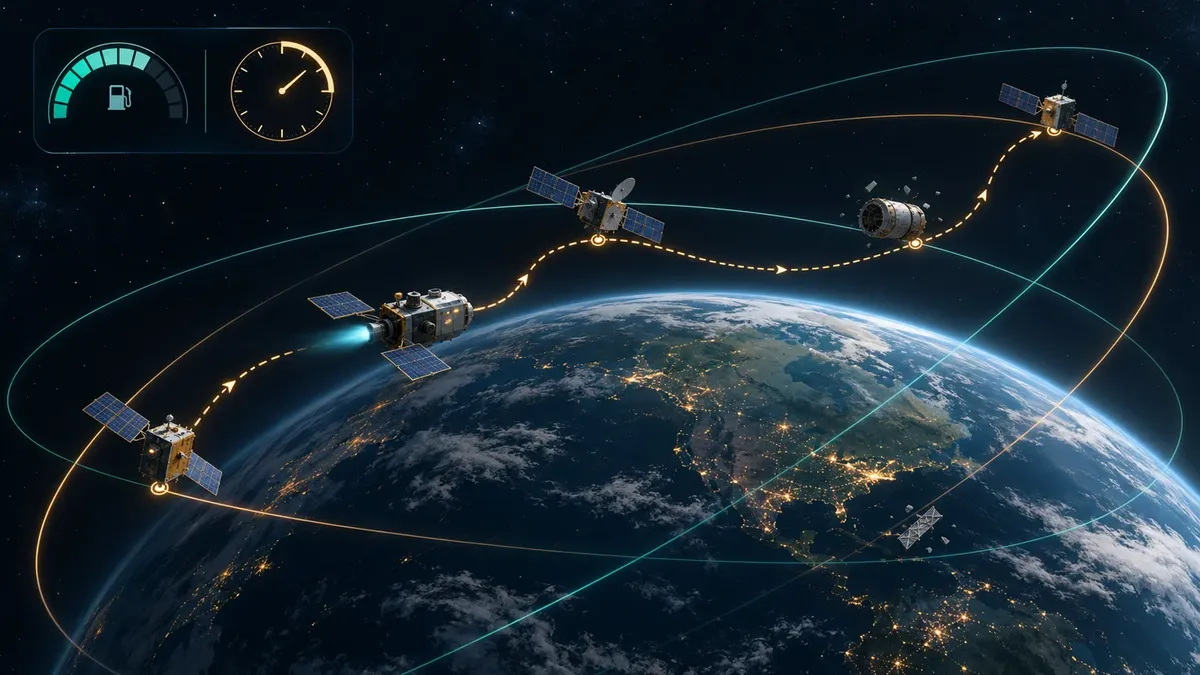
A spacecraft visiting several targets must balance orbital geometry, propellant and time. The authors present Space Postman, a planning service intended to find efficient routes, alongside ATLAS, a proposed tug designed for different kinds of cargo. Their examples show how route order and scheduling can change whether a mission fits its fuel budget—but the results are simulations, not demonstrations of an operational service or vehicle.
One spacecraft, many destinations
A tug that delivers satellites, a servicer that visits clients, or a vehicle that collects debris may face the same basic puzzle: which targets should it visit, and when? In low Earth orbit, the answer depends partly on orbital planes—the tilted paths objects follow around Earth. Earth’s slight equatorial bulge makes those planes rotate over time, at different rates. A spacecraft can sometimes use this drift to line up with a target while spending less propellant, but waiting takes time. The best route therefore depends on target order, transfer timing, fuel and the mission deadline.
The paper introduces Space Postman, a planning service that takes a list of targets, spacecraft details and time constraints, then proposes a route and estimates the propellant needed for each leg. It also presents ATLAS, a tug concept intended to carry different payloads, such as debris-removal equipment, client satellites or propellant. The authors’ business proposal is to offer planning software first and consider a dedicated tug later.
A planner that searches and checks
The planning method first estimates the cost of possible transfers, including waiting for orbital planes to align and using a so-called drift orbit to change the tug’s plane gradually. It searches possible visit orders and transfer times. For missions requiring a rendezvous—meeting a target at a particular place and time—the plan can then be refined with a more detailed model of Earth’s gravitational effects and checked using independent propagation and simulation tools.
The paper distinguishes between these levels of evidence. It calls the initial estimates “design fidelity”; rendezvous plans can receive further verification. The authors say the initial model treats burns as instantaneous and accounts for Earth’s oblateness, but does not yet include effects such as atmospheric drag during long transfers or low-thrust propulsion. The software also does not select which targets to omit if a mission cannot reach them all, and it provides no proof that a proposed route is globally optimal.
Two illustrative missions
In a notional debris-recycling case, the planner routes a stand-in spacecraft among ten upper stages in the same orbital shell. With the paper’s assumed spacecraft and a three-year deadline, its design estimate is about 1,098 metres per second of velocity change and 844 kilograms of propellant. An evenly divided schedule for the transfer time costs 27% more velocity change in this model. Simply waiting for the orbital planes to align would not work for this set of targets, the authors report, because the stages’ planes drift at the same rate.
These are not measured results from a DEXTER flight project. DEXTER is developing tools to harvest aluminium from debris and turn scrap into propellant; the paper’s mission is a hypothetical follow-on, with an assumed spacecraft and service time. Its calculations about how much harvested material might reduce propellant use are also parametric examples, not reported DEXTER performance. The authors verify the tour as an impulsive rendezvous under a more detailed orbital model, but say finite-burn flights and drag effects remain to be assessed.
The second case considers a representative rideshare carrying eight client satellites. The planned delivery order puts all eight within the assumed 600-kilogram propellant tank. Delivering them in the manifest’s listed order would exceed that tank in the model; a hand-sorted order would fit but use more propellant than the searched route. This case is at design fidelity, and the manifest is illustrative rather than a real customer list. The study also does not establish that the proposed ATLAS vehicle exists or can fly these missions.
As a further software check, the authors compare their planner with the published winning solution to a public debris-removal benchmark. They report reproducing a reference mission’s cost closely, then finding routes with 3.5% less total velocity change across the same ten launches, debris and launch dates. That is a comparison under the benchmark’s stated setup—not evidence that the planner is better overall than the winning team’s complete approach. The benchmark’s launch assignments and dates were supplied to the planner, and the paper notes that other solutions remain cheaper under different comparisons.
What the results do—and don’t—show
The examples make a practical point: orbital routing is not just a matter of choosing the shortest-looking path. Time and fuel trade against one another, and a different visit order can make the difference between a plan that fits a tank and one that does not. But the paper’s business case depends on missions that are still at early stages, on assumptions about customers and costs, and on models that need further development.
This work is a preprint of a paper accepted for presentation at the 77th International Astronautical Congress. Its case studies are primarily models and simulations, not operational demonstrations. The authors disclose that the first author is affiliated with a company developing the planning software and ATLAS concept. These limitations matter when interpreting claims about cost savings or lowering barriers to entry: the paper presents a planning approach and a proposed business pathway, not proof that the service or tug is commercially viable.
- orbital logistics
- space tug
- mission planning
- orbital debris
- satellite delivery
- preprint
Related reading
Automatically matched by shared topic keywords. These links do not imply that the sources agree or establish a consensus.