TRANSMISSION // 2611.32808v1
A broader census of massive stars in the Magellanic Clouds
Source published
A new catalog combines Gaia, Hubble and other survey data to identify massive-star candidates across the Large and Small Magellanic Clouds and the Bridge between them.
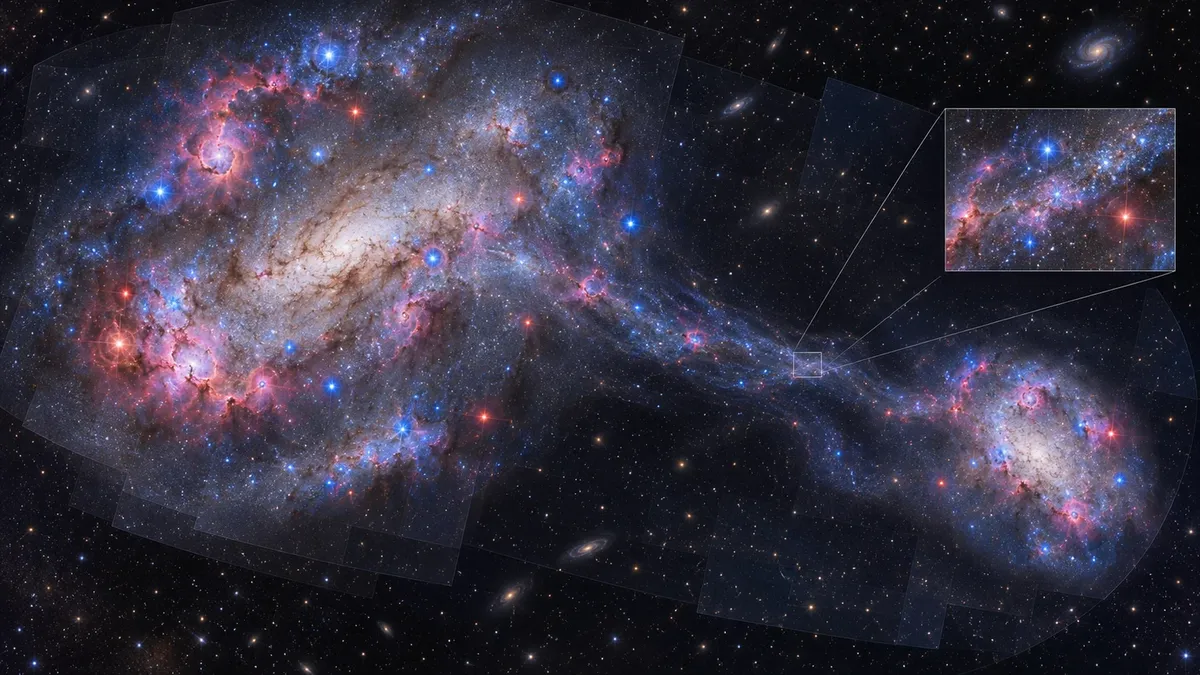
Massive stars are bright, short-lived markers of active star formation—but dust, crowded skies and gaps between surveys can hide them. A new catalog brings together observations from several sources to find candidates across the Magellanic Clouds and their connecting Bridge.
The Large and Small Magellanic Clouds are nearby galaxies that offer astronomers a view of massive stars beyond the Milky Way. Between them lies the Magellanic Bridge, a region containing stars and gas associated with the Clouds. Mapping massive stars across this system can help researchers study where such stars are found and guide future observations. But a star may be missed if dust dims and reddens its light, or if neighboring stars blur together in a crowded image.
In a new installment of the Alma catalog of OB stars, researchers assemble a catalog of massive-star candidates across all three regions. They define a massive star as one with an initial mass of roughly eight times the Sun’s or greater. The category includes hot O- and early-B-type stars, several kinds of supergiants, luminous blue variables and Wolf–Rayet stars.
Combining different views of the same sky
The team combined Gaia’s third data release (DR3), which provides positions, motions and optical brightness measurements, with records in the SIMBAD astronomical database and observations from other optical and infrared surveys. They also used Hubble Space Telescope observations to address a particularly difficult case: the crowded 30 Doradus star-forming region in the Large Magellanic Cloud, where Gaia may not distinguish neighboring sources reliably.
The selection was not based on brightness alone. The researchers compared stars’ colors and brightnesses with expected patterns for massive stars, allowing for the way dust changes observed colors. They also considered Gaia’s measurements of motion and variability, available spectral classifications, and information from the literature. Where one survey lacked useful measurements, another could provide a check or a substitute. For some sources with incomplete Gaia photometry, the team derived synthetic Gaia measurements from other observations.
This approach matters because no single survey sees every star equally well. Optical and infrared measurements offer different clues about reddened stars, while higher-resolution Hubble images can separate sources blended in ground- or space-based survey data with lower angular resolution. The researchers also checked for duplicate catalog entries and for multiple-star systems, which can be represented differently in different observations.
More than 50,000 candidates
The resulting ALS IV catalog lists 51,954 massive-star candidates: 36,506 in the Large Magellanic Cloud, 15,264 in the Small Magellanic Cloud and 184 in the Bridge. It brings together identifiers, coordinates, measurements across multiple wavelengths, astrometry, variability information and spectral classifications where available. The authors estimate that about 98% of its entries are genuine massive-star candidates, though that estimate does not mean every candidate has been confirmed spectroscopically.
The catalog’s maps trace familiar star-forming areas, including 30 Doradus and N11 in the Large Cloud, and NGC 346 and NGC 330 in the Small Cloud. The authors also describe patterns in the stars’ measured motions. In their analysis, the motion data show a connection between the Small Cloud and the Bridge, consistent with the broader picture of interaction between the Clouds. The catalog is a collection of candidate stars and measurements, however—not a direct test of what caused those motions.
A useful census, not a complete head count
The total should not be read as the final number of massive stars in the system. The authors note that the catalog’s reach is limited by Gaia DR3’s brightness and measurement constraints, especially for faint or heavily reddened stars. Crowding and unresolved multiple systems create further difficulties. The Bridge has sparse spectroscopic coverage, and many catalog entries lack spectral classifications. The team also cautions that counts of particular types based on SIMBAD classifications reflect uneven observations and classification practices, rather than a uniform census of every stellar subtype.
Catalog totals can also differ when studies use different definitions of “massive star” or draw different boundaries around the Bridge and the Clouds. The authors explain that these choices account for some differences between their results and earlier catalogs; raw totals are therefore not necessarily like-for-like comparisons.
The paper describes the catalog as a resource for studies of massive stars and a starting point for future surveys. More precise Gaia data and improved processing of crowded regions could help refine the sample, while additional spectroscopy would help establish which candidates are truly massive and fill gaps in the Bridge. The study is an accepted Astronomy & Astrophysics manuscript presented as proofs in the supplied source text; as with any catalog, its selection choices and limitations matter when researchers use it.
- Magellanic Clouds
- massive stars
- Gaia
- Hubble Space Telescope
- star catalogs
- stellar astronomy
Related reading
Automatically matched by shared topic keywords. These links do not imply that the sources agree or establish a consensus.
Gaia Diagram Seeks Cataclysmic Binary Candidates
Source published
Shared keywords: stellar astronomy
A metal-poor stellar trail follows the Magellanic Clouds
Source published
Shared keywords: magellanic clouds
Galaxy arcs sharpen models of double-image quasars
Source published
Shared keywords: hubble space telescope
Hubble and JWST Measure WLM’s Sky Motion
Source published
Shared keywords: hubble space telescope
A Census of Nearby Galaxies Finds Concentrated Stellar Mass and an Unusual Dwarf
Source published
Shared keywords: hubble space telescope