TRANSMISSION // 2611.32803v1
Robots must know not just how to team up, but who is needed
Source published
MRBench tests whether AI agents can identify the smallest robot team a task needs—or recognize when no team can do it. Simulated trials expose a gap between coordinating robots and judging physical necessity.
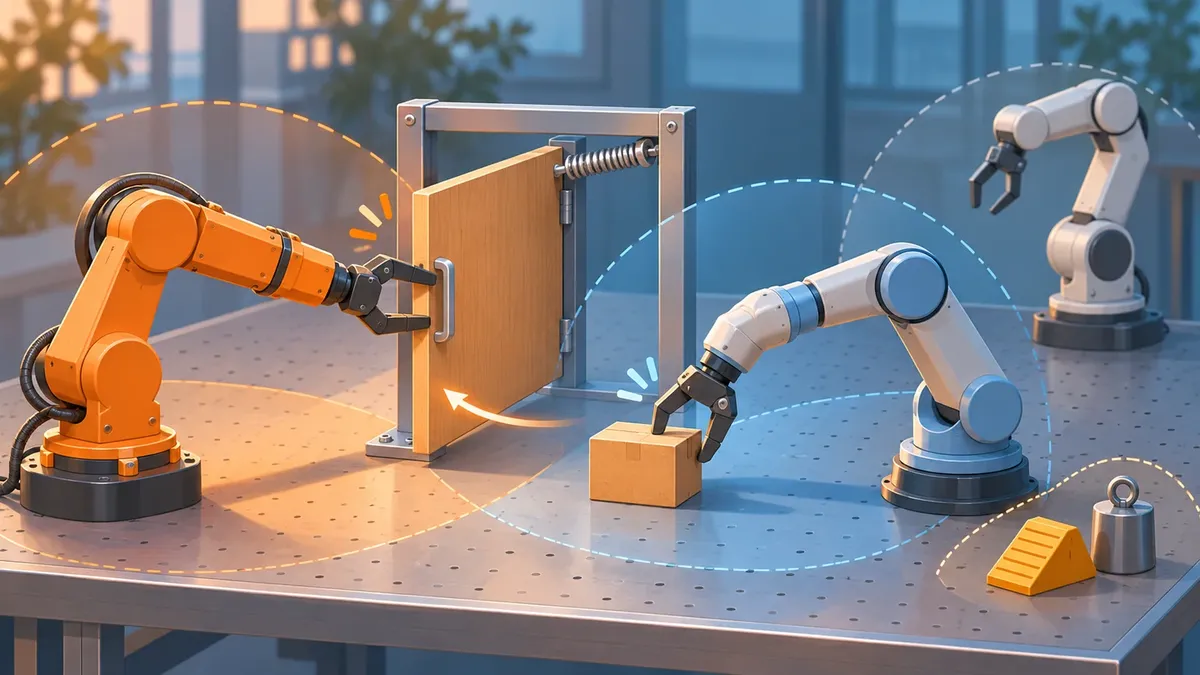
A robot team may complete a job without every member being necessary. MRBench puts that distinction to the test, asking whether AI agents can reason about reach, simultaneous actions and objects that might substitute for a robot.
A team of robots can finish a task and still leave an important question unanswered: did the task really need all of them? A successful group effort shows that the team was sufficient. It does not show that each robot was necessary—or that another robot or a simple object could not have done the job instead.
That distinction matters when a robot is unavailable, a different model takes its place, or an object can provide support. Researchers introduce MRBench, a benchmark designed to test whether AI agents can work out the physical resources a task requires, rather than simply coordinate a team they have already been given.
The benchmark asks agents to identify the smallest feasible robot team, account for objects that might take over a robot’s role, and say when a task cannot be done with the available resources. The paper calls this capability “physical necessity reasoning.”
Two ways a task can need several arms
MRBench contains eight simulated manipulation tasks built around two kinds of physical constraint. Concurrency tasks require multiple actions at the same time—for example, holding two spring-loaded doors open while another arm removes a box. Reach tasks require work at locations that no single fixed arm can cover, so an object must be passed between arms or each arm must work in its own area.
Each task is tested in five configurations that keep the goal the same while changing the available resources. There may be exactly the needed arms, an extra arm, too few arms, a different robot model in an existing position, or a passive object that could replace a robot’s support. Some configurations are deliberately impossible. The full benchmark comprises 40 task versions and 480 simulated scenes.
To establish the benchmark’s answers, the researchers used geometric reach checks and an exact search for the smallest feasible teams, then validated scripted solutions in Isaac Sim. The tasks and scoring distinguish a genuinely minimal team from one that merely manages to finish. That distinction matters: if three arms succeed where two would have sufficed, success alone can reward unnecessary staffing.
Measuring capabilities before choosing a team
The proposed method, MRScissors, separates two questions agents can otherwise mix together: what jobs the task requires, and which available resources can perform them. A language model first describes the jobs and which must happen simultaneously. Code then measures physical capabilities, such as whether each arm can reach a required position. A search procedure uses those measurements to find a smallest feasible team—or determine that no team works. The method also considers whether an object can substitute for an arm and includes review steps to check the model’s task description.
The researchers compared MRScissors with several adapted robot-team coordination approaches using two language-model backbones. Across the 480 scenes, MRScissors selected the correct team in 85.4% of cases with one backbone and 91.2% with the other. The strongest competing methods scored 75.0% and 81.7%, respectively. These are results on this benchmark, not evidence that the system will select teams equally well in a real workcell.
The detailed results reveal where the challenge remains. Agents often struggled when an arm’s model changed or an ordinary object could take over a robot’s role. Even MRScissors got only 59.4% and 66.7% of the “borrow” cases right across the two backbones. An ablation study also indicates that the model’s task description is an important potential source of error, but its comparisons change more than one component at a time, so they do not isolate the effect of that description alone.
Choosing the right team did not guarantee successful simulated execution. When MRScissors named a correct team, its generated plan succeeded in 55.9% and 58.8% of feasible cases. An executor given the gold-standard team succeeded in 58.7% and 60.3%. This suggests that team selection and carrying out a plan are related but distinct challenges.
A useful test, not a field trial
MRBench offers a structured way to test whether an agent can distinguish “enough robots to finish” from “the fewest resources that can do it.” But the evidence has important limits. The experiments use eight designed tasks in a simulated workcell, with fixed robot positions and defined physical rules. The results do not establish how well the method would handle the variety, uncertainty and hardware failures of real-world settings.
The benchmark’s ground-truth answers also depend on its task descriptions and physical model. The authors report audits and simulation checks, but those safeguards do not show that every real-world task can be represented by the same job-and-capability framework. And while MRScissors performs better than the tested baselines here, the unresolved difficulty of identifying passive substitutes points to a clear weakness.
This article is based on an arXiv preprint, which may not have undergone peer review; its findings should therefore be treated as provisional. Within that scope, the central point is practical: coordinating robots is not the same as understanding what a task physically needs. A capable team planner must answer both questions.
- multi-robot manipulation
- robotics
- robot teams
- physical reasoning
- MRBench
- MRScissors
- robot benchmarks
Related reading
Automatically matched by shared topic keywords. These links do not imply that the sources agree or establish a consensus.
Robots Need to Know Not Just What to Do, but When
Source published
Shared keywords: robot benchmarks
A robot can finish the task—and still ignore the instructions
Source published
Shared keywords: robot benchmarks
Robot Memory Fails When the World Keeps Moving
Source published
Shared keywords: robot benchmarks
Teaching a robot model to predict what its actions will change
Source published
Shared keywords: robot benchmarks
Why a robot’s interface can matter as much as its AI
Source published
Shared keywords: robot benchmarks