TRANSMISSION // 2611.32759v1
A metasurface lets classical waves choose how coherence is shared
Source published
A reconfigurable electromagnetic metasurface creates Bell-like and GHZ-like classical wave patterns, changing both which field properties participate and how many share a coherent relation.
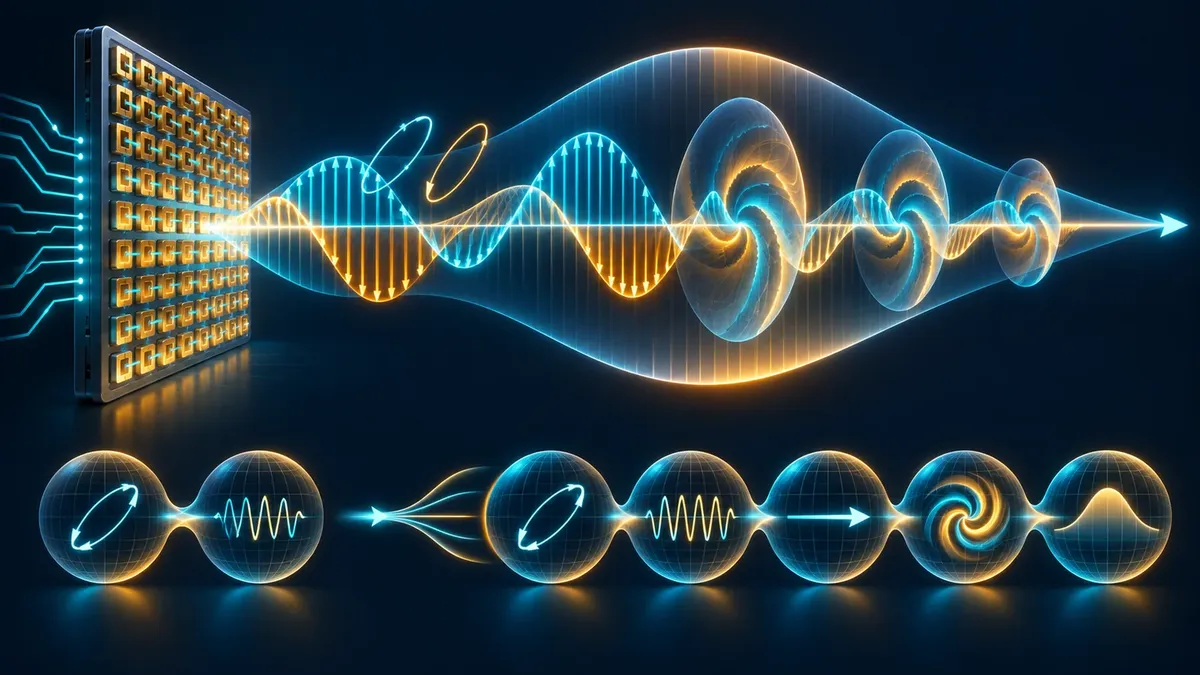
Quantum entanglement links parts of a quantum system in ways that cannot be described independently. A new experiment uses classical electromagnetic waves to reproduce selected mathematical structures of multipartite entanglement—and makes the participating wave properties programmable. The result is an analogue, not quantum entanglement itself.
The question: can a wave choose its own structure?
A wave can have several physical properties at once: its polarization, frequency, direction of travel, orbital angular momentum (a pattern of phase winding), and spatial envelope. These can be treated as distinct state spaces. When properties are coherently linked, the whole field may have a structure that cannot be factored into independent pieces.
In quantum physics, entanglement describes nonseparable relationships between quantum subsystems. Classical waves can show mathematical analogues of some of these relationships, but the analogy has limits: a classical electromagnetic field is not a collection of entangled particles and does not demonstrate quantum nonlocality. The researchers ask whether they can program not only the wave’s state, but also which of its physical properties participate in a shared coherent structure.
How they built and tested it
The team used a reflective spatiotemporal metasurface: a patterned surface whose response can be electronically changed across space and time. Its two polarization channels could be controlled independently. By programming those channels, the researchers created coherent branches of a wave and linked them to selected states in other properties.
The platform drew on five state spaces: polarization, frequency, wavevector direction, orbital angular momentum, and orthogonal amplitude-envelope modes. The authors switched which properties were active while holding the number of participants fixed, or increased that number while using the same hardware. They produced Bell-like structures involving two properties and GHZ-like structures involving three, four, or five.
To check the patterns, they measured the complex electromagnetic field, including phase as well as amplitude, and projected it onto the relevant product-state bases. From those measurements they reconstructed classical coherency matrices and compared them with the intended target states. Phase measurements matter here: intensities alone would not distinguish a coherent superposition from an incoherent mixture with the same branch populations.
What they found
The metasurface produced complete Bell-like and GHZ-like families across the tested orders, from two to five participating state spaces. It could also exchange which properties formed a state without changing its multipartite order. For example, a second factor could be represented by frequency, direction, orbital angular momentum, or an envelope mode while retaining the Bell-like structure.
For GHZ-like states, the defining relative phase linked two complementary branches across all participating factors. In the ideal mathematical construction, tracing out any one factor removes that phase from the remaining reduced state. The measured complex fields showed the targeted branch coherence, and the authors report high fidelities for the reconstructed states. For the complete Bell-like families across four compositions, reported fidelities ranged from 94.9% to 99.0%; this range should not be taken as a single performance figure for every configuration in the larger hierarchy.
The five-partite demonstration involved all five state spaces available on the platform. The authors describe it, to their knowledge, as the highest multipartite order experimentally realized in classical electromagnetic fields. That is a claim about classical fields—not a record for quantum entanglement experiments.
What the result does—and does not—show
The advance is a way to reconfigure where coherence resides in a classical field: both the identity and the number of participating properties can change. That makes the setup a laboratory for studying selected structures used to describe multipartite quantum states, including how coherent branches and reduced states behave.
It does not create quantum entanglement, establish nonlocality, or show that a classical metasurface can perform quantum information tasks. The paper explicitly distinguishes its classical coherency representation from quantum statistical interpretation. The demonstrations also focus on Bell-like and GHZ-like families; more varied structures, such as W-like or graph-like states, are discussed as possible extensions rather than reported results.
These findings come from a single experimental platform, and the evidence described here concerns projected electromagnetic fields and their agreement with selected target structures. Broader claims about applications or generalization would require further work. The source is an arXiv preprint; its peer-review status is not established by the available source material.
- classical electromagnetic waves
- spatiotemporal metasurface
- multipartite coherence
- Bell-like states
- GHZ-like states
- structured light
Related reading
Automatically matched by shared topic keywords. These links do not imply that the sources agree or establish a consensus.