TRANSMISSION // 2611.32700v1
A small radio array listens for solar outbursts
Source published
TWIN-1 is a two-element radio interferometer in India that monitors the Sun at low radio frequencies. Its commissioning paper describes the instrument and reports detections, while noting interference and limits in the current analysis.
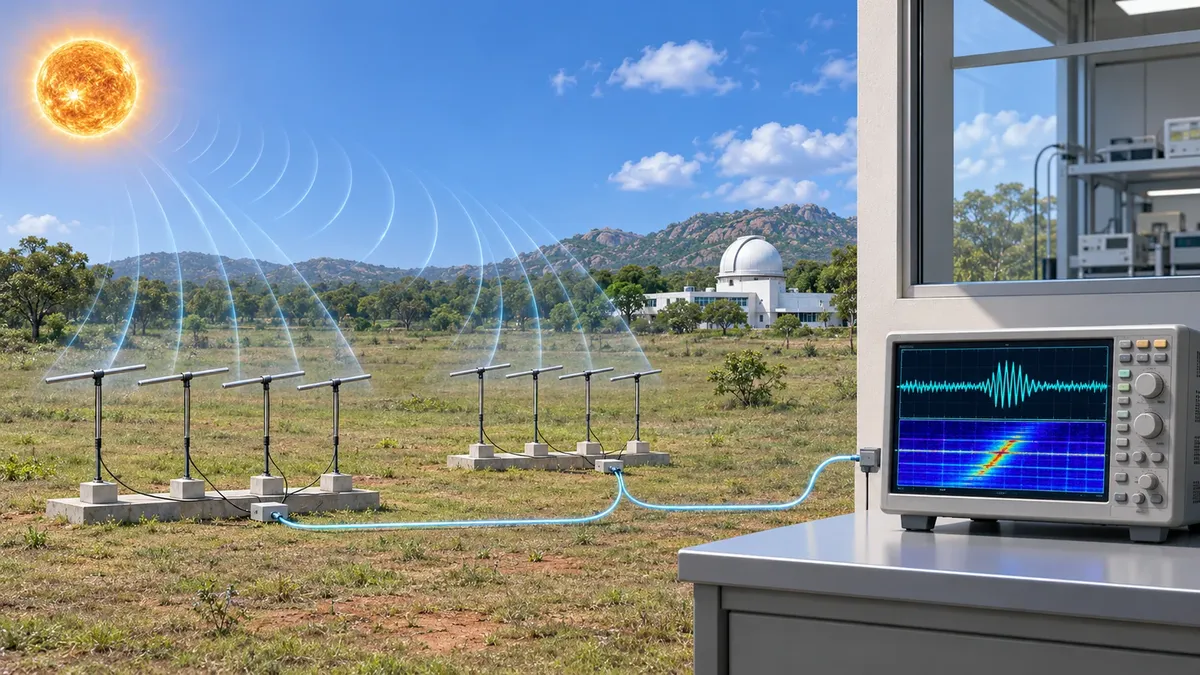
The Sun can reveal eruptions through radio signals that are invisible to our eyes. At Gauribidanur Observatory in India, researchers have built a compact instrument to monitor some of those signals. The paper introduces TWIN-1, explains how it collects data and reports solar-event detections—along with practical limits that shape what the instrument can currently observe.
Solar eruptions can produce radio bursts: changes in radio emission linked to activity in the Sun’s atmosphere. Monitoring those signals can help researchers study solar events and their possible relevance to space weather. But detecting them from the ground is not simply a matter of pointing an antenna at the Sun. The signals are weak, and human-made radio transmissions can interfere.
A team led by Abhishek R and colleagues presents TWIN-1, a two-element radio interferometer at the Gauribidanur Radio Observatory in India. The instrument observes between 185 and 350 megahertz, a band of low radio frequencies. Its purpose is routine monitoring of solar events, and the authors describe its design, commissioning and initial observations.
Two antenna groups, one shared signal
Each of TWIN-1’s two elements combines signals from four log-periodic dipole antennas, or LPDAs. The elements sit eight metres apart along an east–west line. An interferometer compares signals arriving at separated antennas; the differences in their timing and phase can help reveal how a radio source changes as it moves across the instrument’s view.
The signal chain was assembled largely in-house. Low-noise amplifiers boost the antenna signals, which are combined and amplified before travelling to the laboratory over optical fibre. There, an oscilloscope digitises the two signals together. It samples at 1.25 billion times per second, but records short bursts of data—9,952 samples per element—once every three seconds. Software written in Python controls observations and supports monitoring and preliminary analysis.
That sampling rate describes how finely the incoming signal is measured during each burst; it does not mean the instrument records continuously. The gap between bursts matters when interpreting brief or rapidly changing activity.
What the team reports
The authors describe observations of the Sun as it crosses the instrument’s view, a transit that takes about three hours. In data plots, the changing interference pattern, or fringe, reflects how the signals from the two elements combine over time and frequency.
The team also reports detecting several solar events during Solar Cycle 25, including an event observed on 7 November 2025. The paper says that this event’s detection matched observations from the e-CALLISTO solar radio spectrograph in Udaipur. It presents a spectrogram of a Type IV radio burst observed on 11 November 2025 as well. These are reports of detections, not a full account of every event or a detailed analysis of what caused each one.
Radio interference is a recurring complication. The authors identify strong signals in the observing band, including features between 240 and 270 megahertz attributed to satellites, as well as occasional signals at other frequencies. Their analysis uses inspection and statistical approaches to identify affected data. The paper describes more comprehensive interference mitigation and automated burst detection as work in development, not as capabilities already completed.
A commissioning report, not the last word
The paper’s main contribution is an account of building and commissioning an instrument that has operated since July 2023. It shows that the system can collect data during solar transits and that solar-event signals have been detected. That establishes a basis for further monitoring; it does not, by itself, demonstrate a complete or automated survey of solar activity, or establish how reliably TWIN-1 measures event properties.
The authors identify an important limitation: tracking delays have not been applied in the analysis presented. Without those corrections, they say, useful interferometric observing time is reduced to about three hours. Applying tracking delays is a future goal intended to support longer observations. The short, regularly spaced data bursts and the presence of interference are additional considerations when assessing what events the system can capture and how precisely they can be characterised.
This article is based on the supplied paper text and abstract. The paper appears as a preprint; the supplied material does not establish whether it has undergone peer review. Some extracted figures and tables are difficult to interpret, so this account focuses on claims stated clearly in the text rather than attempting to reconstruct uncertain details. The authors also refer to separate and forthcoming analyses of the accumulated observations. Those results should not be treated as findings of this commissioning paper. The researchers’ next steps include automated interference removal, event detection, improved tracking and continued data archiving.
- solar radio astronomy
- radio interferometry
- solar radio bursts
- Gauribidanur Observatory
- radio interference
- instrumentation
Related reading
Automatically matched by shared topic keywords. These links do not imply that the sources agree or establish a consensus.
A radio telescope concept for the Moon’s far side
Source published
Shared keywords: radio interferometry
How the Sun’s atmosphere blurs its own radio signals
Source published
Shared keywords: radio interferometry, solar radio bursts
Late solar radio bursts point to particle acceleration after a flare’s peak
Source published
Shared keywords: solar radio bursts
How magnetic fields steer plasma waves and electron heating
Source published
Shared keywords: solar radio bursts
A hybrid approach to calibrating radio arrays
Source published
Shared keywords: radio interferometry