TRANSMISSION // 2611.32694v1
When a quantum walk needs a rule at infinity
Source published
A mathematical study finds that deformation can confine or spread a quantum state along a Krylov chain—and, in one regime, leave its late-time motion undetermined without an extra boundary rule.
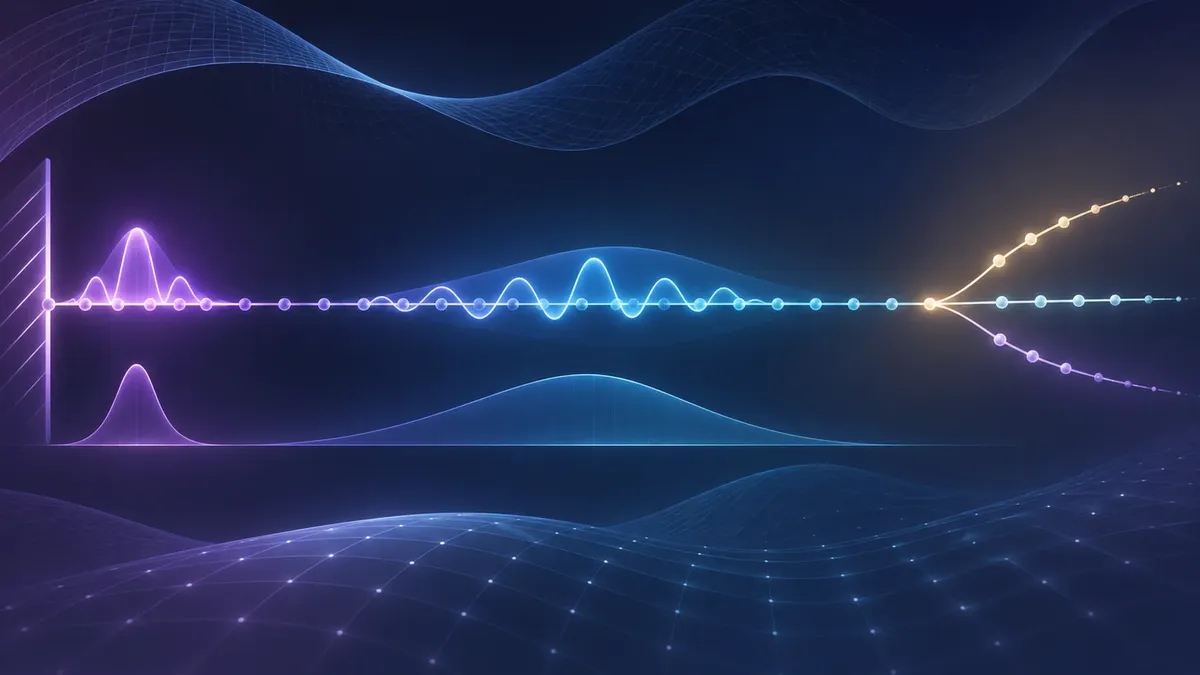
Krylov complexity tracks how far quantum evolution travels along an abstract chain. A new mathematical analysis of deformed oscillators finds several distinct patterns of motion, including a regime where the chain’s hopping strengths alone do not specify a unique evolution.
A quantum system becomes a chain
Quantum motion can be represented in a less familiar way: as a walk along a one-dimensional chain of states. The chain is built using the Lanczos procedure, and its hopping strengths—called Lanczos coefficients—encode how the system evolves from an initial state. Krylov complexity measures the walker's average position on this chain. It is a measure of spreading in this mathematical representation, not a direct measure of how complicated a device or calculation is.
In a preprint, Tunde Joseph Osunmusanmi studies chains generated by a two-parameter deformed oscillator. The parameters, p and q, change the oscillator's algebra and therefore the chain's hopping strengths. The model includes familiar cases such as the ordinary oscillator and connects, for particular parameter choices, to a chain used in studies of double-scaled SYK. The central question is how those altered hopping rules shape the walk—and whether the rules always determine one answer.
Following the walk mathematically
The paper uses the relationship between Krylov chains, tridiagonal operators (Jacobi operators) and families of orthogonal polynomials. In this framework, the Lanczos coefficients specify a recurrence for the polynomials, while a spectral measure—a distribution over possible energy values—can be used to calculate the evolving state and its complexity.
For the deformed displacement model, the starting state is the oscillator vacuum and the generator is proportional to the sum of the raising and lowering operators. In this setup, the Krylov basis matches the oscillator's number-state basis, so complexity is the mean excitation number. The author derives formulas linking its rate of change to a deformed momentum and its acceleration to the expectation value of the deformed commutator. In plain terms, the algebra sets an effective force along the chain.
The work combines analytical results with numerical evolution of finite, truncated chains. The author reports checks against exactly solvable chains and tests of formulas against numerical calculations. These are mathematical and computational analyses, not laboratory measurements.
Four patterns of spreading
The parameter values divide the model into four regimes. When both p and q are below one, complexity remains bounded: the deformation itself produces localization on the Krylov chain, without disorder in the model. The paper also conjectures that a particular bound is finite throughout this regime; it does not prove that conjecture.
When one parameter equals one and the other is below one, complexity grows linearly at late times, the pattern called ballistic spreading. For this case, the author derives an exact expression for the asymptotic speed as a theta-type series. At p = q = 1, the ordinary oscillator chain instead gives complexity proportional to time squared.
The most unusual result occurs when either parameter exceeds one. Here, the infinite-chain operator is not essentially self-adjoint, and the associated moment problem is indeterminate. In practical terms, the Lanczos coefficients no longer specify a unique infinite-time evolution: additional information, expressed mathematically as a boundary condition at infinite chain position, is needed.
This is not just a formal distinction in the analysis. Truncating the chain at successively larger sizes gives different limiting evolutions depending on whether the truncation length is even or odd. The two limits correspond to particular solutions of the moment problem; the odd-truncation solution includes a discrete contribution at zero energy. More generally, a family of allowed boundary choices gives a family of complexity curves. They agree at early times and separate later, when the spreading wave reaches the far end of the chain in finite time according to the model.
What the result does—and does not—show
The findings clarify a mathematical limitation: in some models, knowing every Lanczos coefficient is still not enough to fix the dynamics. The paper notes that this issue is not expected for local-operator growth in many-body systems, where Lanczos coefficients grow at most linearly, but could matter for deformed oscillators used as effective models or for other nonlocal or unbounded generators.
These conclusions concern a specific theoretical chain and its mathematical extensions. They do not establish that the same regimes occur in a particular experimental system, or that Krylov localization is the same as ordinary spatial localization. The work is an arXiv version 1 preprint, not evidence of peer review; its results should be read as the author's analysis pending independent scrutiny. The paper also identifies open questions, including proving the proposed bound in the localized regime and developing a fuller analytic treatment of the family of late-time evolutions.
- Krylov complexity
- quantum dynamics
- deformed oscillator
- orthogonal polynomials
- mathematical physics
- preprint
Reviewed cross-references
These connections were reviewed by a model, not independently fact-checked by a human. Similarity does not imply agreement; consult the original papers and the evidence below.
Can a Refined Complexity Measure Avoid False Alarms About Scrambling?
Shared method: Both studies use Krylov-space constructions based on Lanczos coefficients: the origin paper maps spread dynamics to a half-line chain, while Camargo et al. define operator-growth measures in a Krylov basis. This is a methodological connection, not evidence that their complexity results agree; the origin concerns deformed-oscillator state spreading, whereas the other paper studies logarithmic operator complexity and scrambling.
Model review: · openai-codex/gpt-6-luna
Evidence and provenance
Selected excerpts, not complete papers. PDF extraction can omit figures or damage equations, tables and reading order; sources may be preprints.
2611.32694v1 — Original paper
Excerpt reference:
static/papers/2611.32694v1.md:121-195
Basis: Paper text
Source SHA-256:64930dc2c1e7c89cb7ef4d12541a91730e949768a69885105e8e10b44b3eb3202603.19359v3 — Original paper
Excerpt reference:
static/papers/2603.19359v3.md:303-370
Basis: Paper text
Source SHA-256:e828bd76b11280d3613167f5299fe2a9fd57271effaa9aafe6a43a4dc13525a6
Related reading
Automatically matched by shared topic keywords. These links do not imply that the sources agree or establish a consensus.
Can a Refined Complexity Measure Avoid False Alarms About Scrambling?
Source published
Shared keywords: krylov complexity
A quantum model links baby universes to hidden observer information
Source published
Shared keywords: krylov complexity
A symmetry-based method for Legendre spectra
Source published
Shared keywords: mathematical physics
Can quantum theory be written without complex numbers?
Source published
Shared keywords: mathematical physics
When a Bose gas follows a simpler equation
Source published
Shared keywords: mathematical physics