TRANSMISSION // 2611.32692v1
How stellar assumptions reshape the black-hole mass gap
Source published
MESA simulations suggest that metallicity, rotation and stellar winds can shift the black-hole mass-gap edge—and affect what gravitational-wave data imply about a nuclear reaction.
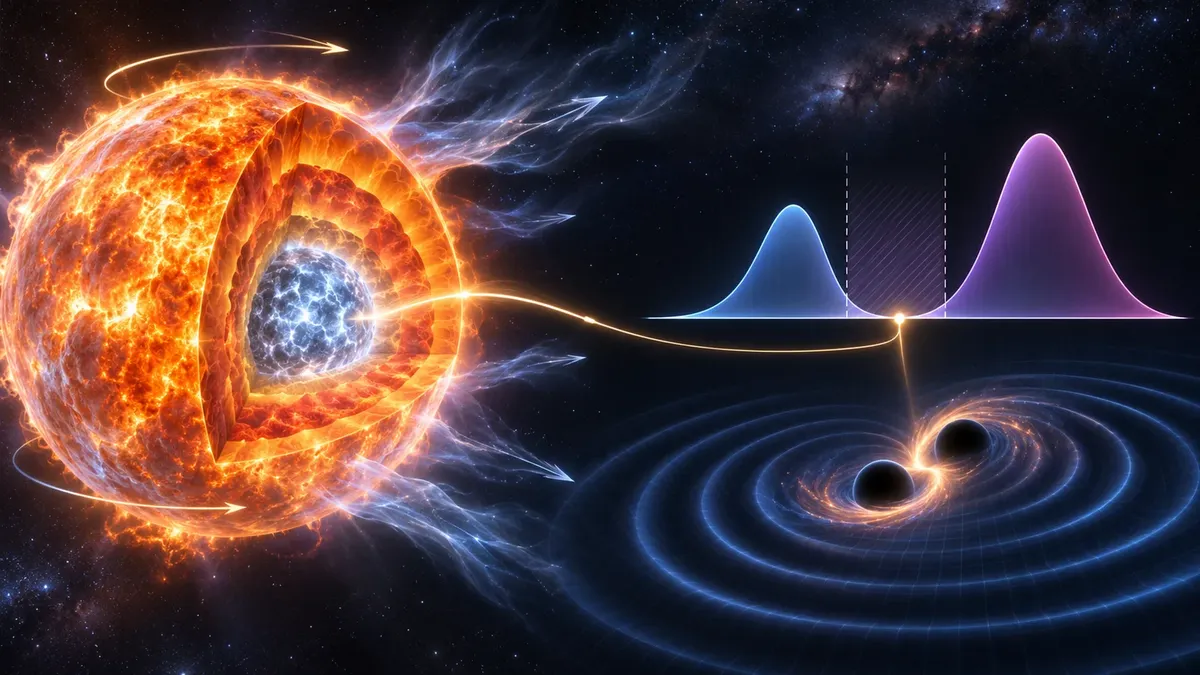
A proposed link between gravitational-wave observations and a nuclear reaction depends on how massive stars evolve. New simulations explore how metal content, rotation and stellar winds may change the black-hole mass boundary used to infer the reaction’s strength.
Why the mass gap matters
When a massive star runs out of fuel, its core can collapse into a black hole. But stars with sufficiently massive carbon–oxygen cores may instead be destroyed in a pair-instability supernova, leaving no black hole. The boundary between these outcomes helps shape the expected upper end of the black holes made by stars—and the mass gap predicted for their remnants.
One ingredient is the reaction carbon-12 plus an alpha particle forming oxygen-16, which consumes carbon during helium burning. Its rate affects the star’s final carbon–oxygen core. Researchers describe the rate with an astrophysical S-factor, here called S₃₀₀. If the observed black-hole mass boundary is interpreted using a particular stellar model, it can therefore be used to infer this nuclear quantity.
The authors say gravitational-wave population analyses of the GWTC-4 catalog imply a low-spin black-hole cutoff near 68.5 solar masses, with substantial uncertainty, and an S₃₀₀ estimate around 108.6 keV barn. That estimate is lower than a commonly cited laboratory evaluation near 140 keV barn. The paper asks whether assumptions about stars—not just the nuclear reaction—could help explain the difference.
A grid of stellar models
The team used the MESA stellar-evolution code to model massive stars through helium exhaustion. They varied three factors: metallicity, or the abundance of elements heavier than helium; rotation; and the prescription used for mass loss in stellar winds. They also sampled several values of S₃₀₀.
The simulations tracked quantities including helium-core and carbon–oxygen-core masses. The authors then estimated the largest black-hole mass allowed before the modeled core crossed their adopted pair-instability threshold. They compared model outcomes with the GWTC-4 mass-cutoff estimate and marginalized over their sampled stellar parameters to examine how the inferred S-factor changes when stellar assumptions are not fixed to a single model.
What the models suggest
In this grid, metallicity-dependent winds had the largest reported influence among the stellar factors studied. Metal-rich stars lose more material through winds, the authors report, leaving smaller helium cores; metal-poor stars can retain more of their cores. Across the grid, metallicity was associated with changes of up to about 20 solar masses in the estimated black-hole boundary. Switching between the two wind prescriptions produced offsets of about 8–10 solar masses at the same metallicity.
Rotation also shifted the modeled boundary upward. The paper attributes this to two effects: rotation changes the core’s structure and temperature, while internal circulation transports some newly made carbon away from the hottest burning regions. In the authors’ models, that combination reduces carbon consumption and changes the resulting core composition.
One model combination—metallicity around one-thousandth of solar, rotation at 0.4 of the critical rate, and the optically thin C15 wind prescription—reproduced the GWTC-4 best-fit cutoff using S₃₀₀ = 108.6 keV barn. This is an example of a compatible model, not a unique measurement of a star’s typical conditions. The authors also argue that the often-quoted 45-solar-mass gap boundary should not be treated as a universal physical threshold: it can reflect how different black-hole population distributions overlap under particular assumptions.
What remains uncertain
The result is a model-based demonstration that stellar-evolution choices can matter; it does not establish that the proposed combination describes the observed progenitors. The simulations use isolated single stars and omit binary interactions, which can alter stellar cores. The paper also identifies uncertainties in mixing, magnetic processes and wind prescriptions. Its parameter grid samples selected discrete values, so it cannot capture every possible stellar history.
The authors report that accounting for stellar parameters changes the inferred S-factor posterior, but the extracted paper text does not provide clear numerical credible intervals for that comparison. The size and robustness of the claimed improvement therefore cannot be assessed from the available text alone. Nor does matching one gravitational-wave cutoff independently confirm the inferred nuclear rate or the stellar conditions.
This is an arXiv preprint, not evidence here of peer review. The supplied manuscript also contains apparent bibliographic inconsistencies, including a 2026 preprint date alongside a 2020 journal header. Its claims should be checked against a finalized version and independent analyses. The central takeaway is narrower: interpreting a black-hole mass boundary as a nuclear measurement requires accounting for uncertain stellar evolution, not just the reaction rate.
- stellar evolution
- black-hole mass gap
- gravitational waves
- MESA
- carbon-12 alpha capture
- pair-instability supernovae
Reviewed cross-references
These connections were reviewed by a model, not independently fact-checked by a human. Similarity does not imply agreement; consult the original papers and the evidence below.
Merging stars could give newborn black holes a faster spin
Shared method: Both studies use MESA stellar-evolution calculations: the origin paper models massive stars across metallicity, rotation and wind prescriptions, while Satish et al. use MESA to examine post-merger stellar remnants and estimate black-hole natal spins. This is a shared computational method, not evidence that their findings about mass-gap boundaries and spin-up support or test each other; the models address different questions and assumptions.
Model review: · openai-codex/gpt-6-luna
Evidence and provenance
Selected excerpts, not complete papers. PDF extraction can omit figures or damage equations, tables and reading order; sources may be preprints.
2611.32692v1 — Original paper
Excerpt reference:
static/papers/2611.32692v1.md:133-224
Basis: Paper text
Source SHA-256:b0566fe1dc64d108954814457c064515926a9b83ebe3900e457a150e653908932607.05495v2 — Original paper
Excerpt reference:
static/papers/2607.05495v2.md:175-233
Basis: Paper text
Source SHA-256:cb0ebcc071f5d148ecfe0f6b7ca6f7f406d3e1442e18278837ee0f0da2494ed62607.05495v2 — Original paper
Excerpt reference:
static/papers/2607.05495v2.md:913-974
Basis: Paper text
Source SHA-256:cb0ebcc071f5d148ecfe0f6b7ca6f7f406d3e1442e18278837ee0f0da2494ed6
When a black hole becomes the heart of a star
Shared method: Both studies use MESA for stellar-evolution calculations. The origin paper evolves massive-star models to helium exhaustion across a grid of stellar assumptions; Shi et al. use follow-up MESA calculations to assess thermal relaxation of shock-heated collision remnants. The shared method does not make their outcomes directly comparable: the stellar configurations, questions and modeled stages differ.
Model review: · openai-codex/gpt-6-luna
Evidence and provenance
Selected excerpts, not complete papers. PDF extraction can omit figures or damage equations, tables and reading order; sources may be preprints.
2611.32692v1 — Original paper
Excerpt reference:
static/papers/2611.32692v1.md:133-224
Basis: Paper text
Source SHA-256:b0566fe1dc64d108954814457c064515926a9b83ebe3900e457a150e653908932608.27596v2 — Original paper
Excerpt reference:
static/papers/2608.27596v2.md:12-64
Basis: Paper text
Source SHA-256:d7928c6e2261c5e8b933e623f528a60619f5c528290681737a02c816db7dcb5f
Related reading
Automatically matched by shared topic keywords. These links do not imply that the sources agree or establish a consensus.
How a star feeds a black-hole binary
Source published
Shared keywords: gravitational waves, stellar evolution
Merging stars could give newborn black holes a faster spin
Source published
Shared keywords: gravitational waves, stellar evolution
A crowded peak, then a possible gap: the black-hole masses in gravitational-wave mergers
Source published
Shared keywords: gravitational waves, stellar evolution
When a black hole becomes the heart of a star
Source published
Shared keywords: gravitational waves
Dying stars’ pulses may explain unexpectedly wide white dwarf binaries
Source published
Shared keywords: stellar evolution