TRANSMISSION // 2611.32671v1
A Three-Part Model for Cosmic-Ray Protons
Source published
An arXiv preprint fits cosmic-ray proton data with three components linked to proposed supernova-remnant populations, then models two possible origins for the ultra-high-energy spectrum.
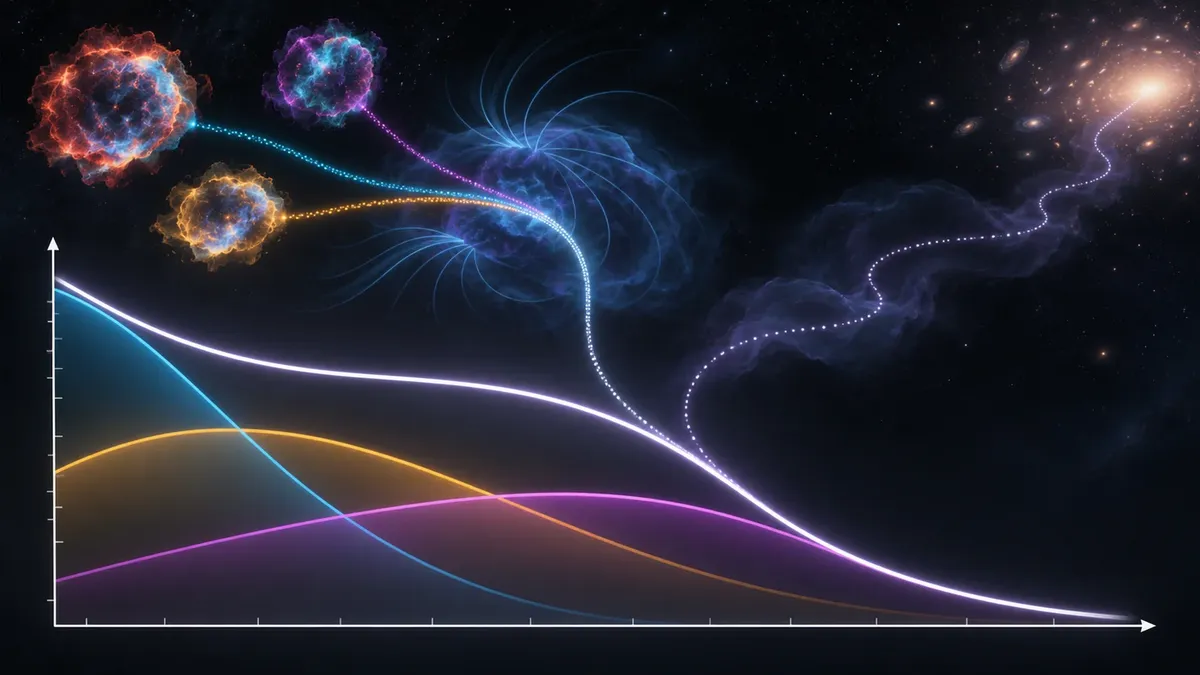
Cosmic rays reach Earth across a vast range of energies, but their sources and journeys remain uncertain. This preprint fits measured proton data with three components, then explores separate models for the ultra-high-energy part of the spectrum.
Cosmic rays are energetic particles traveling through space. Their measured energies span a wide range, but how different sources contribute remains an open question. In this version 1 arXiv preprint, Timur Dzhatdoev, Ilya Kudryashov and Anatoly Semenov fit the proton spectrum from 40 gigaelectronvolts (GeV) to 10 exaelectronvolts (EeV) with three components. They suggest these could correspond to distinct populations of supernova remnants (SNRs), the expanding debris left by stellar explosions.
Fitting the proton spectrum
The authors combine proton-spectrum measurements from DAMPE, LHAASO and IceTop with an estimate based on Pierre Auger Observatory data. Auger measures cosmic-ray nuclei together rather than isolating protons. To estimate the proton intensity, the authors multiply an observed proton fraction by an approximation of the total, all-nuclei spectrum. They report energy-calibration factors for LHAASO, IceTop and Auger; DAMPE is not listed among the datasets receiving that adjustment.
Using the emcee fitting program, they fit the combined spectrum with three mathematical components. These are not all described by exactly the same curve: the first uses a smoothly broken power law with an ankle, while the second and third use smoothly broken power laws. Parameters for the first two components are taken from an earlier study; the paper gives parameters for the third. The fit is phenomenological: it tests whether the chosen mathematical shapes describe the assembled measurements, not whether particular remnants have been identified as the sources.
The authors report that the three-component sum reasonably describes the data across the stated energy range. They suggest the components could represent SNR populations with different maximum particle energies. As context, they note that typical remnants are expected to accelerate protons to around 10 teraelectronvolts (TeV), while hypernovae or remnants with sub-relativistic shock speeds may reach roughly 1 EeV. These are proposed acceleration capabilities, not detections linking specific remnants to the fitted components.
Separate models for ultra-high energies
The paper then discusses two scenarios for the ultra-high-energy cosmic-ray spectrum. These are distinct from the three-component fit: they explore possible origins and propagation at the highest energies rather than demonstrating that the fitted components come from either setting.
In the supergalactic scenario, the authors consider diffusion in a nearby magnetic structure with a characteristic radius of 1–20 megaparsecs. They discuss a local magnetic field that could reach about 1 microgauss. To illustrate a possible anisotropy signal—a difference in arrival directions—they calculate an example for iron nuclei at 8 EeV, under specified assumptions about diffusion, source distribution and distance. Their example estimate is described as not very far from the reported measurement. It is a model comparison for that case, not a general result for all cosmic rays or evidence that the assumed structure exists.
In the cosmological scenario, the calculation allows sources out to a maximum redshift of 6. It uses a specified source-evolution history and an assumed injected proton spectrum, then models propagation with CRPropa 3.2. The calculation includes energy losses from interactions with the cosmic microwave background and extragalactic background light, as well as losses associated with cosmic expansion. In this model, photopion losses produce a cutoff above 50 EeV, associated with the Greisen–Zatsepin–Kuzmin effect. This outcome depends on the adopted source and propagation assumptions; the paper does not present it as a direct measurement of those conditions.
What the fit cannot settle
A reasonable fit shows that the selected mathematical components can describe the assembled proton data; it does not establish that star formation or three particular SNR populations are the actual explanation. Some data are not direct proton measurements. In particular, the Auger-derived proton intensity is estimated using a measured proton fraction and an approximated all-nuclei spectrum. That distinction matters when interpreting the fit, especially at energies where the proton contribution is inferred rather than separately measured.
The authors also state that protons are probably subdominant in the total ultra-high-energy cosmic-ray intensity above about 4 EeV, where heavier nuclei may dominate. Their extension to helium and heavier nuclei is preliminary; they say a detailed treatment of nuclear photodisintegration remains necessary.
The evidence here is a version 1 arXiv preprint, not a settled account of cosmic-ray origins. Its spectrum fit and propagation calculations support model interpretations under stated assumptions, but do not select between the two ultra-high-energy scenarios or establish the proposed source populations as fact.
- cosmic rays
- proton spectrum
- supernova remnants
- star formation
- ultra-high-energy cosmic rays
- astrophysics
Related reading
Automatically matched by shared topic keywords. These links do not imply that the sources agree or establish a consensus.
Why ultra-high-energy cosmic rays may need metal-rich sources
Source published
Shared keywords: ultra high energy cosmic rays
Could Nearby Radio Galaxies Explain the Highest-Energy Cosmic Rays?
Source published
Shared keywords: ultra high energy cosmic rays
Auger searches cosmic-ray directions for patterns at different scales
Source published
Shared keywords: ultra high energy cosmic rays
Reading the first moment of a cosmic-ray shower
Source published
Shared keywords: ultra high energy cosmic rays
One Gamma-Ray Glow, Two Possible Sources
Source published
Shared keywords: cosmic rays