TRANSMISSION // 2611.32656v1
What stellar chemistry can tell us about binary stars
Source published
A study of 181,011 nearby FGK dwarf stars finds that inferred binary patterns vary with metallicity and individual elements, but these links are correlations, not proof of causes.
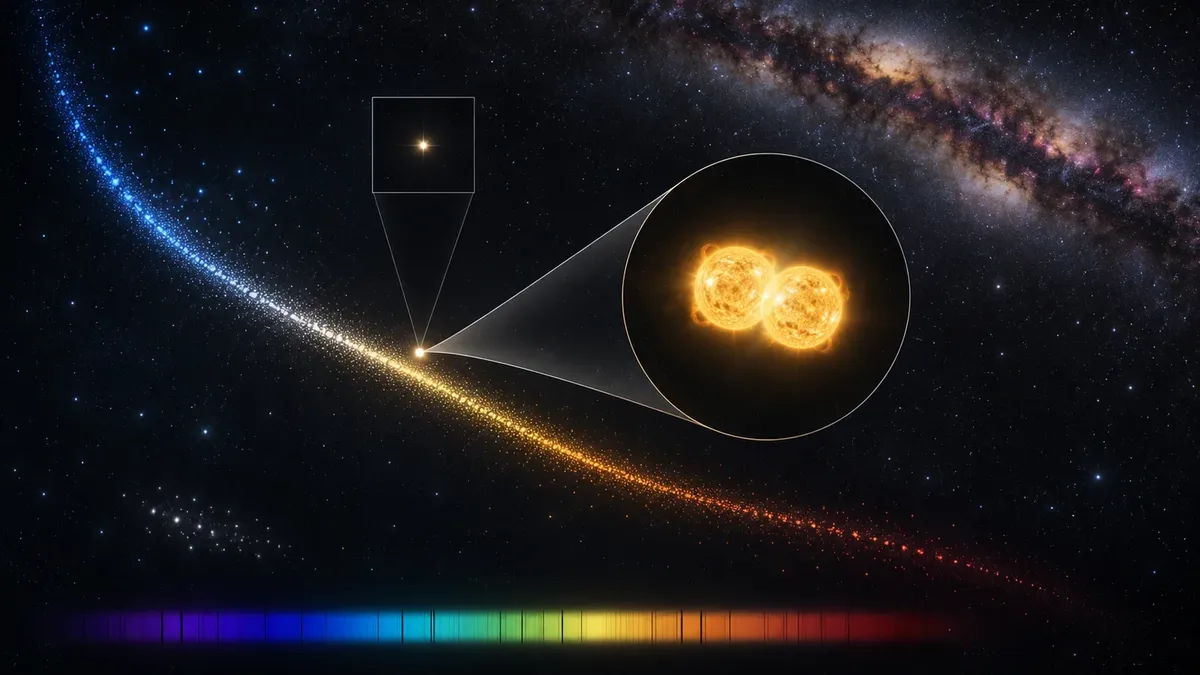
Unresolved binary stars can leave a subtle color signature in their combined light. Using Gaia and LAMOST data, researchers looked for that signature in nearby Sun-like stars and asked how the inferred binary population varies with chemistry and age.
A pair of stars can look like a single point of light when a telescope cannot separate them. But the companion still contributes light, sometimes shifting the system’s colors away from the pattern expected for one star. Researchers can use that subtle difference to estimate the frequency of unresolved binaries without tracking stellar motion over time.
A new study applies this approach to 181,011 FGK dwarf stars—roughly Sun-like stars—within 1,000 parsecs of the Sun. The researchers ask whether the fraction of systems identified as binary, and the distribution of companion masses, vary with chemical composition or age. The study is a preprint on arXiv, so its findings should be considered preliminary rather than settled scientific consensus.
Reading the color pattern
The team combined measurements from Gaia Data Release 3 with stellar properties from LAMOST’s ninth data release. Gaia’s low-resolution XP spectra were used to calculate synthetic BP, G and RP magnitudes. LAMOST data supplied estimates of temperature, surface gravity, iron abundance and, for some stars, individual element abundances. A separate catalog provided estimated stellar ages.
Their method, called Stellar Locus Outlier (SLOT), begins by fitting the color pattern of stars thought to be single. An unresolved companion can shift a system’s colors from that reference, contributing to an asymmetric tail in the distribution of color offsets. The researchers simulated samples of single stars and binaries, then compared these models with observed offsets to estimate the binary fraction.
They also tested different models for the mass-ratio distribution: the relative masses of a star and its companion. In particular, they estimated the distribution’s slope at higher mass ratios rather than fixing its shape. Because several models could fit the observations similarly well, they averaged over compatible models instead of selecting only the single best fit.
The analysis used quality cuts and focused on stars within a selected color range. It is therefore not a census of every nearby star or every kind of binary. SLOT detects systems through their combined light, and its sensitivity depends on how much light the companion contributes.
Chemistry and the inferred binary population
In the thin-disk subsample, the inferred binary fraction generally fell as iron abundance increased. It ranged from roughly 0.4–0.5 in some metal-poor bins to about 0.25–0.30 near solar iron abundance, and was around 0.15 in the most metal-rich bin studied. The researchers found no clear equivalent trend across the thick-disk sample, where estimates were roughly 0.25–0.35 across the iron-abundance range. These figures describe the study’s selected sample and method, not the fraction of all Milky Way stars with companions.
The mass-ratio results suggest a possible metallicity link as well. More metal-rich bins tended to favor a steeper, more negative slope in the high-mass-ratio part of the distribution. In the researchers’ model, this corresponds to relatively fewer systems with intermediate companion-to-primary mass ratios and a distribution more weighted toward lower mass ratios. The team emphasizes that this result is qualitative: the method has limited precision for the mass-ratio distribution, and its inferred slope depends on assumptions about where the model changes between low and high mass ratios.
The element-by-element results differ. In thin-disk-dominated groups, magnesium and silicon abundances tended to be anticorrelated with the inferred binary fraction, while calcium showed a positive correlation. The study found no significant abundance correlations in bins dominated by thick-disk stars. These are statistical associations, not evidence that an element directly determines whether a binary forms. The authors note that temperature, age, data quality and disk membership were not all controlled across the abundance bins.
A modest age pattern, with important caveats
Across ages from 1 to 10 billion years, the estimated binary fraction varied modestly. In the thin-disk-dominated range, it rose between about 2 and 6 billion years; the increase then slowed, with no significant further rise in the oldest bins. The researchers caution against interpreting this as a simple effect of aging. The age estimates partly reflect chemical patterns, so the apparent age trend may instead trace relationships involving chemical composition.
Selection also matters. Unresolved binaries can be brighter and easier to include in a sample, even though the distance limit was intended to reduce this bias. The method detects only systems whose companions leave a measurable color signature. Gaia’s angular resolution also means that pairs wider than roughly 2 arcseconds may be resolved as separate stars and thus missed as binaries by this analysis. The authors tested distance-related effects and found their main trends persisted, but such checks cannot remove every uncertainty.
The analysis models single stars and binaries. Although higher-order multiples could also affect colors in principle, the authors estimate their additional contribution is below the measurement precision and treat all multiples as binaries in the model.
Overall, the results point to a complex relationship between binary populations, chemistry and Galactic history—not a single chemical rule. The study offers a large-sample analysis using Gaia-derived colors, but further work is needed to test how robust the trends are across samples and modeling choices.
- binary stars
- Gaia XP
- stellar chemistry
- metallicity
- FGK dwarf stars
- mass-ratio distribution
- Milky Way
Related reading
Automatically matched by shared topic keywords. These links do not imply that the sources agree or establish a consensus.
Milky Way stars reveal chemistry and motion don’t tell the same story
Source published
Shared keywords: milky way, stellar chemistry
A Nearly All-Sky Dust Catalog for 87 Million Stars
Source published
Shared keywords: milky way
Testing Spectra for Hidden Stellar Companions
Source published
Shared keywords: binary stars
Lead-Rich Stars Offer Clues to a Hidden Heavy-Element Factory
Source published
Shared keywords: binary stars
A hidden population of faint neutron-star binaries
Source published
Shared keywords: binary stars, milky way