TRANSMISSION // 2611.32654v1
DexWAC: Teaching robots to act, predict and evaluate
Source published
DexWAC trains a robot policy alongside models that predict action outcomes and estimate task value. Simulation and two physical tasks show promise, but broader reliability and scalability remain open questions.
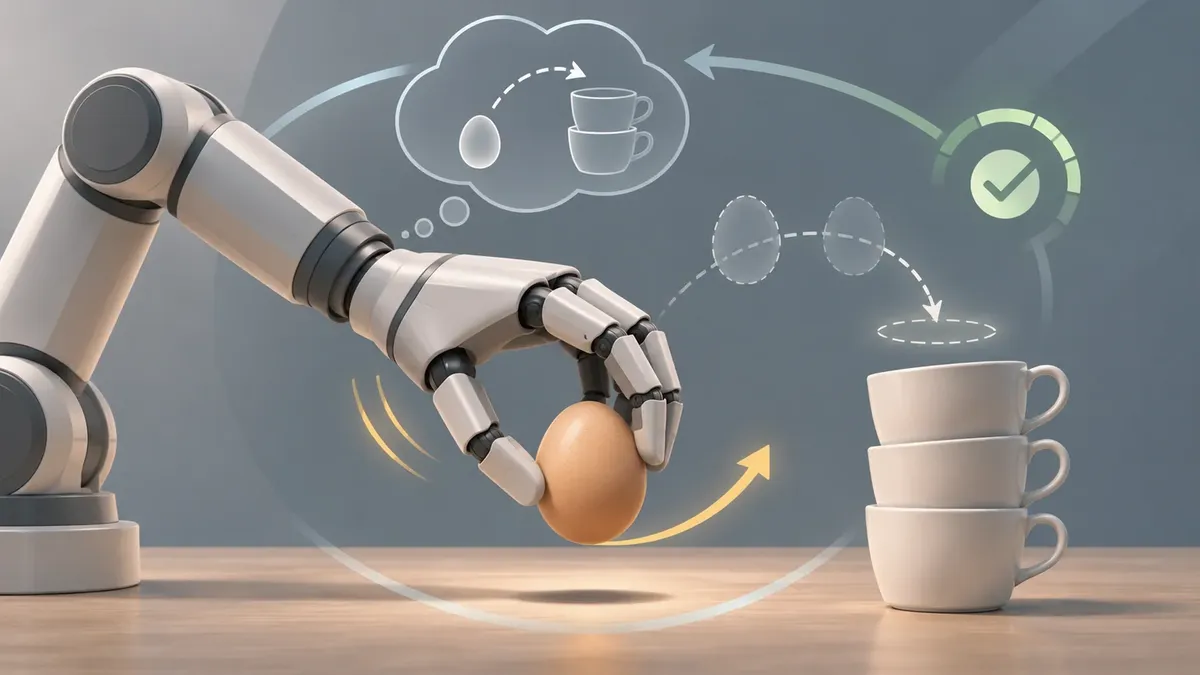
Robot demonstrations record more than movements: successful and failed trajectories can also help indicate how actions change a scene and whether the task is progressing. DexWAC uses these signals to train an action-producing model together with a predictor and a value estimator. Its reported results are promising, but the physical tests cover only two tasks, and the authors say reliable improvement and large-scale scalability remain unresolved.
A robot learning to move an egg between trays or separate a cup from a stack needs more than a list of movements. It also needs to learn how actions relate to changes in the scene and which outcomes matter for success. DexWAC, a proposed system for dexterous robot manipulation, combines action learning, prediction and value estimation in one training framework.
Vision-language-action (VLA) models map observations and instructions to actions. World-action models (WAMs) add predictions of future observations, but the authors argue that these predictions have often served mainly as an auxiliary training objective. Other approaches may train a world model and a value model separately. DexWAC asks whether a robot can learn to act, predict and estimate value in a single pretraining process.
One model, three jobs
DexWAC combines an actor, which proposes actions; an action-conditioned world model, which predicts selected consequences; and a critic, which estimates the value of a state. Its architecture has a generative world-model backbone and a compact actor–critic expert with separate weights. They share representations through attention: the expert reads features produced by the backbone.
The training targets include demonstrated actions, predicted future states and visual features, and reward and continuation targets constructed from successful and failed trajectories. For each action chunk—a short sequence of controls—the world model predicts a visual latent representation and the robot’s proprioceptive state at the chunk’s endpoint, as well as reward and whether the episode continues. That supplies an imagined transition without generating intermediate video frames.
Training proceeds in stages. First, the actor, world model and critic are trained together. Next, the researchers adapt the world model and critic using demonstrations and successful and failed rollouts from the pretrained actor, leaving the actor unchanged during this adaptation. For policy improvement, they test two routes using imagined experience. PPO updates the actor with behavior-cloning regularization on expert actions. Alternatively, critic-guided best-of-N selection uses a critic trained on imagined transitions to rank candidate action chunks. The imagined rollouts are short, which the authors say helps limit accumulating model error.
What the tests found
The study evaluates DexWAC in the DexJoCo and RoboTwin 2.0 simulations and on two tasks with physical robots. In DexJoCo, the jointly pretrained policy averaged 65.5% success across the evaluated tasks, close to Motus at 66.83% and above the reported 57.92% for π0.5. On RoboTwin 2.0, DexWAC reached an 88.1% average across 50 tasks; the paper reports 87.8% for Motus and 87.5% for FACT.
For prediction quality, the researchers tested held-out DexJoCo trajectories against Ctrl-World, FACT and VLA-MBPO under the study’s evaluation setup. They report that DexWAC achieved the best results on all six image-quality metrics, using three denoising steps. Its reported chunk-endpoint prediction latency was 0.214 seconds. The authors describe this as approximately 8.5 times faster than FACT, 20 times faster than Ctrl-World and 300 times faster than VLA-MBPO. These measurements were made on an RTX 5090 with the methods’ evaluated configurations; the paper notes the comparisons are not matched-compute tests, so the ratios are not general speed guarantees.
On DexJoCo, imagined PPO raised mean success from 65.50% before policy improvement to 67.75% after 500 updates. The gain was concentrated in bimanual tasks, and some individual skills regressed. Critic-guided selection reached 66.58% average success. These improvement results come from simulation, not the physical-robot trials.
For the physical tests, DexWAC used 300 demonstrations per task and was evaluated without the later policy-improvement step. Across 30 trials per task, its observed success was 50% for transferring an egg between trays and 100% for extracting a cup from a stack and returning it to the table. The reported π0.5 baseline results on those same tasks were 20% and 70%. These are limited trial results, not precise estimates of performance in other setups; the reported table does not give uncertainty estimates.
Ablations—experiments that remove parts of the training objective—also suggest that critic supervision helped in this setup. In the eight-task DexJoCo ablation, removing the critic reduced the reported average from 68.00% to 60.75%. These figures are from the ablation comparison, distinct from the Stage 1 headline average of 65.50%; they do not establish that the same effect will hold on other tasks or robots.
What remains uncertain
The authors identify reliable improvement in imagined environments as a challenge. They suggest that models trained on limited rollouts may miss contact outcomes, allowing a policy or critic to exploit prediction errors. This is their interpretation of a risk, not a guarantee that every imagined rollout is misleading. In additional experiments, IQL reduced average success, while applying another method’s original optimization settings led to policy collapse. Gains were not uniform across tasks.
The physical evidence covers two tasks and 30 trials per task. In simulation, the study uses eight of DexJoCo’s eleven tasks, excluding three that require long-horizon memory. The authors also say they have not evaluated DexWAC with large-scale robot pretraining. Its scalability across broader datasets, tasks and embodiments therefore remains unknown.
This work is an arXiv preprint; its availability there does not establish peer review. The findings are the authors’ reported results, not independent confirmation. Further evaluation would be needed to determine how the approach performs on untested tasks, datasets and robot embodiments.
- DexWAC
- robot manipulation
- world-action models
- robot learning
- model-based reinforcement learning
- dexterous robotics
Related reading
Automatically matched by shared topic keywords. These links do not imply that the sources agree or establish a consensus.
Teaching a robot model to predict what its actions will change
Source published
Shared keywords: robot learning, robot manipulation, world action models
Can a Robot Learn a New Task by Watching One Video?
Source published
Shared keywords: robot learning, robot manipulation, world action models
A robot model that predicts the moving target—not the whole world
Source published
Shared keywords: robot learning, robot manipulation, world action models
Can a general AI model control a robot arm?
Source published
Shared keywords: robot learning, robot manipulation
How a robot model learns from each task
Source published
Shared keywords: robot learning, world action models