TRANSMISSION // 2611.32649v1
What ICLWorld Reveals About AI Agents on Screens and Robots
Source published
ICLWorld tests whether agents can learn unusual rules from text or video and apply them in computer and robot tasks. Its results show a gap between identifying a rule and successfully acting on it.
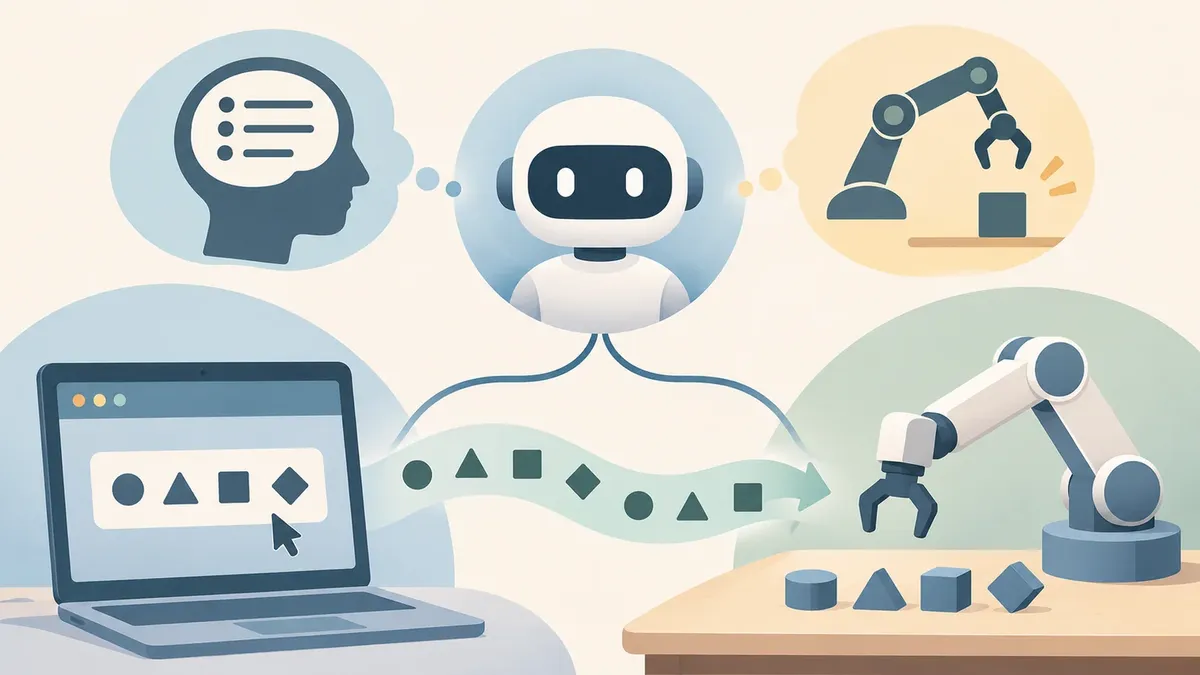
Can an AI agent learn a user’s instructions from an example and apply them when the situation changes? ICLWorld tests this question in computer interfaces and robot tasks. In this benchmark, agents did better on computer tasks than robot tasks, and answering a question about a rule did not guarantee successful action.
In-context learning is the ability to acquire a rule from information provided during a task, without updating a model’s parameters. It could let an agent adapt to a user’s requirements by reading an instruction or watching a demonstration. But identifying a rule and carrying it out are different challenges. ICLWorld is a benchmark designed to test both, across computer use and robot use.
The researchers created 160 tasks: 110 involving web or desktop applications and 50 involving tabletop robot manipulation. Each task has three versions with the same goal and starting situation but different rules. The rules were deliberately customized and sometimes counter-intuitive. The authors designed the tasks so that, without the rule, success would require guessing it; in practice, some no-rule computer runs did succeed by chance.
Agents received rules as written text or video demonstrations. The researchers built 30 environments and recorded 630 demonstration videos, totaling more than 10 hours. Their shared interface, UIverse, let agents observe and act in both domains through a graphical interface. Six models were tested, and software verifiers checked whether each task’s goal and rule had been met. The researchers also asked agents questions about rules before action and ran trials without giving the rule.
To distinguish learning a rule from repeating an example, the benchmark uses three levels of generalization. In a replay, the demonstrated situation is restored. In a resampled task, the agent faces a new instance in the same environment. In a relocated task, the rule and goal move to a counterpart environment with a different layout or, for robots, different physical conditions. Not every task supports every level.
In the main results, Claude Opus 5.5 and GPT-6 Astra succeeded on 82% and 76% of computer-use runs, respectively, compared with 27% and 26% of robot-use runs. These are results on ICLWorld, not measures of performance in every real-world setting. In a separate ablation on a 54-task subset, the three tested models succeeded on 2.7–8.1% of computer runs without the rule, and on 0% of robot runs. That control supports the authors’ view that the tasks generally required information from context, while showing that occasional computer successes could occur without it.
The difference between answering and doing was especially clear in the same 54-task subset. GPT-6 Astra answered rule questions correctly in 97.3% of computer cases and 98.0% of robot cases, but succeeded on 57.7% and 19.6% of the corresponding runs. GLM-5.3-Flash answered every robot rule question correctly in this subset yet succeeded on 5.9% of robot runs. A correct answer was therefore not a reliable sign that the agent could complete the task, particularly in the robot setting.
Text and video results depended on the model and task. In computer use, the text–video success gap for the two strongest agents was within two percentage points of zero. Four other models did better with text on average in that domain. Video-based success by weaker agents fell when the demonstrated situation was replaced with a new instance: on 13 replayable computer tasks, their video success dropped from 84.6% to 46.2%. This suggests that replay can reward copying specific actions rather than learning a rule. On a separate 37-task computer subset, the strongest agents’ success stayed within three percentage points when tasks moved to counterpart applications. These findings apply to the tested models and subsets, not to transfer in general.
ICLWorld shows a benchmark gap, but it does not establish one general cause for that gap. Robot tasks require interpreting camera views and controlling arms through sequences of movements; computer tasks involve different actions. The shared interface makes the comparison more consistent, but does not make the tasks equivalent. Robot execution in this benchmark was in simulation, not a real-world robot evaluation.
The authors list further limits: the environments are hand-built, the benchmark has 160 tasks, some analyses use only three models, and no task combines computer and robot use. The paper is an arXiv preprint, which may not have undergone peer review; the source does not establish independent validation. ICLWorld offers a structured test of learning and acting under rules, but its findings should be interpreted within these boundaries.
- AI agents
- in-context learning
- robotics
- computer-use agents
- AI benchmarks
- generalization
Reviewed cross-references
These connections were reviewed by a model, not independently fact-checked by a human. Similarity does not imply agreement; consult the original papers and the evidence below.
Can AI benchmarks keep up with computer-use agents?
Shared method: Both assess agents acting in interactive environments and verify outcomes against task requirements: ICLWorld describes rule-specific verifiers, while CUA-SEE uses executable, state-grounded checkpoints. This is a bounded methodological connection, not a direct performance comparison; ICLWorld spans computer and simulated robot tasks, whereas CUA-SEE evaluates computer-use agents.
Model review: · openai-codex/gpt-6-luna
Evidence and provenance
Selected excerpts, not complete papers. PDF extraction can omit figures or damage equations, tables and reading order; sources may be preprints.
2611.32649v1 — Original paper
Excerpt reference:
static/papers/2611.32649v1.md:13-145
Basis: Paper text
Source SHA-256:7f551d1d27d0710b2fece4088f1aaab6af3f4b65897a58b38c7422ac99a985be2611.32649v1 — Original paper
Excerpt reference:
static/papers/2611.32649v1.md:146-214
Basis: Paper text
Source SHA-256:7f551d1d27d0710b2fece4088f1aaab6af3f4b65897a58b38c7422ac99a985be2611.30962v1 — Original paper
Excerpt reference:
static/papers/2611.30962v1.md:81-256
Basis: Paper text
Source SHA-256:437b78faae070becbfe784827e1db4c4582c5b950ef96bb9b9050f5779868d04
Related reading
Automatically matched by shared topic keywords. These links do not imply that the sources agree or establish a consensus.
Why computer-savvy AI struggles with a real keyboard
Source published
Shared keywords: ai benchmarks, computer use agents
Can AI benchmarks keep up with computer-use agents?
Source published
Shared keywords: ai benchmarks, computer use agents
Why AI Can Get Civil Time Wrong
Source published
Shared keywords: ai benchmarks
How Robot Memory Can Guide the Next Move
Source published
Shared keywords: in context learning
How a robot can learn from its own attempts
Source published
Shared keywords: in context learning