TRANSMISSION // 2611.32639v1
ReFocus gives robots extra practice where they stall
Source published
A reinforcement-learning framework tracks progress through multi-step tasks, diagnoses bottlenecks and directs extra practice to difficult stages. Results are promising, with important limits.
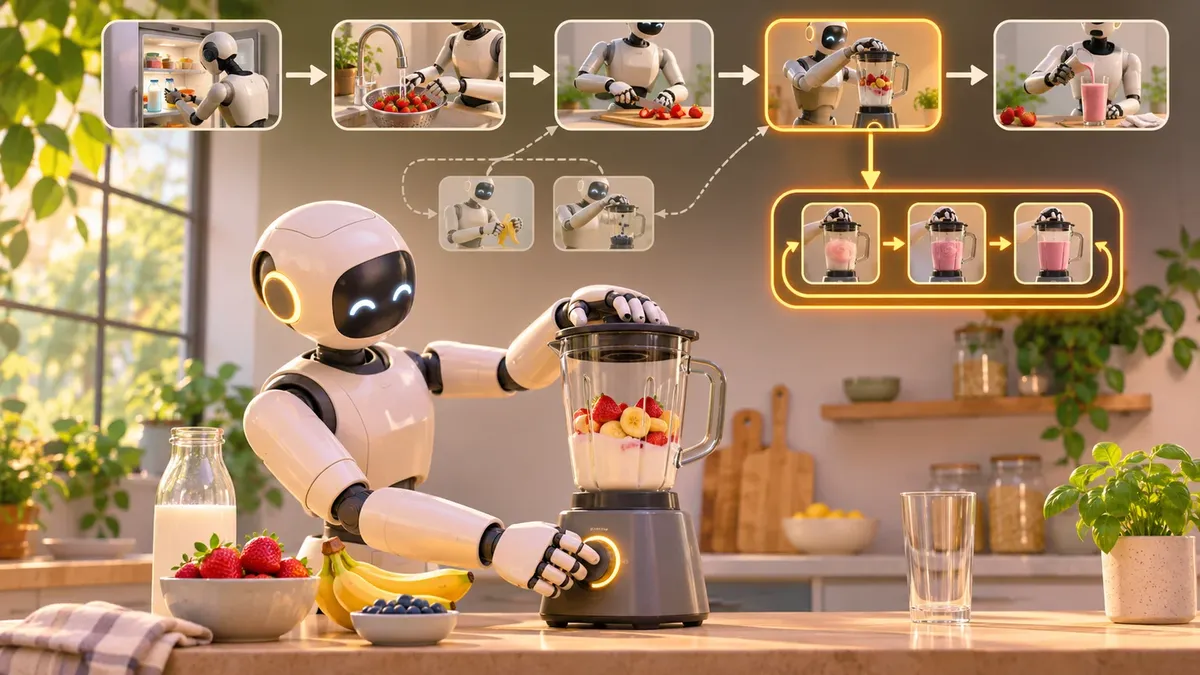
A robot can fail a long task at very different points, yet a simple success-or-failure signal treats every failed attempt alike. ReFocus aims to make that feedback more useful: it maps task steps, spots recurring stalls and gives a robot extra practice on the stages it struggles with.
A robot asked to load a dishwasher, place dishes on a rack and close the door must get through a sequence of dependent actions. If it fails near the end, a simple failure signal may not distinguish that attempt from one that failed at the first grasp. That makes it hard to tell what the robot should practice next.
A framework called ReFocus addresses this problem in long-horizon robotic manipulation: tasks that require a robot to complete multiple connected steps. The researchers use reinforcement learning, in which a policy improves through interaction and feedback, to help vision-language-action (VLA) policies learn from their own attempts. Their central idea is to track partial progress, identify stages where a policy repeatedly stalls, and focus additional training on those bottlenecks.
Turning task progress into a training signal
ReFocus first represents a task as a directed acyclic graph, or DAG. In practical terms, this is a map of subtasks and their prerequisites: some actions can happen in either order, while others must wait until earlier steps are complete. For example, a robot might need to put two dishes on a rack before moving on to closing the dishwasher.
During Global RL, the policy attempts whole tasks. A progress reward gives credit for verified subtask completions, not just for finishing the entire task. The reward is divided across stages so that a stage does not receive more credit simply because it has been split into more small subtasks. The researchers also use records of progress, failed attempts and visual observations to diagnose where a policy repeatedly stops advancing.
Then, during Local RL, a scheduler selects an “Adaptive Practice Window”: a segment of a task running from an entry stage to a target stage. The policy gets extra practice on that segment, while the researchers continue updating the whole policy rather than training an entirely separate specialist. Three types of training rollout connect this focused practice to the task as a whole: one concentrates on the selected window, one starts from the normal task beginning and reaches the target, and one continues from the window toward full-task completion. The system alternates between these focused rounds and whole-task training and evaluation.
Results in simulation and on a robot
The authors evaluated ReFocus on LIBERO-Long, a simulation benchmark with long tabletop tasks, and a selected set of 16 Composite-Seen tasks from RoboCasa365, a kitchen-task simulation benchmark. Starting from a supervised-fine-tuned π0.5 policy, ReFocus reached reported average success rates of 97.8% on LIBERO-Long and 51.3% on RoboCasa365. The starting policy scored 90.6% and 39.3%, respectively. The paper also compares ReFocus with several reinforcement-learning baselines and reports higher overall success on both benchmarks.
The authors tested a real-robot adaptation on a Unitree G1 humanoid across three tasks: stacking bowls, picking fruit and putting bread in a toaster before pressing its switch. Because restoring intermediate states is impractical on physical hardware, this version did not use the simulator’s Local RL procedure in the same way. Instead, it adapted RECAP, a method that trains from recorded rollouts, adding progress rewards and giving more training weight to selected task segments. The paper reports results averaged over three runs, with 20 trials per task in each run. For ReFocus-based adaptation, reported success was 100% on StackBowl, 100% on PickFruit and 95% on BreadBaker. The SFT-initialized comparison policy scored 80%, 75% and 30%, respectively; RECAP scored 90%, 85% and 70%.
What the results do—and don’t—show
These experiments suggest that tracking intermediate progress and targeting practice can improve performance in the tested tasks. They do not establish that ReFocus will work equally well for other robots, tasks or environments. The real-world evaluation covers only three tasks and a limited number of trials, and its training procedure differs from the simulator’s. In simulation, the reported scores also depend on task definitions and completion checks designed for those benchmarks. A scheduler helps select practice windows, and the paper reports that its choice of language model affects results and cost.
The evidence comes from an arXiv preprint, which may not have undergone peer review. The reported results should be read in light of the authors’ experimental setup, not as a guarantee of general performance. The paper’s limitations note that some simulator training relies on restoring intermediate states, a capability that is not readily available on physical hardware; extending the scheduler to intervene during task execution is presented as future work.
Source: ReFocus: Progress-Guided Adaptive Practice for Long-Horizon Robotic Manipulation Reinforcement Learning, arXiv preprint.
- robotics
- reinforcement learning
- robot manipulation
- vision-language-action models
- long-horizon tasks
- adaptive practice
Reviewed cross-references
These connections were reviewed by a model, not independently fact-checked by a human. Similarity does not imply agreement; consult the original papers and the evidence below.
When a robot misses a grasp, force feedback can cue a retry
Shared method: Both methods use localized reinforcement learning to improve behavior in a selected part of a manipulation task: ReFocus allocates Local RL to diagnosed bottleneck windows while updating the shared policy, whereas FoRe refines a dedicated retry policy from post-failure grasp states. This is a shared training approach, not evidence that the methods or their results are interchangeable; their targets and policy designs differ.
Model review: · openai-codex/gpt-6-luna
Evidence and provenance
Selected excerpts, not complete papers. PDF extraction can omit figures or damage equations, tables and reading order; sources may be preprints.
2611.32639v1 — Original paper
Excerpt reference:
static/papers/2611.32639v1.md:131-191
Basis: Paper text
Source SHA-256:c2edd64e5a752db8ccd3dc39cba42712d4076f83c109649c6b6e492811d306cd2611.27011v1 — Original paper
Excerpt reference:
static/papers/2611.27011v1.md:83-151
Basis: Paper text
Source SHA-256:8f58f9ea3b73eabc626b4d28024538a4c21254db490963de5128b89585d41045
Related reading
Automatically matched by shared topic keywords. These links do not imply that the sources agree or establish a consensus.
How a robot can learn from its own attempts
Source published
Shared keywords: reinforcement learning, robot manipulation, vision language action models
When a robot misses a grasp, force feedback can cue a retry
Source published
Shared keywords: reinforcement learning, robot manipulation, vision language action models
Teaching robot actions to stay on track—and gentle
Source published
Shared keywords: reinforcement learning, robot manipulation
Can a general AI model control a robot arm?
Source published
Shared keywords: robot manipulation, vision language action models
Teaching Robot AI to Focus on Motion, Not Scenery
Source published
Shared keywords: robot manipulation, vision language action models