TRANSMISSION // 2611.32629v1
When photons return, compact stars cool more slowly
Source published
A ray-tracing study finds that photons returning to an ultracompact star can slow its cooling and raise the surface luminosity needed to balance gravity.
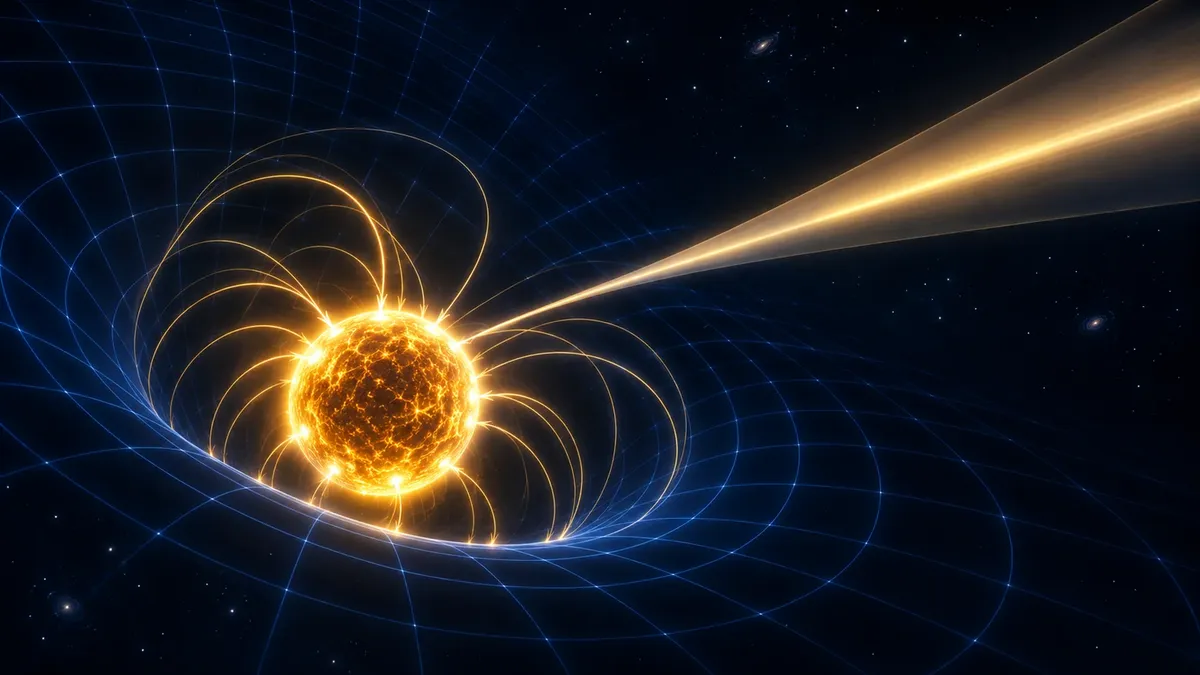
What happens to a star’s radiation when its surface lies inside the photon sphere? A theoretical study follows light through curved spacetime and finds that some photons can curve back to the surface. Their return affects both cooling and the balance between radiation pressure and gravity.
The Eddington limit is often described as a tipping point: radiation pushes outward strongly enough to balance gravity. For an ordinary star, it provides a useful link between an object’s properties and its brightness. But what if a compact object has a physical surface so close to its gravitational boundary that light can follow paths that bring some photons back to it? In that case, the usual picture needs reconsideration.
In an arXiv preprint, Tisha Desai and colleagues examine spherical stars whose surfaces lie inside the photon sphere, the region associated with unstable circular photon orbits. They ask how returning light affects the critical luminosity—the brightness at which radiation pressure balances gravity—and the rate at which a star loses energy as radiation.
Following light around a compact star
The researchers use analytical ray-tracing formulas in Schwarzschild spacetime, the standard description of gravity outside a non-rotating spherical mass. They assume a spherical photosphere emitting radiation isotropically. Outside it, they track photons along curved paths, neglecting interactions such as scattering in a surrounding medium.
For a surface outside the photon sphere, the study treats outward-emitted photons as able to escape. For a surface inside it, only photons emitted within a limited range of directions—the “escape cone”—can reach distant observers. Others curve back and strike the star. The team uses this geometry to calculate both the luminosity seen far away and the momentum carried by returning photons.
That distinction matters. A distant observer sees fewer photons from an ultracompact surface, but the photons that fail to escape have not vanished: they deliver energy and inward momentum when they return. The paper argues that a calculation counting only escaping light misses this contribution.
A different balance between light and gravity
The authors find that returning photons reduce the net outward radiation flux at the surface. For a fixed intrinsic luminosity, that means the star cools more slowly: less energy escapes to infinity. The same inward momentum means that a higher surface luminosity is needed for radiation pressure to balance gravity.
The paper’s central result is that these effects compensate in the observed critical luminosity. Under the study’s assumptions, the luminosity at infinity for a star radiating at this critical balance follows the same redshifted expression whether the surface lies inside or outside the photon sphere. The authors say this revises a formula used in earlier X-ray-burst discussions, which accounted for the escape cone’s reduction in observed light but did not include the force from photons returning to the surface.
Below the photon sphere, the equilibrium is also different in character. It is non-local: the radiation force at one patch of the surface depends partly on photons emitted elsewhere and returning later. The authors therefore require the system to remain approximately steady over the photons’ travel-and-return time. They suggest that this coupling could allow symmetry breaking and uneven emission across the surface, but present that as a possible consequence, not an observed result.
What the result does—and does not—establish
These are calculations within an idealized model, not observations of a confirmed ultracompact star. The analysis assumes a non-rotating Schwarzschild geometry, spherical symmetry and isotropic emission, and neglects scattering outside the surface. The paper notes that limb darkening could modify the radiation force, and that its critical-luminosity expression may not apply during a rapidly changing burst rise if conditions change on timescales comparable to photon fallback. Beamed emission and other departures from spherical symmetry also require different treatment.
The work therefore does not show that such a star exists or establish that real bursts must behave as predicted. It identifies a physical effect that models of sufficiently compact objects should consider: photons outside the escape cone can return and push inward. This is a theoretical result presented in an arXiv preprint; the supplied source does not establish its peer-review status.
- compact stars
- photon sphere
- Eddington luminosity
- general relativity
- photon fallback
- X-ray bursts
Related reading
Automatically matched by shared topic keywords. These links do not imply that the sources agree or establish a consensus.
Dark Matter and the Evolution of Strange Stars
Source published
Shared keywords: compact stars
Neutron Star Tides Could Complicate Tests of Einstein’s Gravity
Source published
Shared keywords: general relativity
When LISA’s other signals hide a test of gravity
Source published
Shared keywords: general relativity
Galaxy clusters test growth under a fixed cosmic model
Source published
Shared keywords: general relativity
Using a black hole’s ringdown to examine nonlinear gravity
Source published
Shared keywords: general relativity