TRANSMISSION // 2611.32623v1
When translation metrics trust the wrong reference
Source published
A benchmark finds that machine-translation metrics can miss flawed references, especially when a plausible name is swapped for the wrong one.
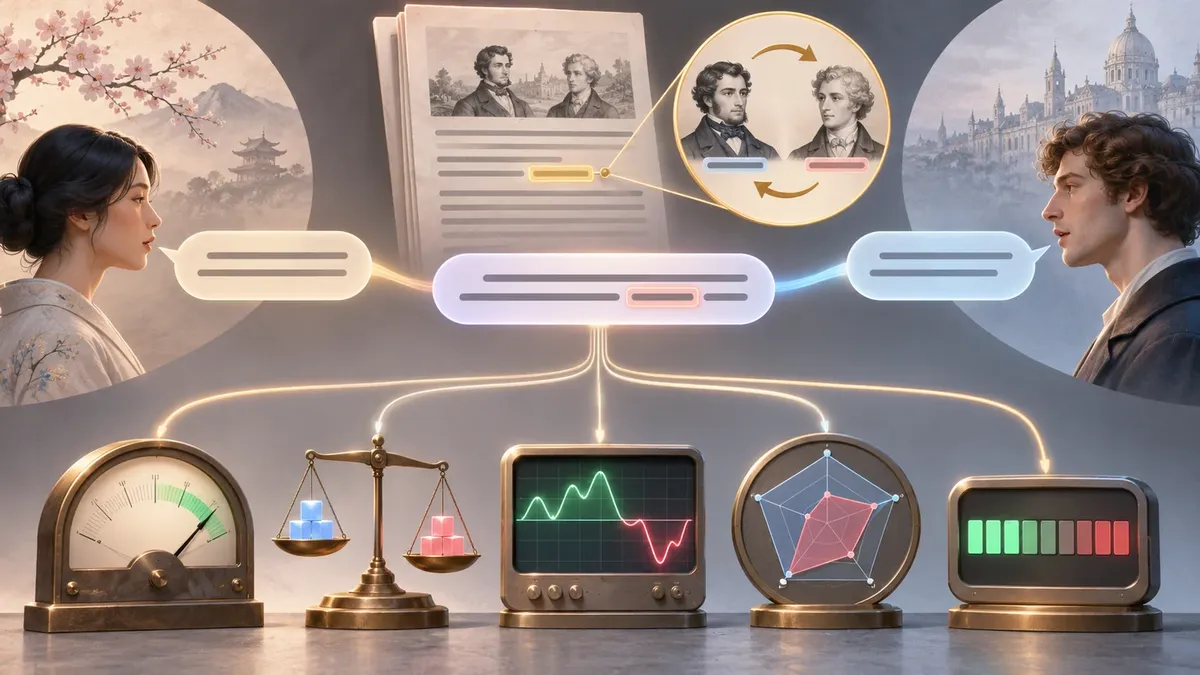
Automatic translation scores often compare a system’s output with a human-written translation. But what if that reference is wrong? A new benchmark tests how eight metrics respond to deliberately flawed references—and finds that even newer learned metrics share a blind spot.
Machine-translation systems are often judged by comparing their output with a human translation, called a reference. The closer the match, the better the score is generally taken to be. But there may be many valid ways to translate a sentence, and the reference itself can contain mistakes. If a system produces a better translation than the reference, a metric that rewards similarity may give a misleading result.
In the preprint REBEAL, Ahrii Kim, Chanjun Park and Seong-heum Kim examine two related questions: how often do human references contain annotated errors, and how do automatic metrics respond when references are flawed? Their work does not show that human translations are generally unreliable. Instead, it tests particular kinds of errors and asks whether metrics can distinguish a clean reference from a deliberately contaminated version.
Seven ways to flaw a reference
The authors first examine human-reference annotations from WMT machine-translation evaluation campaigns between 2022 and 2024. In the 2024 campaigns they analyze, the human reference ranked below the best system in all three language pairs. Across the campaigns with reference annotations, the share of reference segments marked with at least one error ranged from 18.6% to 86.7%. The researchers caution that differences in annotation practices and error rates across campaigns affect this range; it is not a direct, universal measure of reference quality.
The team then created REBEAL, a benchmark based on human post-edited translations in English-to-German, English-to-Chinese and English-to-Korean. For each segment, they kept a clean reference and made a version with one of seven controlled changes. These included typos, copied source-language text, an unrelated language, a sentence from elsewhere in the same document, an unsupported addition, a flipped positive or negative meaning, or a changed named entity—for example, replacing one person’s name with another.
Eight metrics scored the same machine-translation output against both versions. The set included character-overlap and embedding-based measures, learned reference-based metrics such as xCOMET and MetricX, and reference-free quality-estimation systems that judge a translation using the source rather than a reference. Human checks supported the benchmark: across the language pairs, annotators preferred the clean version in an average of 99.8% of sampled comparisons. This confirms that the constructed changes were generally judged harmful; it does not establish how often each type occurs in everyday translation.
A shared blind spot
On average across the tested contamination types, the newer learned reference-based metrics xCOMET-XXL and MetricX-24-XXL had lower rates of ranking a contaminated reference above its clean counterpart than older or surface-oriented metrics. But no metric family was reliable in every case.
The clearest shared weakness was a swapped named entity. Character-based chrF and BERTScore often gave the altered reference a higher score than the clean one. The learned metrics did better, but still assigned a higher score to the contaminated version in roughly one in four segments in this test. A single swapped entity was particularly easy to miss. The authors connect this to real-world evidence: among reference segments with an annotated named-entity error in the three releases that label this category separately, 87% had exactly one such error.
That blind spot could affect comparisons between translation systems, not just individual scores. When the researchers ranked nine systems, entity swaps changed the ordering of up to eight of the 36 possible system pairs, depending on the metric. Other errors exposed different weaknesses: surface metrics readily flagged references in an unrelated language, while learned metrics were more likely to treat those references as nearly correct.
What the study cannot settle
REBEAL is a controlled diagnostic, not a complete picture of translation quality. Its seven error types cover a median 37.6% of reference-error annotations in the campaigns analyzed. The benchmark applies one type of contamination at a time, even though real segments can contain several errors together. Its controlled tests use English as the source and only three target languages; the results may differ for other language directions. Two types of contamination were generated with an AI model, which may introduce patterns unlike human mistakes.
The authors also compare naturally flawed references in one English-to-German setting, describing that result as corroboration rather than an independent general test. And the paper’s finding that some reference errors are annotated does not mean every marked issue affects every metric equally.
The takeaway is not that reference-based scoring is useless. It is that a score can inherit assumptions from its reference—and that different metrics can fail in different ways. REBEAL measures those failures; it does not offer a complete fix. The paper is a preprint, so its claims should be treated as provisional pending further scrutiny and testing on broader data.
- machine translation
- translation evaluation
- REBEAL
- reference bias
- xCOMET
- MetricX
- AI benchmarks
Related reading
Automatically matched by shared topic keywords. These links do not imply that the sources agree or establish a consensus.
Can Reinforcement Learning Help Small Models Translate the Law?
Source published
Shared keywords: translation evaluation
Hy-MT3 expands multilingual translation and targets fewer errors
Source published
Shared keywords: machine translation, translation evaluation
Testing Vision-Language AI Across Seven Languages
Source published
Shared keywords: ai benchmarks
When should a translation system look at the picture?
Source published
Shared keywords: machine translation
Why a simpler AI pipeline may translate medieval Latin better
Source published
Shared keywords: machine translation