TRANSMISSION // 2611.32622v1
How RoboRecast adapts robot demonstrations to new situations
Source published
RoboRecast uses simulation feedback to adapt robot motions and scenes while preserving the interactions a task requires. Early tests show promise, with limits.
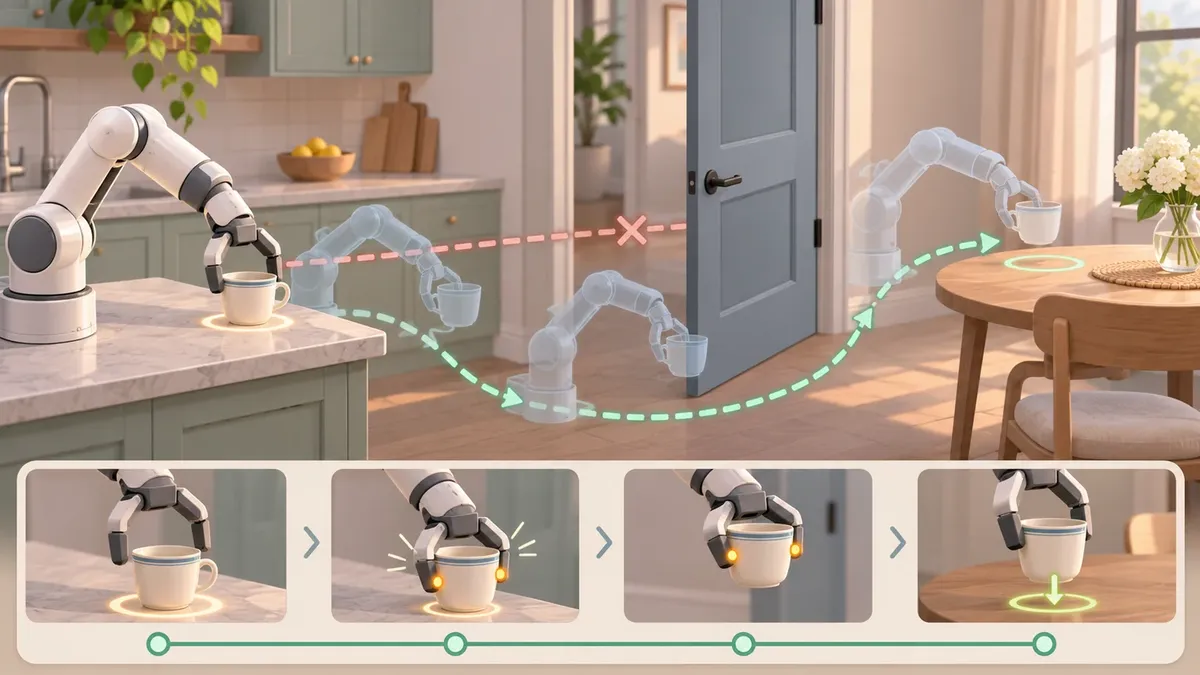
A robot’s familiar motion may fail when an object, layout or robot changes. RoboRecast aims to preserve what the demonstration accomplishes—not copy every movement—by revising scenes and trajectories together in simulation.
A robot demonstration is more than a sequence of arm movements. It also shows which objects must touch, what should change, and in what order. If a robot simply replays those movements with a different object or in a new layout, it may miss the target or collide with something. RoboRecast asks whether simulation can adapt a demonstration to new conditions while preserving the interactions that make the task work.
Preserve the task, adapt the motion
The researchers frame a task as a set of interaction requirements. These describe, for example, which gripper should contact a handle, whether that contact must be maintained, and what state change should follow—such as a door opening. Requirements also capture which steps must happen before others, while allowing independent actions to overlap.
The method reconstructs a simulated scene from a demonstration, maps the task’s objects and roles to a target configuration, and creates a robot trajectory using semantic waypoints. These waypoints specify positions, orientations, gripper actions and timing. Importantly, the method does not insist on preserving every source contact or path: it can choose a different grasp or route if that still achieves the required interaction.
The robot then attempts the task in the MuJoCo simulator. Checks look for issues such as unstable objects, collisions, unreachable poses and joint or speed limits. If a required interaction fails, the agent uses images and numerical logs—such as contact records—to diagnose a likely cause. It can revise scene details, physical properties or motion waypoints, then simulate again. In the paper’s example, a cup strikes a door during transport; the agent uses the failure evidence to consider whether the path needs more clearance. Verified earlier phases can be saved as checkpoints, avoiding unnecessary replay after some edits.
What the tests found
The team evaluated policies trained with RoboRecast-generated demonstrations in several settings. On a physical UR5 robot, adding reconstructed demonstrations to a set of real demonstrations raised average full-task success on three rigid-object tasks to 38.3%, compared with 18.3% for RoboSnap and 23.3% for AR2S in the reported comparison. On four layout-augmentation tasks, the average was 53.8% with RoboRecast-generated additions, versus 33.8% with MimicGen and 40.0% with CP-Gen. These are results for the paper’s particular tasks and setup, not a general ranking of methods.
The authors also tested adapting demonstrations to objects or robots without demonstrations collected in that target configuration. For three new-object tasks, policies trained on 50 synthesized trajectories per task reached an average full-task success of 21.7%; using 100 trajectories raised it to 33.3%. For a different robot, Piper-X, policies trained only on adapted trajectories reached 12.5% average success with 50 trajectories per task and 22.5% with 100. The paper reports additional gains in simulated bimanual tasks. Together, the results suggest the approach can generate useful training data, but do not show that it removes the need for target-specific data in general.
A small ablation study examined the optimization process on 20 demonstrations. With explicit interaction requirements, all 20 final rollouts succeeded, compared with 13 of 20 when the agent was prompted to reproduce the source trajectory and correct execution. In another comparison, targeted updates to scene or trajectory parameters reached all 20 successes in an average of 223 seconds. These results suggest that describing task effects and focusing revisions may help in this test; the study is limited in size.
What remains uncertain
Simulation success is not the same as reliable performance in the physical world. A simulation can misrepresent geometry, friction or contact, and generated images may not look sufficiently like real observations. The paper’s real-robot tests provide evidence beyond simulation, but cover a limited set of tasks, robots and objects. The method also relies on an agent to interpret demonstrations and diagnose failures, and generating each example involves scene modeling and repeated simulation. The authors identify efficiency, mobile manipulation, and visual realism and diversity as areas for further work.
The paper is an arXiv preprint, so its findings should be treated as provisional rather than as independently established conclusions. Its experiments compare methods under specific data, training and evaluation choices; results may differ in other settings. RoboRecast is best understood as a promising approach to demonstration augmentation, not proof that simulation can yet replace broad real-world robot training data.
- robot learning
- robot manipulation
- simulation
- synthetic demonstrations
- robot policy
Reviewed cross-references
These connections were reviewed by a model, not independently fact-checked by a human. Similarity does not imply agreement; consult the original papers and the evidence below.
Teaching Robots Through Verified Synthetic Touch
Supporting evidence: Both papers report policy-success gains after adding generated training data in their evaluated settings: RoboRecast reports gains on real single-arm and simulated bimanual tasks, while VeriTouch reports gains across four policies on five real-world tasks. This supports only the bounded point that generated data helped in these experiments; the methods, tasks and evaluation conditions differ, so the results are not a direct comparison.
Model review: · openai-codex/gpt-6-luna
Evidence and provenance
Selected excerpts, not complete papers. PDF extraction can omit figures or damage equations, tables and reading order; sources may be preprints.
2611.32622v1 — Original paper
Excerpt reference:
static/papers/2611.32622v1.md:146-189
Basis: Paper text
Source SHA-256:daf66f667633d671e07924bf729ed3311a26dcaed972f87e6a55de10789e27262611.30572v1 — Original paper
Excerpt reference:
static/papers/2611.30572v1.md:163-203
Basis: Paper text
Source SHA-256:3a556e823387ef6a21c430ed29565613ad56d4ae76ec2df38d235e2f4bca5f24
Related reading
Automatically matched by shared topic keywords. These links do not imply that the sources agree or establish a consensus.
Teaching Robots Through Verified Synthetic Touch
Source published
Shared keywords: robot learning, robot manipulation
Choosing Robot Policies Without Testing Every Checkpoint
Source published
Shared keywords: robot learning, robot manipulation
EgoLAM separates hand motion from camera motion
Source published
Shared keywords: robot learning, robot manipulation
A smarter starting point for robot actions
Source published
Shared keywords: robot learning, robot manipulation
Robots may learn more from human corrections when they do not copy them exactly
Source published
Shared keywords: robot learning, robot manipulation