TRANSMISSION // 2611.32616v1
Gaia Can Flag Unusual Stars, but Not Confirm LBVs
Source published
A study of 75 Galactic luminous blue variables and candidates finds that Gaia can reveal variability and possible eclipsing binaries, but its short observations cannot confirm most LBVs.
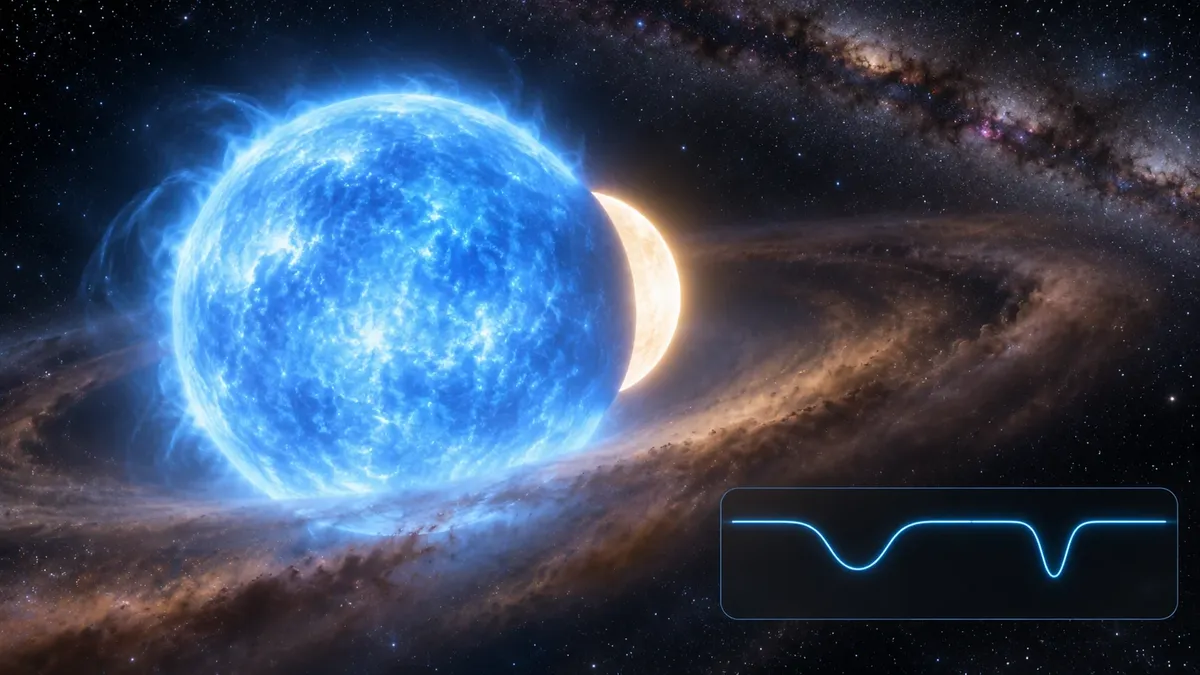
Luminous blue variables can change over years or decades, yet a short, uneven run of observations may capture only a fragment of their behavior. A catalog study tests what Gaia and other surveys can reveal about these rare stars—and where the evidence falls short.
Luminous blue variables (LBVs) are massive, evolved stars identified in part by long-term changes in their brightness and spectra. Some undergo giant eruptions; others show slower cycles that take years or decades. Stars with LBV-like features but without the long observational record needed to confirm this behavior are often called candidate LBVs, or cLBVs.
Brightness changes alone do not establish that a star is an LBV. A binary system, for instance, can produce repeated dips when one star passes in front of another. Maria Messineo and Donald F. Figer’s study asks what Gaia Data Release 3 (DR3) and other survey observations can tell astronomers about LBV-like variability—and what they cannot.
Bringing together catalogs and light curves
The authors recompiled a sample of 75 Galactic objects identified in the literature as LBVs or candidates: 17 bona fide LBVs and 58 cLBVs. They gathered infrared measurements from surveys including 2MASS, WISE and Spitzer programs. These data helped check source identifications, particularly in crowded or dusty regions, and supplied context about circumstellar dust.
The team examined brightness measurements from Gaia DR3, the Bochum survey, ASAS-SN and the Zwicky Transient Facility (ZTF). The surveys differ in observing cadence, time coverage and sensitivity. For selected stars, the researchers used Lomb–Scargle and phase-dispersion-minimization (PDM) methods to search for periodic signals. PDM is useful for examining repeating light curves that do not follow a simple sinusoidal shape; a detected period, however, does not by itself identify what causes the variation.
Gaia matches were available for about 67% of the sample. Among the 50 matched objects, Gaia classified 38 as variable. That flag indicates measured brightness changes, not an LBV classification.
Variability is a clue, not a verdict
Gaia DR3’s observations span about 2.8 years. That is too short to capture most S Doradus cycles, which can last years to decades; rare giant eruptions are sporadic and require decades of observations to document. Gaia’s relatively sparse measurements also limit what can be learned about shorter-term changes. The authors conclude that Gaia light curves alone cannot confirm LBV status.
The study uses a change of roughly 0.6 magnitudes in Gaia’s red-sensitive RP band as a practical trigger for closer inspection. Six confirmed LBVs and five candidates show larger variations in the reported analysis. The authors stress that this is not a classification boundary: confirmed LBVs show a range of amplitudes, and short-term brightness changes are not unique to them.
Two candidates, OMN2000 LS1 and DWC2011 140, show recurring light curves with primary and secondary minima—patterns that strongly suggest eclipsing binaries. The authors report periods of 80.29 days for OMN2000 LS1 and 95.07 days for DWC2011 140. The OMN2000 LS1 period is examined using Gaia, ASAS-SN and ZTF data; DWC2011 140 is compared across Gaia and ASAS-SN data. The authors interpret both as binary candidates, not confirmed systems. Eclipses are not proven: other possibilities include ellipsoidal variation, where a star’s shape changes the observed light, and contributions from surrounding material. Radial-velocity monitoring and higher-resolution spectroscopy could test the binary interpretation and help separate orbital effects from changes in the stars themselves.
What the evidence can—and cannot—say
The study illustrates how survey data can flag variable stars and identify targets for follow-up. Infrared measurements help with source identification and dust context, but neither they nor a short light curve replace the historical record needed to establish LBV behavior. Confirmation calls for multiple kinds of evidence over time, including brightness and color changes alongside spectroscopy.
The source is an arXiv preprint, so its findings should be read as research that may not yet have undergone peer review. Its sample was recompiled from literature classifications; the results describe these selected objects, not every possible Galactic LBV. Coverage and data quality also vary among stars. The clearest conclusion is about the limits of the method: Gaia DR3 can provide useful clues, but variability alone cannot settle a star’s classification.
- luminous blue variables
- Gaia DR3
- variable stars
- eclipsing binaries
- time-domain astronomy
Related reading
Automatically matched by shared topic keywords. These links do not imply that the sources agree or establish a consensus.
When Quasar Variability Hides in the Noise
Source published
Shared keywords: time domain astronomy
Three kinds of observations refine the orbit and masses of V819 Herculis
Source published
Shared keywords: eclipsing binaries
A Global Telescope Network for the Universe in Motion
Source published
Shared keywords: time domain astronomy
A faster method for finding rhythms in astronomy data
Source published
Shared keywords: variable stars
Four stars put stellar models to the test
Source published
Shared keywords: eclipsing binaries