TRANSMISSION // 2611.32613v1
A Deep New Survey Searches for the Milky Way’s Most Metal-Poor Stars
Source published
The ZERO survey uses Subaru images of calcium-sensitive starlight to estimate stellar abundances, building a catalog that may help trace the Milky Way’s early history.
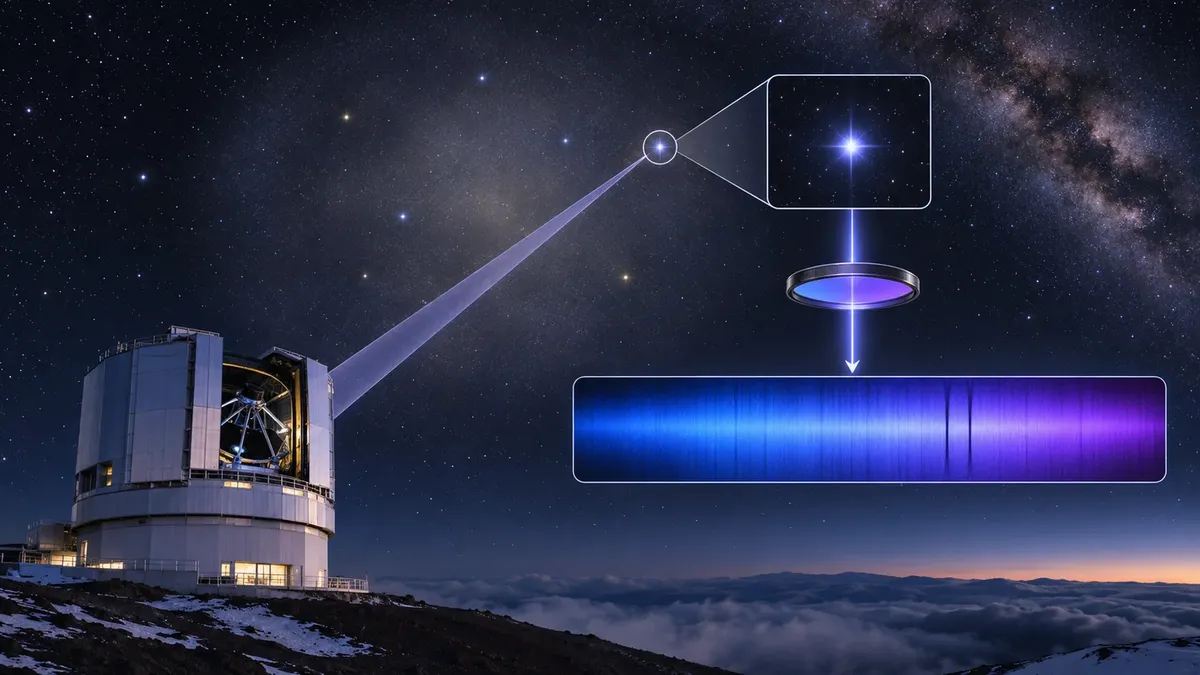
Stars preserve clues about the material from which they formed. The ZERO survey aims to find especially chemically primitive stars by measuring how their light is absorbed in a narrow slice of blue-violet wavelengths. Its first study presents a calibration method and early abundance estimates—not discoveries of metal-free stars.
The first stars formed from material made mostly of hydrogen and helium. Later generations incorporated heavier elements forged by stars and stellar explosions. To learn how the Milky Way assembled, astronomers look for surviving stars with very low abundances of these elements: their chemistry can preserve evidence about early enrichment.
The challenge is that such stars are rare, and measuring their detailed chemistry with spectroscopy takes substantial observing time. The Zero Enrichment Rare Objects (ZERO) survey seeks to identify candidates from images instead. Its first paper describes observations with Hyper Suprime-Cam on the Subaru Telescope, focusing on a custom narrow-band filter called NB395. The filter captures light around the calcium H and K absorption lines, which become stronger or weaker depending partly on a star’s chemical composition.
Calibrating a narrow slice of starlight
A filter measurement is useful only if astronomers can reliably compare brightnesses across the camera’s field and between observing visits. The team calibrated NB395 using two kinds of reference stars: synthetic NB395 measurements derived from Gaia’s low-resolution BP/RP spectra, and stars in a recalibrated catalog from the repeatedly observed SDSS Stripe 82 region. The latter supplied many fainter reference stars across the survey’s equatorial fields.
The researchers modeled an overall brightness offset for each observation and variations across the camera’s field of view. They also applied a color-dependent correction in visits with enough red reference stars. To check the calibration, they compared repeated observations and matched sources against photometry from the Pristine survey. These checks test consistency; they do not remove every possible source of systematic error.
For abundance estimates, the team combined NB395 with broader-band colors from the HSC Subaru Strategic Program and, where needed, Gaia-derived colors. They fitted stars’ positions in color diagrams—plots comparing brightness differences between filters—to a modeled stellar sequence, or “locus.” Because reference spectra are scarce for the most metal-poor stars, the method also uses stellar-atmosphere calculations to constrain how the colors should change at very low calcium abundance.
What the first data show
The current observations cover 21 pointings, about 35 square degrees along the celestial equator. In a one-hour integration, the survey reaches approximately NB395 magnitude 24.5 at a signal-to-noise ratio of 10. The paper reports typical calibration precision of about 0.3% for the brightness zero point and better than 1% for flat-field variations on scales larger than eight arcminutes. For sources observed repeatedly under typical conditions, photometric precision is about 1.5% at magnitude 20, but falls to roughly 10% at magnitude 24.
The abundance estimates target calcium, reported as [Ca/H], rather than iron, [Fe/H]. That distinction matters: NB395 directly samples calcium-sensitive absorption, while turning calcium into an iron estimate would require assumptions about the calcium-to-iron ratio. The authors’ model tests indicate that NB395 traces [Ca/H] more directly than [Fe/H], though the filter’s signal is not exclusively calcium: overall metallicity and other atmospheric effects also contribute.
Compared with LAMOST spectroscopic estimates, the photometric [Ca/H] values have a reported dispersion of 0.18 dex for giants and dwarfs. The paper says estimates are better than 0.18 dex for sources brighter than about magnitude 20, across a range from [Ca/H] −3 to +0.5. Precision worsens for fainter stars: at magnitude 23, the paper estimates uncertainties around 0.4 dex at [Ca/H] −1 and 0.7 dex at −2. Surface gravity also produces systematic trends, particularly for giants; adding spectroscopic gravity information improves agreement in the tested comparison, but that information is not generally available for photometric-only targets.
The catalog contains about one million sources with NB395 photometry, of which 61,845 receive [Ca/H] estimates. These are measurements and candidate resources, not confirmed metal-free stars. The authors describe the catalog and fitting code as planned public releases; the data-release date is not specified.
What remains uncertain
The survey is still an early, non-contiguous footprint, and the abundance method depends partly on models where very metal-poor spectroscopic comparison stars are scarce. Faint measurements are less precise, and distinguishing faint giants from dwarfs can be difficult. The paper also notes that some sources classified as extended may be galaxies, especially at faint magnitudes, and that selection effects complicate their classification.
The study is a November 2026 draft posted as an arXiv preprint. The source does not establish that it has undergone peer review. Its results demonstrate a calibration and estimation approach over the observed fields; they do not yet show that ZERO has found surviving Population III stars or settled how the first stars formed. Broader observations and follow-up spectroscopy will be needed to test the method and investigate the survey’s larger questions.
- ZERO survey
- metal-poor stars
- Subaru Telescope
- stellar abundances
- calcium
- Milky Way
Reviewed cross-references
These connections were reviewed by a model, not independently fact-checked by a human. Similarity does not imply agreement; consult the original papers and the evidence below.
A metal-poor stellar trail follows the Magellanic Clouds
Supporting evidence: Both studies report that photometric methods can help identify metal-poor stars: ZERO estimates calcium abundance from NB395 colors, while the Pristine–Gaia study reports an approximately 87% success rate for selecting very metal-poor candidates at the faint magnitudes it tested. These are complementary results, not a direct comparison: the surveys use different photometric methods and samples, and the Pristine result comes from 33 spectroscopically followed candidates.
Model review: · openai-codex/gpt-6-luna
Evidence and provenance
Selected excerpts, not complete papers. PDF extraction can omit figures or damage equations, tables and reading order; sources may be preprints.
2611.32613v1 — Original paper
Excerpt reference:
static/papers/2611.32613v1.md:1451-1516
Basis: Paper text
Source SHA-256:0bd2545da828d116d37963117b5c57f0a9485e302794c7ce37090dcf862215632611.32613v1 — Original paper
Excerpt reference:
static/papers/2611.32613v1.md:1386-1450
Basis: Paper text
Source SHA-256:0bd2545da828d116d37963117b5c57f0a9485e302794c7ce37090dcf862215632611.07563v1 — Original paper
Excerpt reference:
static/papers/2611.07563v1.md:1297-1350
Basis: Paper text
Source SHA-256:9f755064f72c87eddd4cfb0bc4866e5936e88ab781446392a74b8e97c102063d
Related reading
Automatically matched by shared topic keywords. These links do not imply that the sources agree or establish a consensus.
A Star’s Chemical Clues to Early Supernovae
Source published
Shared keywords: stellar abundances
A rare Sculptor star points to enrichment by two early stellar explosions
Source published
Shared keywords: stellar abundances
Reading the Third Peak in Ancient Starlight
Source published
Shared keywords: metal poor stars, stellar abundances
Testing a radioactive clock for the Milky Way’s oldest stars
Source published
Shared keywords: metal poor stars
Low-resolution starlight reveals 133 candidate chemical families in the Milky Way
Source published
Shared keywords: milky way, stellar abundances