TRANSMISSION // 2611.32564v1
How Robot Memory Can Guide the Next Move
Source published
MXI-MemICL lets a robot retrieve memories of demonstrations and past interactions to guide manipulation without updating its model during deployment. The preprint reports gains in simulation and real-robot tests, but the results come from a limited set of tasks and evaluation conditions.
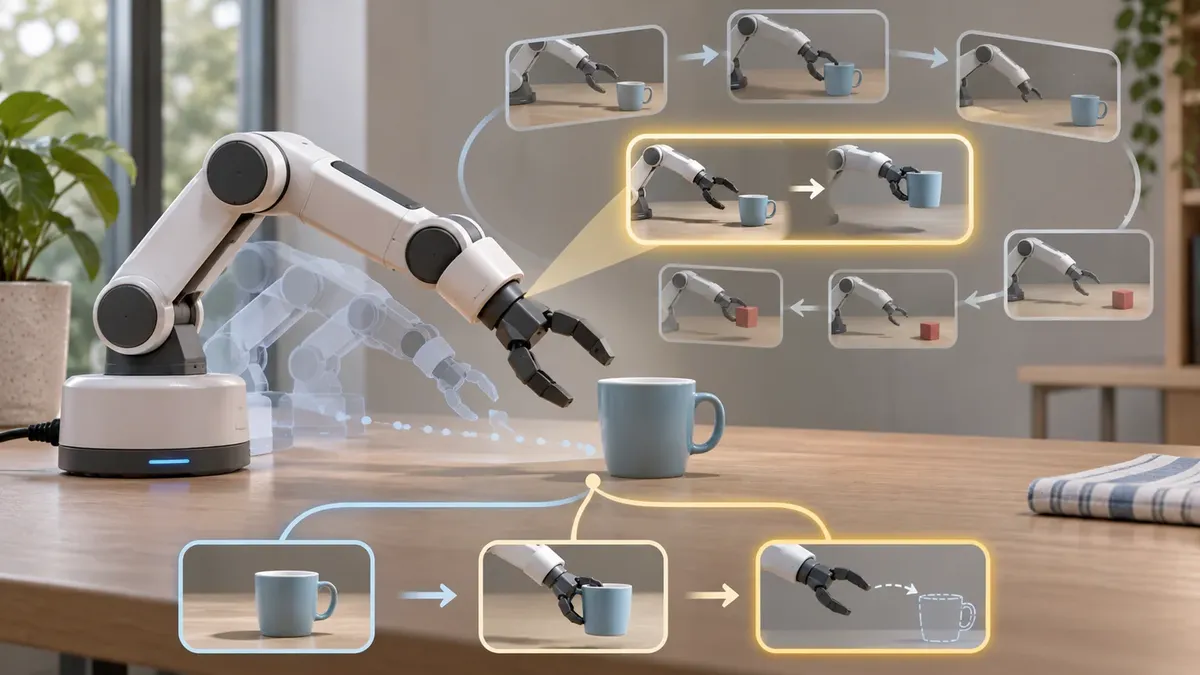
A robot’s current camera view may not reveal what happened moments ago—or what step of a longer task should come next. MXI-MemICL, a preprint framework, gives a vision-language-action model a way to consult stored experience while it works. The authors report improved task success in benchmarks and on a physical robot, with additional gains when a demonstration is supplied.
The challenge: remembering how an action changed the scene
A robot manipulating an object has to do more than map the latest image to a movement. In a multi-step task, the current view may not show whether an earlier action succeeded, and the next useful move can depend on that history. One way to adapt a robot is to retrain its policy on new task data, but that requires additional training. Another is to provide a demonstration as context, without changing the model’s parameters. This is called in-context learning.
The authors of MXI-MemICL ask whether a robot can make this kind of learning more effective by storing demonstrations and completed interactions as memories, then retrieving the experiences that seem relevant to its next action. Their work is a preprint: its claims have not necessarily been assessed through peer review.
How the memory system works
The framework is built around a vision-language-action (VLA) model, which uses visual observations and language instructions to produce robot actions. During deployment, MXI-MemICL keeps the model’s parameters fixed. Instead, it adds a memory system that can draw on completed interactions and, when available, a successful demonstration.
For each interaction, a visual-action encoder links the robot’s actions with what changed in the observed scene. The system stores these records in a memory bank, separating recent experience from older records. It also predicts the intent of the upcoming stage of a task. That predicted intent helps it search for experience relevant to what the robot may need to do next, rather than relying only on the current image.
Retrieved memories are turned into tokens that condition the language backbone. The system uses both prefixes and gated cross-attention—a mechanism that lets the model regulate how strongly retrieved experience influences its representations. After the robot acts, the observed result can itself be added to memory.
The authors evaluated the framework in the RoboTwin 2.0, RoboCasa365 and LIBERO simulation benchmarks, and on five tasks with an ARX X5 bimanual robot. They also tested whether a single successful demonstration could help on seen tasks and on some held-out conditions or tasks. The demonstration is retrieved as experience; the robot does not simply replay the recorded action sequence.
What the authors report
In the paper’s main comparison on RoboTwin 2.0, MXI-MemICL had a mean success rate of 51.9%, compared with 37.5% for the authors’ reproduced π₀.₅ baseline. On five selected RoboCasa365 tasks, the reported mean was 78.6%, versus 70.4% for that baseline. The paper’s abstract summarizes the differences as gains of 14.4 and 8.2 percentage points, respectively.
On the five real-robot tasks, the system’s average success rate was 69.0%, compared with 60.0% for π₀.₅. In separate demonstration-guided tests, adding a successful demonstration raised mean success by 5.0 percentage points on seen tasks and 16.7 points on unseen tasks, compared with the same system without a demonstration. These are results under the authors’ specific task splits and protocols, not guarantees that the approach will work similarly in other settings.
Ablations—tests that remove or change parts of a method—also suggest that both recent interaction context and longer-term retrieval contributed to performance on the selected RoboCasa365 tasks. The authors report a 78.6% mean with both memory timescales, compared with 74.4% using short-term memory alone and 72.8% using long-term memory alone. They also found a practical trade-off: on those tasks, MXI-MemICL’s average inference latency was higher than the baseline’s, even as success rates improved.
What remains uncertain
The findings support the idea that retrieved action-and-effect memories can help a robot handle the tested tasks. They do not establish that the method will generalize to all manipulation problems, robot platforms, or unfamiliar environments. The physical-robot evaluation covered five tasks, and demonstration tests involved a particular setup and task split. Simulation results likewise depend on the benchmarks, training data, and evaluation procedures chosen by the authors.
The paper reports repeated simulation evaluations and gives rollout counts for several experiments, but the available text does not provide uncertainty intervals for the headline comparisons. Success-rate differences should therefore be read as reported experimental results, not as precise estimates of performance across every possible run or deployment.
Finally, the source is an arXiv preprint, and its code is described as forthcoming. Independent replication and peer review could clarify how robust the results are, how well the method transfers beyond the tested conditions, and whether its added computation is acceptable in practical use. For now, MXI-MemICL is evidence for a promising memory-based approach—not a demonstration that robots can reliably learn arbitrary new skills from one example.
- robotics
- robot manipulation
- robot memory
- in-context learning
- vision-language-action models
- MXI-MemICL
Reviewed cross-references
These connections were reviewed by a model, not independently fact-checked by a human. Similarity does not imply agreement; consult the original papers and the evidence below.
How a robot can learn from its own attempts
Supporting evidence: Both papers report robot policies using accumulated experience to guide later actions without deployment-time parameter updates: MXI-MemICL retrieves demonstrations and completed interactions, while VLRLA conditions on interaction history and reward feedback. This supports the bounded proposition that experience can inform fixed-parameter robot policies; their different mechanisms, tasks, and evaluations do not establish comparative performance.
Model review: · openai-codex/gpt-6-luna
Evidence and provenance
Selected excerpts, not complete papers. PDF extraction can omit figures or damage equations, tables and reading order; sources may be preprints.
2611.32564v1 — Original paper
Excerpt reference:
static/papers/2611.32564v1.md:153-209
Basis: Paper text
Source SHA-256:6c155b5dcc81e46dcac8c6c6638a3716f7d4428ac197b75400e8045bdc0b6caf2610.19517v2 — Original paper
Excerpt reference:
static/papers/2610.19517v2.md:62-109
Basis: Paper text
Source SHA-256:43123c92b46b50ec8e840300c38623b7a1a0797c88f64bc91cd86a02962b5d17
Related reading
Automatically matched by shared topic keywords. These links do not imply that the sources agree or establish a consensus.
How a robot can learn from its own attempts
Source published
Shared keywords: in context learning, robot manipulation, vision language action models
A robot plan that knows what remains—and when to consult a demonstration
Source published
Shared keywords: in context learning, robot manipulation, vision language action models
A Robot Memory System That Keeps the Lesson, Not Every Detail
Source published
Shared keywords: robot memory, vision language action models
Can a Robot Learn a New Task by Watching One Video?
Source published
Shared keywords: in context learning, robot manipulation
Can a general AI model control a robot arm?
Source published
Shared keywords: robot manipulation, vision language action models