TRANSMISSION // 2611.32563v1
How space detectors could look for oscillating dark matter
Source published
Researchers derive formulas for how ultralight scalar-field dark matter could move test masses and affect laser measurements in space interferometers. Their comparisons use idealized detector assumptions; the study reports no detection or new observational limit.
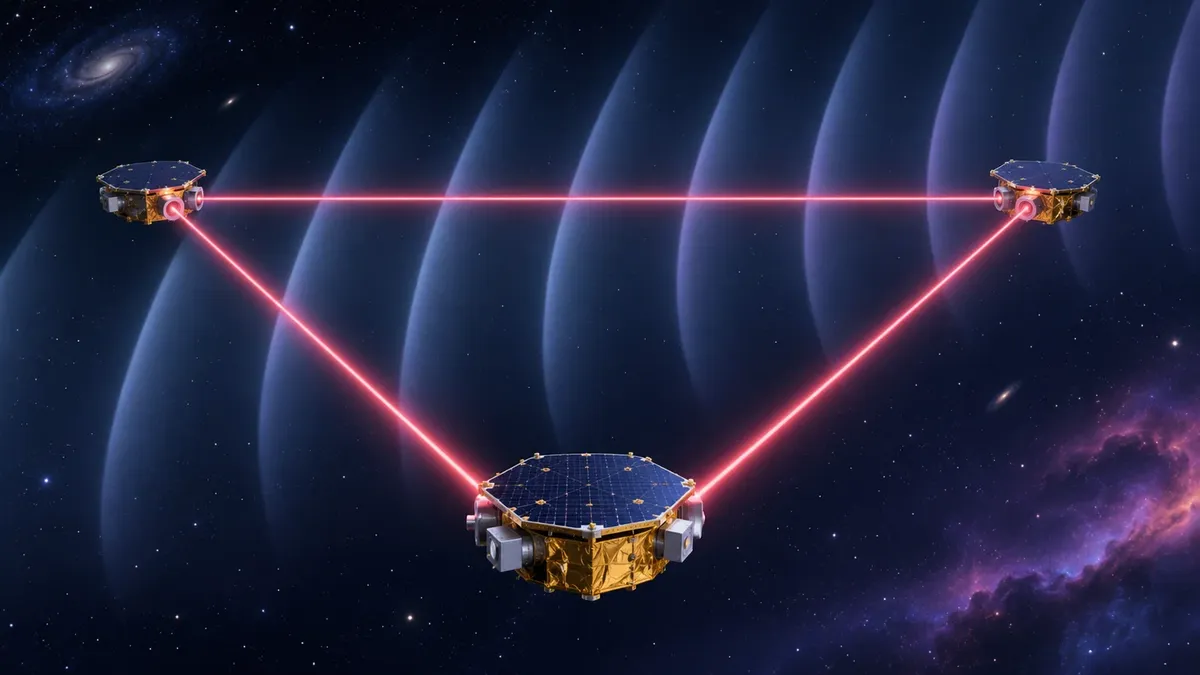
Could a space-based gravitational-wave detector also probe dark matter? A theoretical study calculates how an oscillating ultralight scalar field might move detector test masses, and how the resulting laser signals combine in different measurement channels.
Dark matter is known through its gravitational effects, but its underlying nature remains uncertain. One possibility is an ultralight scalar field: because many field excitations could occupy the same state, it can be treated as a coherent oscillating wave. If it couples to ordinary matter, it could affect the motion of a detector’s test masses. That motion would change the light-travel time between spacecraft and produce a measurable frequency shift in a laser link.
Wenqiu Tang and colleagues develop formulas for how this proposed signal would appear in space-based gravitational-wave detectors, including LISA, Taiji and TianQin. They do not analyze observational data. Instead, they calculate detector responses under different time-delay interferometry (TDI) combinations. TDI combines delayed measurements from spacecraft to suppress laser-frequency noise, which would otherwise obscure smaller signals.
The authors begin with an effective interaction between the scalar field and a test mass. From it, they derive the mass’s additional displacement and the resulting Doppler response in a single laser link. This single-link response depends on the field’s direction relative to the link. They then combine the links using TDI delay coefficients and derive analytic expressions for the direction-averaged power response. This average describes the expected response after averaging over possible field directions; it is distinct from the direction-dependent response of an individual link.
To check the analytic averages, the researchers compare them with numerical angular integrations for the A, E and T combinations. The calculation uses an equal-arm, equilateral-triangle detector model and 100,000 isotropically sampled directions at frequencies from 10⁻⁵ to 1 hertz. In this tested setup, the paper reports amplitude deviations below approximately 0.3%. This is a numerical check of the formulas over the specified grid and model, not an experimental confirmation of dark matter or a guarantee for other detector configurations.
The paper also examines 45 geometric TDI combinations: three with 12 links, four with 14 links and 38 with 16 links. Some combinations that have different names produce identical responses under the equal-arm assumptions. The authors group the combinations into “ordinary” and “ζ” types according to their low-frequency behavior. Ordinary combinations have two low-frequency regimes in the expansion they derive; ζ-type responses lack the same leading terms and are more suppressed there. These labels describe mathematical response behavior. They do not mean that a ζ channel is noise-free or automatically more sensitive.
Sensitivity depends on both the signal response and the noise. For their sensitivity comparison, the authors assume independent optical metrology system (OMS) noise and test-mass acceleration noise, with identical spectra across links and test masses, using LISA-like secondary-noise spectra. Under this prescription, different response curves can yield the same single-channel sensitivity when signal and noise share a common filtering factor. A larger response, or more links, therefore does not by itself establish better sensitivity. The paper sets out a theoretical way to calculate these quantities under its assumptions; it does not produce a new confidence-level exclusion or observational limit on scalar dark matter.
Those assumptions are important. The comparison treats the detector as static, uses equal arms, and models the field as a monochromatic plane wave with fixed velocity. It does not include spacecraft motion or orbital modulation. The authors note that arm variations could matter depending on frequency, the accuracy required and the observable; near response zeros or in suppressed channels, relative changes may be large. Extending the calculation to specific mission orbits is left for future work. Time-varying arms also require a suitable TDI construction to preserve laser-noise cancellation.
This is a theoretical methods study, not a report of a dark-matter search. Its results describe detector responses and sensitivities within a defined model, rather than demonstrating that a signal is detectable in practice. That would require mission-specific modeling and a separate statistical analysis. The source is an arXiv preprint; the supplied material does not establish whether it has been peer reviewed.
- ultralight scalar dark matter
- space-based gravitational-wave detectors
- time-delay interferometry
- LISA
- detector response
- dark matter searches
Related reading
Automatically matched by shared topic keywords. These links do not imply that the sources agree or establish a consensus.
A time-frequency route to modeling LISA’s response
Source published
Shared keywords: time delay interferometry
Could LISA test a quadratic dark-matter interaction?
Source published
Shared keywords: dark matter searches
A LISA null-stream method has limits
Source published
Shared keywords: time delay interferometry
Testing Gaussian-process methods for LISA data
Source published
Shared keywords: time delay interferometry