TRANSMISSION // 2611.32552v1
How JWST’s Earliest Galaxies Shift a Cosmic Measurement
Source published
A preprint finds that the most distant JWST galaxy counts can push the Hubble constant higher in an early-dark-energy model, through changes in inferred small-scale structure.
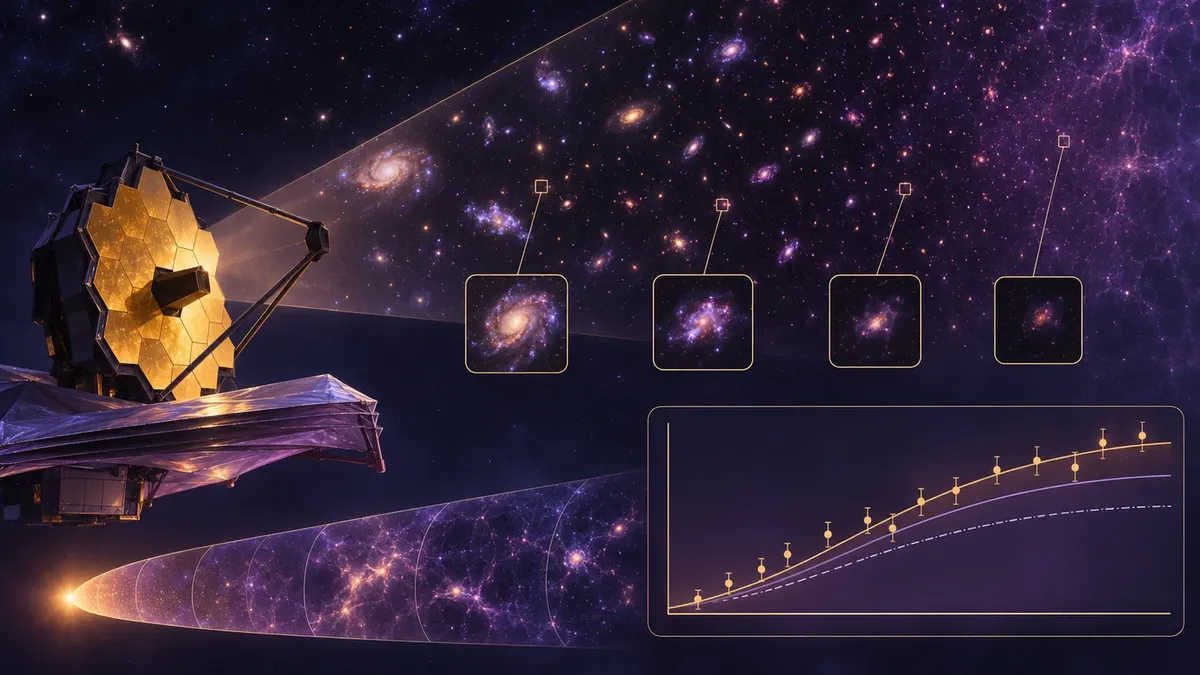
Could the abundance of galaxies in the young universe affect how fast the universe expands today? A new preprint argues that, within one early-dark-energy model, JWST’s most distant galaxy measurements help move the inferred Hubble constant closer to the local distance-ladder result. The result depends on the cosmological model and on how the galaxy data are analyzed.
The universe’s present expansion rate, expressed by the Hubble constant, is inferred in different ways. Measurements based on the cosmic microwave background (CMB)—light released when the universe was young—give a lower value under the standard cosmological model than measurements using the local distance ladder. This mismatch is known as the Hubble tension.
A new preprint by Guo-Hong Du and colleagues asks whether observations of very early galaxies can help explain how a model of early dark energy fits that discrepancy. In this idea, an additional energy component briefly affects the universe’s expansion before recombination, changing the sound-horizon scale used to interpret the CMB. The authors focus on a further link: the abundance of early galaxies also constrains how much matter clumps on small scales, and that information can influence the model’s inferred expansion rate.
Combining the sky’s different clues
The researchers analyze measurements of the galaxies’ ultraviolet luminosity function, which describes how numerous galaxies are at different brightnesses. Their JWST sample includes 39 detections across redshifts 7 to 12.5. Redshift is a measure of how much the universe has expanded since light left an object; larger values point to earlier cosmic times.
They combine those measurements with CMB data from Planck, ACT and SPT, CMB lensing measurements, and baryon acoustic oscillation data from DESI. They calculate cosmological predictions using a version of the CAMB software and estimate model parameters with Markov chain Monte Carlo sampling.
One methodological detail matters: galaxy luminosities and inferred number densities depend on the reference cosmology used to interpret the observations. The authors convert the theoretical predictions to match the reference cosmologies used by the different JWST samples, rather than treating every published galaxy measurement as if it had been derived under the same assumptions.
The highest-redshift bins matter most
In the authors’ baseline axion-like early-dark-energy model, the combined data give a Hubble constant of 72.76 ± 1.00 kilometres per second per megaparsec. By the paper’s chosen measure of disagreement with the SH0ES local distance-ladder result, this is a 0.1-sigma difference. That is a close fit within this analysis—not proof that the broader Hubble tension has been settled.
The authors find that galaxy abundances at redshifts 11 and 12.5 sit above the predictions of their ΛCDM comparison. Removing those highest-redshift measurements lowers the inferred Hubble constant: excluding the 12.5 bin gives 71.38, while excluding both the 11 and 12.5 bins gives 70.50 kilometres per second per megaparsec. These tests suggest that the most distant galaxy measurements are particularly influential in this fit.
The proposed connection runs through small-scale matter clustering. More abundant early galaxies can favor stronger matter fluctuations on small scales. In the model, that preference can be accommodated by raising the primordial scalar spectral index. The authors report positive correlations between that index, the early-dark-energy fraction and the Hubble constant under CMB constraints. Moving among these correlated parameters can therefore raise the fitted Hubble constant.
They also test a more flexible description of the primordial power spectrum by allowing its spectral index to vary with scale, a parameter called running. With that extra freedom, the fit favors positive running at about 4.3 sigma and gives a Hubble constant of 73.75 ± 1.04 kilometres per second per megaparsec. That estimate is higher than the SH0ES central value reported in the paper, though the uncertainty is substantial.
A model-dependent result, not a final resolution
These conclusions are conditional on the selected data, model, assumptions about galaxy formation and the analysis choices. The luminosity-function comparison relies on a halo-abundance prescription and relations connecting halo mass, stellar mass and ultraviolet brightness, including dust corrections. The paper’s data-cut tests show sensitivity to particular high-redshift bins; they do not establish that those measurements alone determine the expansion rate.
The reported “sigma” agreement is a statistical comparison within the authors’ analysis, not independent confirmation that early dark energy is the correct explanation. Adding running also gives the primordial spectrum more flexibility, so its preference should be assessed alongside other constraints and alternative models. The supplied source is a November 2026 arXiv preprint; the material provided does not establish peer-review status or independent replication. Accordingly, the result is best read as a model-dependent analysis of how JWST galaxy counts may affect cosmological parameter estimates—not as a settled solution to the Hubble tension.
- Hubble tension
- JWST
- early dark energy
- Hubble constant
- early galaxies
- cosmic microwave background
- cosmology
Reviewed cross-references
These connections were reviewed by a model, not independently fact-checked by a human. Similarity does not imply agreement; consult the original papers and the evidence below.
Early Galaxies Narrow a Search for Neutrino Interactions
Supporting evidence: Both studies use JWST high-redshift ultraviolet luminosity-function observations to probe small-scale structure: Du et al. report that the z=11 and 12.5 abundances favor more small-scale power in their axion-EDE analysis, while Mondol et al. use Planck plus JWST luminosity-function data to constrain neutrino self-interactions through their effects on the matter power spectrum. These are complementary applications, not independent confirmation of either study’s specific parameter constraints; the analyses use different models and data combinations.
Model review: · openai-codex/gpt-6-luna
Evidence and provenance
Selected excerpts, not complete papers. PDF extraction can omit figures or damage equations, tables and reading order; sources may be preprints.
2611.32552v1 — Original paper
Excerpt reference:
static/papers/2611.32552v1.md:638-706
Basis: Paper text
Source SHA-256:d27f4f79ea3eced4c7b420e2cb3d725df848ec45257cb4c4de0c6326cd7f1fbb2611.32552v1 — Original paper
Excerpt reference:
static/papers/2611.32552v1.md:707-772
Basis: Paper text
Source SHA-256:d27f4f79ea3eced4c7b420e2cb3d725df848ec45257cb4c4de0c6326cd7f1fbb2611.07013v1 — Original paper
Excerpt reference:
static/papers/2611.07013v1.md:12-51
Basis: Paper text
Source SHA-256:63c5c49e482f3ea397dd27cbf1083a4b7917f81ae4c9a3803b357e5cdfc388762611.07013v1 — Original paper
Excerpt reference:
static/papers/2611.07013v1.md:52-193
Basis: Paper text
Source SHA-256:63c5c49e482f3ea397dd27cbf1083a4b7917f81ae4c9a3803b357e5cdfc38876
Related reading
Automatically matched by shared topic keywords. These links do not imply that the sources agree or establish a consensus.
The ‘tail’ of early dark energy may matter for the Hubble tension
Source published
Shared keywords: cosmic microwave background, early dark energy, hubble tension
Early dark energy faces a tight cosmic ceiling
Source published
Shared keywords: cosmic microwave background, early dark energy, hubble tension
Two early-universe changes improve a fit to cosmic expansion data—but not across every test
Source published
Shared keywords: cosmic microwave background, early dark energy, hubble tension
A late-time dark-matter supply could soften a cosmological trade-off
Source published
Shared keywords: early dark energy, hubble tension
Four CMB routes agree within ΛCDM assumptions
Source published
Shared keywords: cosmic microwave background, hubble constant, hubble tension