TRANSMISSION // 2611.32515v1
How to combine AI specialists into one model
Source published
A two-stage distillation recipe helps one model absorb capabilities from specialists that have drifted far from their shared starting point, while trying to preserve what the student already knows.
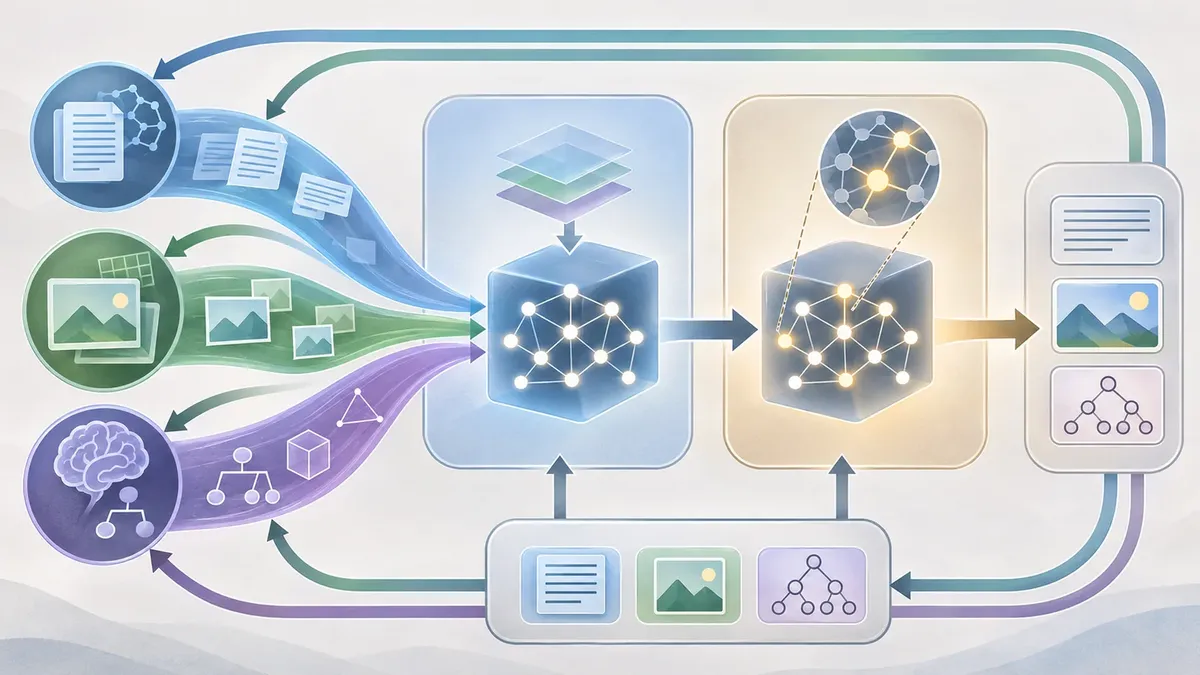
Combining specialized AI models can be harder than averaging their weights or asking them to teach a student. This preprint tests a recipe that consolidates specialists through on-policy distillation, then targets skills that remain behind.
When separate AI models are trained to excel at different tasks, they can develop complementary abilities. The challenge is bringing those abilities back into one model without losing skills the original model already had. A new preprint, “Branch and Consolidate,” studies a particularly difficult case: specialists that have moved substantially away from the shared checkpoint they started from.
The authors say much previous research studies specialists that remain relatively close to their starting model. In that setting, combining weights or distilling knowledge may be easier. Their work asks how to consolidate more strongly diverged specialists into one model of the same size as the original student.
Training the student on its own outputs
The approach uses multi-teacher on-policy distillation. The student generates its own responses, and the specialist for a given task provides training feedback on them. This lets training address the inputs and partial answers the student actually produces, rather than relying only on teacher-generated examples.
The recipe has two stages. First, the authors average the starting student’s weights with those of the specialists. This merged model is an initialization for distillation, not the final model: according to the paper, merging improves overlap between the student’s and specialists’ likely next-token choices, making their guidance easier for the student to use.
The training data are selected deliberately. For each specialist, the team prioritizes queries that it handles better than the original student. Queries the student fails are added to an error pool and can be revisited. The loss averages across queries within each specialist route and then weights the routes equally. This is designed to prevent longer responses or uneven numbers of queries from determining how much influence each specialist receives. A frozen copy of the merged initialization acts as an additional teacher on queries the original student handles, helping limit drift from capabilities it already has.
After consolidation, the researchers identify capabilities that still lag behind their specialists. They reintroduce the lagging specialists through a short refinement stage and check whether other capabilities need specialist supervision to avoid losing ground.
Results in two settings
In the industrial experiment, six multimodal specialists were trained from a shared internal checkpoint. Their capabilities included instruction following, perception, agentic business tasks, business understanding, general reasoning, and domain reasoning. The authors report that the full recipe recovered 97.0% of the specialists’ average gain over the original student. The strongest prior method in their comparison, IM-MOPD, recovered 79.8%; the best weight-merging baseline recovered 42.3%. The consolidated model came close to each specialist in its own domain and exceeded the perception specialist on the reported evaluation. Consolidation alone, before refinement, recovered 91.3%.
The team also tested a fully open five-domain setup based on Qwen3-4B. There, the method recovered 95.7% of the specialists’ average gain after consolidation and 97.5% after refinement, compared with 94.1% for IM-MOPD. These figures measure recovery relative to the specialists’ gains over the student; they are not general accuracy percentages across tasks.
Ablations examine how individual choices affected results in the reported settings. Removing the frozen self-teacher reduced recovery in the industrial experiment, as did averaging loss across all tokens without balancing specialist routes. Using random rather than selected queries also reduced recovery, as did removing error replay. These are separate comparisons, and do not establish that each component will help in every model or task.
What remains uncertain
The findings are bounded by the study design. It assumes all specialists branch from the same student and share its architecture. It does not test combining unrelated models or distilling larger specialists into a smaller student. In the industrial experiment, several evaluation benchmarks are internal and undisclosed, limiting independent replication and detailed comparison. The paper also says some practical guidance is based on these runs and has not been broadly validated; choosing thresholds and allocating training across many specialists remain open questions.
The results come from a preprint and may not have undergone peer review. They concern particular models, tasks, data, and evaluation procedures—not evidence that the recipe will reliably preserve all capabilities elsewhere. The authors say code will be released, but the source does not establish that it is already available. The contribution is a tested consolidation recipe and a framework for diagnosing incomplete transfer, not a universal solution to combining AI specialists.
- AI model distillation
- multi-teacher learning
- on-policy distillation
- model consolidation
- multimodal AI
Reviewed cross-references
These connections were reviewed by a model, not independently fact-checked by a human. Similarity does not imply agreement; consult the original papers and the evidence below.
Robots Learn From Teachers, Then From Failure
Shared method: Both papers use multi-teacher on-policy distillation: teachers supervise a student on trajectories it generates, rather than only on fixed teacher demonstrations. Liang et al. study consolidating multimodal specialists; Zhang et al. apply the approach to flow-based embodied models. This is a methodological connection, not evidence that their results transfer across these settings.
Model review: · openai-codex/gpt-6-luna
Evidence and provenance
Selected excerpts, not complete papers. PDF extraction can omit figures or damage equations, tables and reading order; sources may be preprints.
2611.32515v1 — Original paper
Excerpt reference:
static/papers/2611.32515v1.md:85-166
Basis: Paper text
Source SHA-256:f8994ee672998348663ca99e10386dab5c7e8e53f08e738deb34ac8e89f031642611.31850v1 — Original paper
Excerpt reference:
static/papers/2611.31850v1.md:77-134
Basis: Paper text
Source SHA-256:c72e3e0438063eae4a071f6e204e5c28087f00a6e4a2c31a1d578ecbaaf3ef9a
How to combine robot skills without making them clash
Shared method: Both papers use teacher supervision on student-generated trajectories to consolidate specialist capabilities. Liang et al. describe token-level MOPD for multimodal specialists; Yang et al. use task-routed velocity-field supervision along student-visited states and action-flow trajectories in robotic policies. The supervision forms and evaluation settings differ, so this connection does not establish comparable outcomes.
Model review: · openai-codex/gpt-6-luna
Evidence and provenance
Selected excerpts, not complete papers. PDF extraction can omit figures or damage equations, tables and reading order; sources may be preprints.
2611.32515v1 — Original paper
Excerpt reference:
static/papers/2611.32515v1.md:85-166
Basis: Paper text
Source SHA-256:f8994ee672998348663ca99e10386dab5c7e8e53f08e738deb34ac8e89f031642611.30632v1 — Original paper
Excerpt reference:
static/papers/2611.30632v1.md:61-101
Basis: Paper text
Source SHA-256:9d56065d9bf3e7b41961c7d858422bfc7d474527ce47943e3c2ead2231184892
Related reading
Automatically matched by shared topic keywords. These links do not imply that the sources agree or establish a consensus.
A bridge between fine-tuning and reinforcement learning
Source published
Shared keywords: multimodal ai, on policy distillation
Teaching Small Vision Models What to Notice
Source published
Shared keywords: multimodal ai, on policy distillation
Why AI Misses Text You Can Read by Squinting
Source published
Shared keywords: multimodal ai, on policy distillation
A multimodal model built for online shopping
Source published
Shared keywords: multimodal ai
How on-policy distillation passed backdoors in tested LLMs
Source published
Shared keywords: on policy distillation