TRANSMISSION // 2611.32496v1
Why some parking agents forget less than others
Source published
A simulated parking study finds that replay can help reinforcement-learning agents retain earlier skills, but does not eliminate forgetting.
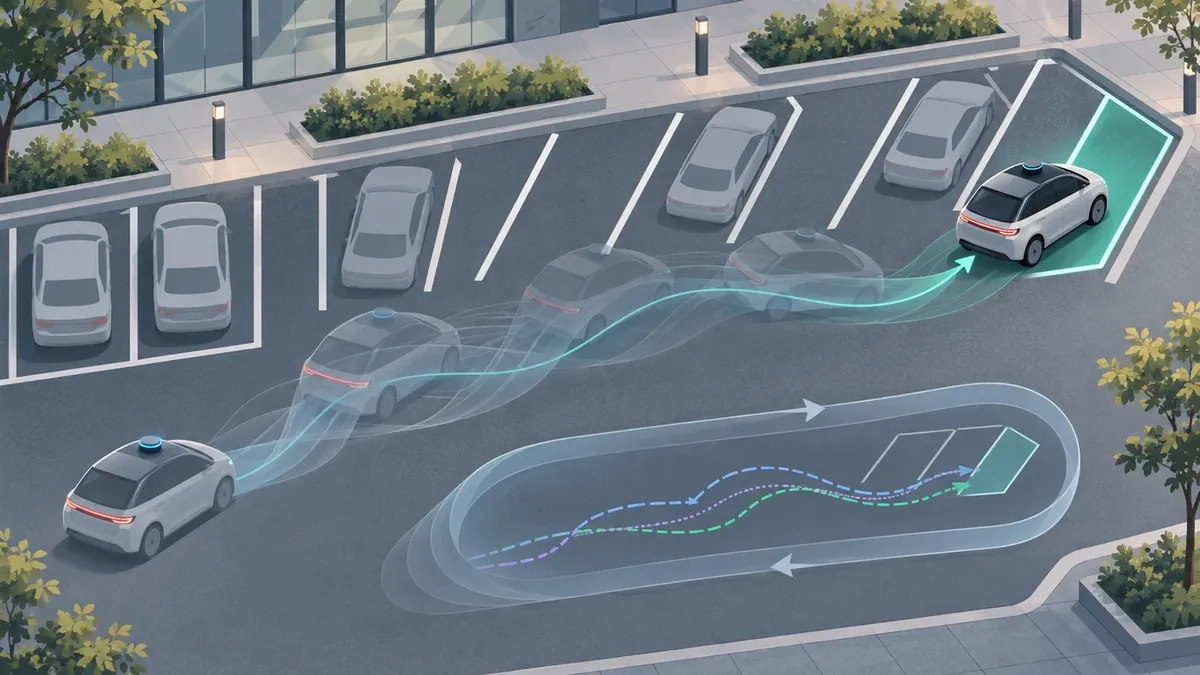
When an AI learns a new task, can it keep doing the old ones? A comparison of three reinforcement-learning approaches in simulated parking suggests that reusing past experience may slow forgetting—but the result is limited to a small set of scenarios.
A vehicle that learns to park in one kind of space may struggle when the space changes. In reinforcement learning, this can happen because learning a new task alters the agent’s policy—the rules it uses to choose actions—and weakens performance on earlier tasks. This is known as catastrophic forgetting. For systems that act in the physical world, forgetting raises questions about whether an agent can adapt without losing previously learned abilities.
Kim N. Nolle and colleagues ask whether some broad classes of reinforcement-learning algorithms are better suited to this continual-learning problem. They compare three representatives: PPO, a model-free, on-policy method; SAC, a model-free, off-policy method; and Drama, a model-based method. Model-free methods learn from experience without building an explicit model of how the environment works. A model-based method learns such a model, which can be used to simulate possible outcomes. SAC stores past experience in a replay buffer, whereas PPO’s on-policy training uses newly collected experience and discards it after updates.
The test environment was simulated autonomous parking, using the highway-env package. Agents learned four tasks in sequence: perpendicular parking, parking at two diagonal angles, and parallel parking. The researchers also tested a reversed task order and an interleaved regime, in which training episodes sampled from all four tasks. Performance was assessed by success rates and measures of forward and backward transfer, which capture how learning one task affects performance on others. They additionally tested Elastic Weight Consolidation (EWC), which penalizes some changes to a model’s parameters in an effort to protect earlier learning.
In sequential training, PPO and Drama lost performance on earlier tasks after task switches. SAC retained its earlier perpendicular-parking performance longer, but later began to lose it too. The authors link this delay to SAC’s replay buffer: older examples remained available for training until the buffer filled and began replacing them. Reversing the task order also produced different outcomes, suggesting that what an agent learns first can shape how well it learns later tasks.
Interleaved training let all three agents train on the four tasks throughout learning and reach success rates similar to their single-task results. But this is not a straightforward solution for deployment: it assumes the future task distribution is known well enough to include those tasks during training. EWC improved PPO’s backward-transfer measure in the reported tests but did not eliminate forgetting. The paper also reports no clear direct advantage for model-based Drama over model-free methods in retaining earlier skills.
The results point to a practical trade-off. Replay can let an agent revisit older experience, which may slow forgetting, but its usefulness depends on retaining enough representative data. A fixed-size buffer may become less helpful as tasks accumulate. All three approaches were also sensitive to the task setup. Parallel parking proved harder than the authors initially expected: a reward function designed for perpendicular parking did not transfer cleanly, and successful learning required changes to the reward design and further hyperparameter tuning. The authors also report that a policy trained on one task order could carry biases into later tasks.
These findings concern a particular simulation and a limited comparison—not proof that off-policy methods are generally safer or more reliable for real vehicles. The study uses one parking environment, four related scenarios, and representative algorithms; results could differ with other tasks, implementations, or resources. Replay delayed forgetting rather than preventing it, while interleaving relied on foreknowledge of tasks. The broader lesson is that an algorithm alone may not solve continual learning: task order, memory, reward design, environment representation, and hyperparameter choices all matter.
The supplied arXiv text identifies itself as a preprint that has not undergone peer review or post-submission correction, and says a Version of Record is published in Artificial Intelligence XLIII. This article describes the supplied preprint text. Readers can consult the Version of Record for the published text; the supplied source does not establish whether its detailed results differ from the preprint.
- continual reinforcement learning
- catastrophic forgetting
- reinforcement learning
- autonomous parking
- replay buffer
- cyber-physical systems
Reviewed cross-references
These connections were reviewed by a model, not independently fact-checked by a human. Similarity does not imply agreement; consult the original papers and the evidence below.
A smart charger gives edge AI a place to learn while it sleeps
Shared method: Both studies use replay of past-task examples to support retention: the parking study reports that SAC can maintain earlier-task performance while its buffer retains enough samples, while Hypnos moves stored samples to a charger-side buffer for rehearsal-based consolidation. This is a connection in replay strategy, not evidence of comparable effectiveness: one evaluates reinforcement learning in simulated parking, the other class-incremental image learning on CORe50.
Model review: · openai-codex/gpt-6-luna
Evidence and provenance
Selected excerpts, not complete papers. PDF extraction can omit figures or damage equations, tables and reading order; sources may be preprints.
2611.32496v1 — Original paper
Excerpt reference:
static/papers/2611.32496v1.md:334-392
Basis: Paper text
Source SHA-256:abe88db2a824e780e4bb25d3aea25626fb107205051c129e68053770e463cb6e2611.24637v2 — Original paper
Excerpt reference:
static/papers/2611.24637v2.md:173-240
Basis: Paper text
Source SHA-256:af62442ef9086b2c0ed978f05894691704957f0203470f6e3a370ad9fa058fa8
Related reading
Automatically matched by shared topic keywords. These links do not imply that the sources agree or establish a consensus.
A spectral map for AI agents facing changing goals
Source published
Shared keywords: reinforcement learning
A smart charger gives edge AI a place to learn while it sleeps
Source published
Shared keywords: catastrophic forgetting
Adaptive step sizes for eligibility traces
Source published
Shared keywords: reinforcement learning
Why AI Reasoning Training May Favor Familiar Problems
Source published
Shared keywords: catastrophic forgetting, reinforcement learning
Can an AI learn what normal looks like in connected systems?
Source published
Shared keywords: cyber physical systems