TRANSMISSION // 2611.32483v1
CodeWAM gives a driving AI an execution plan
Source published
A driving model combines executable vehicle dynamics with learned scene predictions to judge plans. Benchmark results are promising, but do not establish real-world safety.
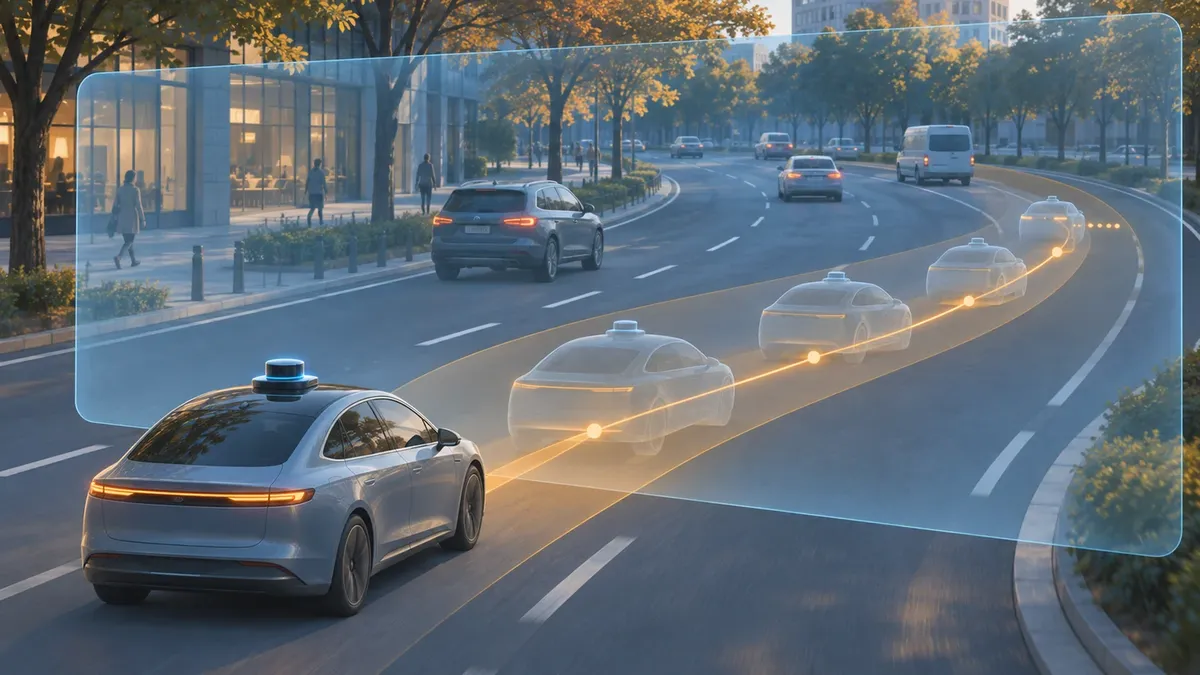
Autonomous-driving systems need to weigh not just where a proposed route leads, but how the vehicle can get there from its current motion. CodeWAM adds an executable model of that motion to a learned model of the surrounding scene.
A route can look safe on a map and still be awkward to follow. If a vehicle is already turning left, for example, a plan that immediately steers right may require a sharp correction. A driving system that scores only the route’s destination could miss the difficulty of making that transition.
That is the planning problem addressed by CodeWAM, a driving world model described in an arXiv preprint. The researchers combine two ways of estimating what a candidate plan might do: a program that simulates the vehicle’s own motion, and a learned model that predicts consequences in the surrounding scene. Their aim is to help a planner assess both the future a route points toward and the motion needed to reach it.
Simulating the car, predicting the scene
For each candidate plan, CodeWAM runs executable code using the vehicle’s current state and a vehicle-motion model. The resulting rollout estimates how the car would move as it follows the plan. The system compares that motion with the previous plan and recorded motion history, assessing whether the new choice connects smoothly with what came before.
A separate learned model uses multi-view camera images to estimate scene-related consequences, including safety, road-rule compliance and driving quality. Unlike the vehicle-motion rollout, this prediction is learned from data and can be uncertain. CodeWAM combines the two assessments when selecting a plan. It also carries the selected plan into the next decision, so consecutive choices are evaluated in the context of motion already underway.
The distinction is useful: the vehicle’s response to a plan can be calculated under an assumed motion model, while the behavior of other road users must be estimated from observations. CodeWAM does not replace learned prediction with code; it uses code as a complementary representation for the ego vehicle’s dynamics.
Benchmark results
The authors report a score of 93.6 PDMS on NAVSIM v1’s navtest benchmark, 92.1 EPDMS on NAVSIM v2 navtest, and 50.6 EPDMS on the more challenging NAVHARD evaluation. These are benchmark-specific composite measures, not percentages of safe real-world trips. The paper reports comparisons with other methods on those benchmarks, but scores from different protocols should not be treated as interchangeable.
The authors also test whether adding the execution assessment helps existing planners. In their reported experiments, incorporating it improves EPDMS for Hydra-MDP and DrivoR without additional training. A separate diagnostic finds better consistency between successive plans in a test using DrivoR candidates. These results support the idea that explicitly evaluating how a plan is executed can be useful beyond CodeWAM’s own planning setup.
The paper further reports a zero-shot test on nuScenes: a model trained on NAVSIM is applied without fine-tuning. That evaluation compares predicted paths with recorded human driving. It is an open-loop comparison, meaning the model’s predictions do not change what the vehicle observes next. Matching recorded paths is informative, but it does not demonstrate safe behavior in a vehicle interacting with live traffic.
What the evidence does—and doesn’t—show
The results come from benchmark evaluations and experiments described by the authors, not from a road deployment. NAVSIM includes non-reactive evaluation in which surrounding actors follow recorded trajectories; NAVHARD adds a two-stage pseudo-simulation setting. Such tests can reveal weaknesses in planning, but they cannot represent every response of real drivers, pedestrians or changing road conditions.
The approach also relies on a specified vehicle-motion model and a learned scene predictor. The program can calculate motion under its assumptions, but that does not guarantee the assumptions match every vehicle or situation. Scene predictions remain uncertain, and the researchers use a calibrated selection rule to reduce the chance that an overestimated candidate wins. The preprint’s own examples show that adding components need not improve every individual frame.
CodeWAM is presented as a research contribution, not proof that code-based planning makes autonomous driving safe. The source is an arXiv preprint, which may not have undergone peer review; the reported findings should therefore be read as the authors’ experimental claims. Further evidence—including evaluation in varied, reactive settings and ultimately real-world testing—would be needed to establish how well the method generalizes. For now, its central contribution is a practical modeling idea: judge a driving plan not only by its predicted destination, but also by the vehicle motion required to carry it out.
- autonomous driving
- world models
- trajectory planning
- vehicle dynamics
- CodeWAM
- NAVSIM
Reviewed cross-references
These connections were reviewed by a model, not independently fact-checked by a human. Similarity does not imply agreement; consult the original papers and the evidence below.
How AXE Selects Driving Paths in Simulation
Shared method: Both evaluate multiple candidate trajectories and select one using predicted or learned consequences. CodeWAM combines executable ego-motion rollouts with a learned scene model; AXE scores a fixed vocabulary and applies perception-based feasibility checks. This is a shared candidate-selection approach, not evidence that either method validates the other.
Model review: · openai-codex/gpt-6-luna
Evidence and provenance
Selected excerpts, not complete papers. PDF extraction can omit figures or damage equations, tables and reading order; sources may be preprints.
2611.32483v1 — Original paper
Excerpt reference:
static/papers/2611.32483v1.md:86-149
Basis: Paper text
Source SHA-256:0acfa7bd4756899f32136e81e29e4593fe0b702ab1603e0d5b42832ca1f351c92611.30511v1 — Original paper
Excerpt reference:
static/papers/2611.30511v1.md:140-187
Basis: Paper text
Source SHA-256:14236f0b803ddaae2f9940fcc52b05e2f849073d7e490ea6fcf3d5d02d410185
Related reading
Automatically matched by shared topic keywords. These links do not imply that the sources agree or establish a consensus.
FlowR2A teaches a driving planner to generate reward-guided routes
Source published
Shared keywords: autonomous driving, trajectory planning
A driving planner that looks where each route leads
Source published
Shared keywords: autonomous driving, trajectory planning
How AXE Selects Driving Paths in Simulation
Source published
Shared keywords: autonomous driving, trajectory planning
DriveFoundry links driving-data corrections with selective AI reasoning
Source published
Shared keywords: autonomous driving, trajectory planning
Can a Recorded Street Become a Reusable Driving Simulation?
Source published
Shared keywords: autonomous driving, world models