TRANSMISSION // 2611.32480v1
When AI Skills Learn from the Tools They Use
Source published
VISE revises AI agents’ reusable tool instructions by examining tool code, offering a feedback source when task-specific success checks are unavailable.
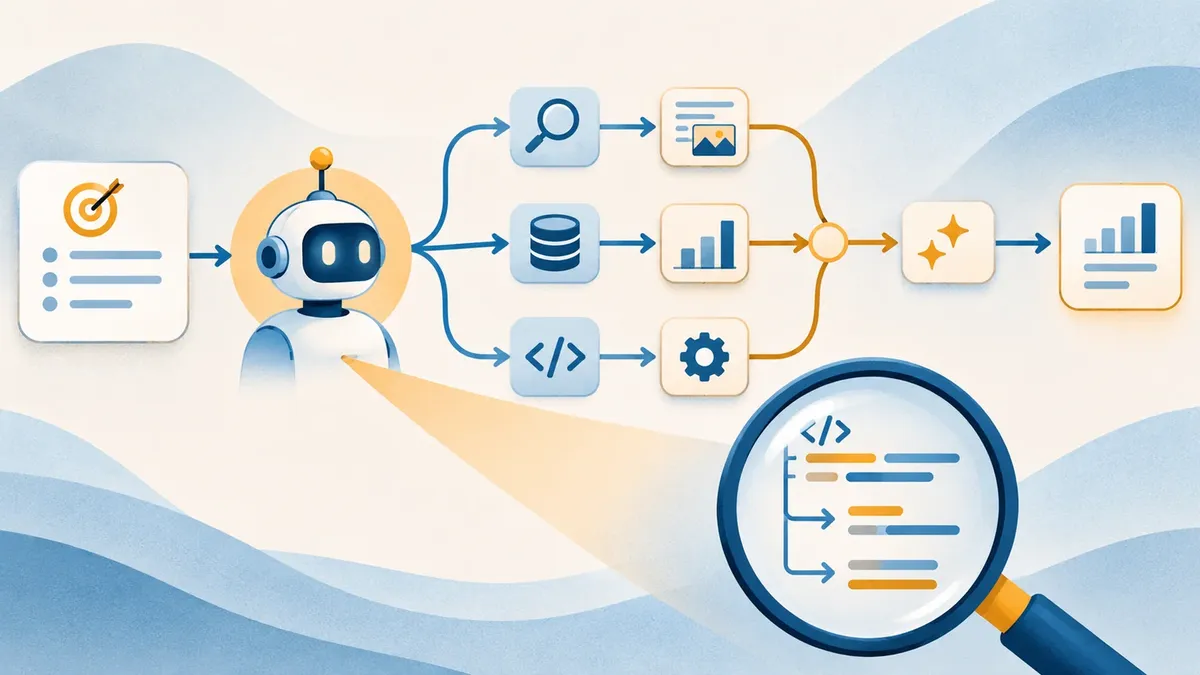
An AI agent may know how to call a tool but not what to do with its output. VISE tries to close that gap by using tool implementations to identify missing or conflicting workflow instructions—without relying on task-specific verifier feedback during revision.
Reusable skills help AI agents handle recurring tasks: instructions can tell an agent which tools to call, how to prepare inputs and how to use results. But those instructions can be incomplete or mistaken. A task-specific verifier—a system that checks whether a particular task was completed correctly—can help identify problems, but may not always be available. How can a skill be improved in that situation?
A paper introducing VISE, short for Verifier-Independent Skill Evolution, explores one answer: inspect the tools’ source code and use it as evidence for revising the instructions. The central idea is that code can reveal what a tool does, what inputs it expects, when it applies and what kind of output it returns. VISE compares those details with the current workflow, the task request and an execution trace, then recommends targeted edits to the skill’s instruction file.
From code to workflow guidance
VISE treats a skill as two parts: executable scripts and written guidance, stored in a file called SKILL.md. The scripts perform operations; the guidance tells the agent how to coordinate them. For a new skill, VISE reuses suitable scripts or creates missing ones, then writes instructions around their operations. For a revision, it extracts structured information from the scripts, including capabilities, usage conditions, ordered steps, constraints and references to the supporting source code.
The system then checks whether the written workflow covers the tool’s relevant operations and requirements. If it finds a gap or a conflict, it produces a specific recommendation, tied to the applicable task conditions and code evidence. The guidance may change, but the scripts remain fixed during this revision stage. The candidate skill is frozen before downstream evaluation; verifier results do not determine which edits VISE makes.
The paper’s video-counting example illustrates the distinction between calling a tool and making use of it. The original instructions broadly advised inspecting scripts and using runtime evidence. The counting script, however, required several arguments and printed a count. VISE recommended instructions to invoke it for each frame–template pair and use the printed counts in later steps. In the revised example execution, the agent collected and parsed those results before assembling a CSV. This example shows a plausible mechanism, not proof that every tool-code-derived edit will improve a workflow.
What the evaluations found
The researchers tested VISE as an additional revision stage for four skill-evolution methods—Self-Refine, TraceEvo, SkillLearn and SkillRevise—on SkillsBench and SkillLearnBench. They compared the VISE-refined skills with the corresponding “No-verifier” conditions, which used the task request, scripts, instructions and execution trace but not task-verifier feedback during revision. Skills were then evaluated in three downstream executions.
Across the four methods, VISE was associated with increases of 9.14–13.35 percentage points in overall average success and 12.36–18.29 points in the share of tasks succeeding in all three runs, relative to those No-verifier conditions. The paper also reports that VISE had higher overall average success and three-run success than the tested task-verifier feedback conditions for these methods. The results were not uniform across every measure or task category: for example, the ordering against verifier-based feedback varied for task coverage, and Report feedback did better than VISE on one software-engineering category comparison. The authors’ task-variant tests also found that changing requirements can weaken skill benefits; coupled-requirement variants remained the lowest-scoring category for every method, even after VISE revision.
These findings suggest that implementation details can provide useful revision evidence in the tested settings. They do not establish that VISE will help every agent, tool or task. The reported comparisons use particular benchmarks, methods and model settings, and the paper notes that overall gains can conceal changes in which individual tasks benefit. Repeated success is a useful measure of consistency across the three recorded runs, not a guarantee of reliability in other conditions.
Limits and open questions
VISE depends on being able to inspect tool implementations. For closed-source tools or remote APIs, visible code may show how to call an interface while revealing little about what happens behind it. The authors suggest that documentation and observed tool behavior could help extend the approach. They also caution that revised instructions may be reused in ways that spread unsafe guidance or sensitive information, and recommend retaining access controls and reviewing updates in security-sensitive settings.
The source is an arXiv preprint, rather than evidence here of peer-reviewed publication. The paper’s results are researchers’ reported benchmark findings, not an independent replication. They support further investigation of tool implementations as a feedback source—not the broader claim that verifier-free skill evolution is solved.
- AI agents
- agent skills
- tool use
- source code
- skill evolution
- VISE
- AI benchmarks
Reviewed cross-references
These connections were reviewed by a model, not independently fact-checked by a human. Similarity does not imply agreement; consult the original papers and the evidence below.
How SkillBoost aims to limit AI skill overfitting
Supporting evidence: Both papers report that skill benefits may not carry over unchanged when task demands differ: VISE says requirement changes in its task variants could weaken or reverse benefits, while SkillBoost frames fitting observed trajectories as a risk to performance on held-out tasks. This supports the bounded concern that gains on observed tasks do not guarantee transfer; the studies use different methods and evaluation settings, so their results are not direct replications.
Model review: · openai-codex/gpt-6-luna
Evidence and provenance
Selected excerpts, not complete papers. PDF extraction can omit figures or damage equations, tables and reading order; sources may be preprints.
2611.32480v1 — Original paper
Excerpt reference:
static/papers/2611.32480v1.md:264-383
Basis: Paper text
Source SHA-256:d3739cfde112a246f65fc1da82376791278b039c0563589f3ef7191f803467842607.26643v4 — Original paper
Excerpt reference:
static/papers/2607.26643v4.md:63-144
Basis: Paper text
Source SHA-256:d0a0d14b3379eb7b27e1e8f435af582295385de75bb39debc8319c274a07351a
Related reading
Automatically matched by shared topic keywords. These links do not imply that the sources agree or establish a consensus.
How AI agents turn successes and failures into reusable skills
Source published
Shared keywords: agent skills, ai agents, ai benchmarks, skill evolution
Teaching AI agents to patch their skills with code
Source published
Shared keywords: agent skills, ai agents
How SkillBoost aims to limit AI skill overfitting
Source published
Shared keywords: agent skills, ai agents
When AI Agents Guess Instead of Asking
Source published
Shared keywords: ai agents, ai benchmarks, tool use
MetaSkill gives AI agents a reusable playbook for using skills
Source published
Shared keywords: agent skills, ai agents