TRANSMISSION // 2611.32469v1
Which branching trees can perfectly transfer a quantum state?
Source published
A mathematical classification finds that, in Grover walks on generalized Bethe trees, perfect transfer between vertex states occurs only on paths and two specific families of uniformly subdivided branching trees.
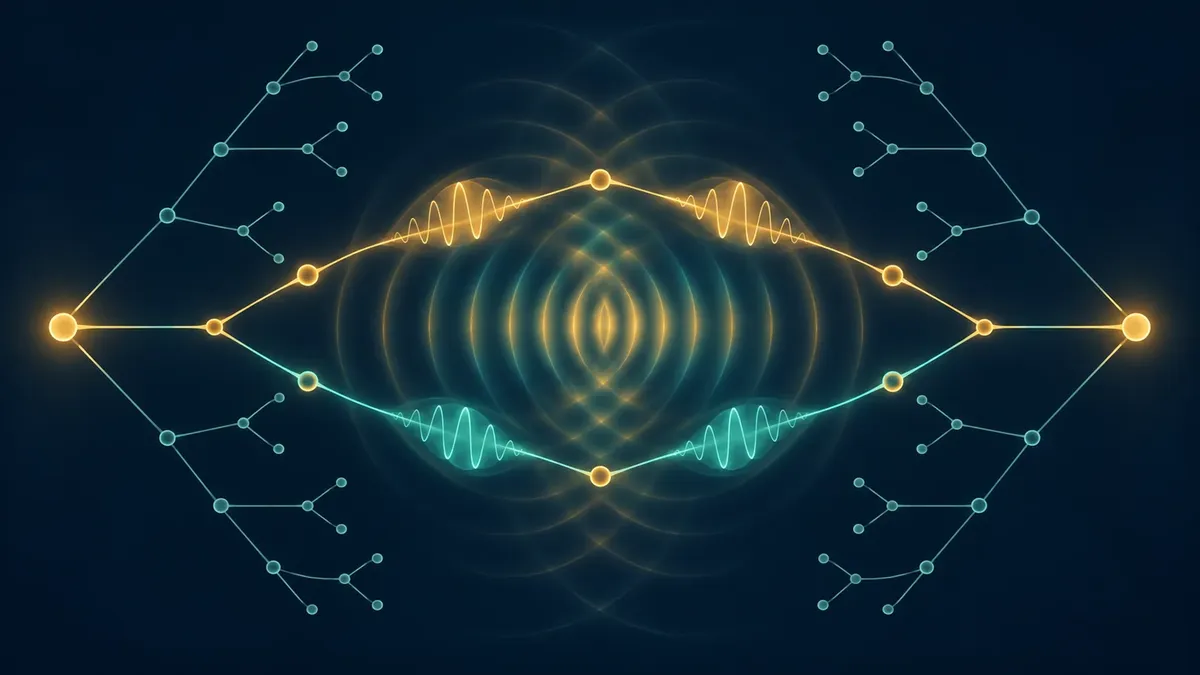
Quantum walks can move amplitudes through a network in ways that depend on both its connections and quantum interference. Koushik Bhakta and Bikash Bhattacharjya ask which trees in a structured class can carry a vertex-based quantum state perfectly from one vertex to another under a Grover walk. Their answer is narrow: paths and two families of branching trees qualify.
A quantum walk on a graph is a mathematical model of quantum evolution constrained by a network. In the Grover walk studied here, the state assigns a complex amplitude to each directed edge, or arc. At each discrete step, a local Grover operation acts at the vertices, then amplitudes on opposite arcs are exchanged. Because amplitudes can interfere, the evolution is not simply a classical random walk.
The paper asks whether a particular kind of starting state, associated with one vertex, can evolve into the corresponding state at a different vertex with certainty. This is called perfect state transfer. It is a precise mathematical condition; it does not by itself demonstrate a working quantum communication device.
The authors focus on generalized Bethe trees. These are rooted trees in which vertices at the same distance from the root have the same number of children, though that number may change from level to level. This structure allows branching while retaining enough symmetry for analysis.
A classification from the tree’s structure
The main result is an if-and-only-if classification: a generalized Bethe tree has perfect state transfer between vertex states exactly when it is a path or a uniform subdivision of one of two particular trees, written as B(2,3) and B(1,2,3). A uniform subdivision replaces every edge with a path of the same length. The notation describes the branching numbers at successive levels of the rooted tree.
The result also specifies which vertices transfer and the minimum number of walk steps required. On a path with n edges, every pair of vertices mirrored across the path’s midpoint transfers, with minimum time n. For a uniformly subdivided B(2,3), the only transferring pair is the two vertices of degree four; the minimum time is 6k, where k is the subdivision length. For a uniformly subdivided B(1,2,3), there are k transferring pairs: corresponding vertices at equal distances along the two branches from the degree-three vertex. Each has minimum time 6k.
The classification is notable because paths are not the whole story for this walk: two branching families also work. But the result applies to this specific walk model and this specific class of trees, not to every quantum walk or every tree.
How the proof works
Rather than simulate walks on many example trees, the authors translate the transfer question into a spectral one. They use the tree’s normalized adjacency matrix, called the discriminant matrix in the paper, and show that perfect transfer is equivalent to a condition involving a Chebyshev polynomial of that matrix. Chebyshev polynomials are a family of functions with useful links to cosine, which helps turn discrete-time evolution into constraints on the matrix’s eigenvalues.
The tree’s level-by-level symmetry lets the matrix be decomposed into smaller tridiagonal blocks, known as Jacobi matrices. The authors use these blocks and restrictions on eigenvalues and symmetries to rule out other branching patterns. They then verify that the surviving families do transfer, identify all transferring pairs, and establish the minimum times.
This is a proof-based structural result, not an experimental study. The paper’s abstract and main theorem support the classification and transfer details described here; they do not report laboratory demonstrations, performance under noise, or implementation costs.
Scope and uncertainty
“Complete classification” should be read within the stated boundaries: generalized Bethe trees, Grover walks, and vertex states. The paper does not claim that these are the only trees allowing perfect transfer under other definitions of a quantum walk, other starting states, or different dynamics. Nor does the mathematical result establish that the networks can be built or would remain reliable in a physical setting.
The source is an arXiv preprint, identified as version 1. A preprint makes research available before or without formal journal publication; the material provided here does not establish whether this work has undergone peer review. The result is therefore best understood as the authors’ mathematical claim in that preprint, rather than as a settled experimental finding.
- quantum walks
- Grover walk
- perfect state transfer
- generalized Bethe trees
- graph theory
- spectral analysis
Related reading
Automatically matched by shared topic keywords. These links do not imply that the sources agree or establish a consensus.
When can a quantum state cross a tree?
Source published
Shared keywords: graph theory, perfect state transfer, quantum walks
When a quantum state leaves its starting point before perfect transfer
Source published
Shared keywords: perfect state transfer
How well can AI reason through graph theory?
Source published
Shared keywords: graph theory
Mapping the Limits of a Quantum Internet
Source published
Shared keywords: graph theory
When quantum walks agree—and when they don’t
Source published
Shared keywords: quantum walks